Anatomy of Flowering Plants — Practice Quiz
ICSE · Class 11 · Biology
Practice questions on Anatomy of Flowering Plants for ICSE Class 11 Biology, with answers. 60 questions in the full chapter test.
Interactive on Super Tutor
Studying Anatomy of Flowering Plants? Get the full interactive chapter.
Quizzes, flashcards, AI doubt-solver and a step-by-step study plan — built for practice quiz and more.
Free trial, no card needed.
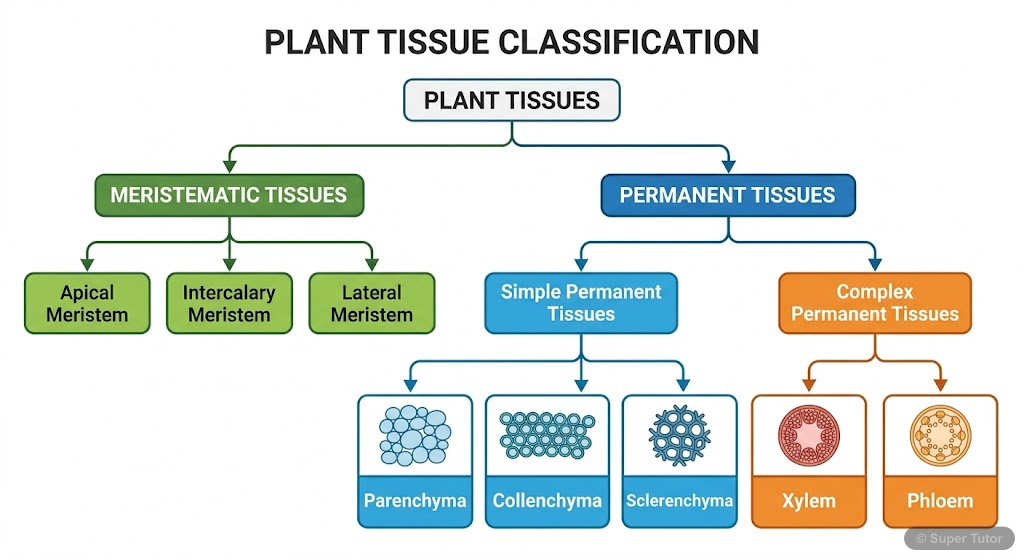
Learn better with visuals Super Tutor pairs illustrations like this with notes and quizzes for Anatomy of Flowering Plants.
Sample Questions
Which of the following is NOT a characteristic of meristematic cells?
Show answer
Large central vacuole
Meristematic cells lack a large central vacuole. A large vacuole would push the nucleus to the periphery, making cell division inefficient. They have dense cytoplasm, large prominent nuclei, and thin cellulosic walls.
Which meristem is responsible for increase in the length of the plant?
Show answer
Apical meristem
Apical meristem is located at the tips of roots and shoots and is responsible for increase in length (primary growth). Lateral meristem (vascular cambium + cork cambium) is responsible for increase in girth (secondary growth).
Collenchyma cells are living and provide support because their walls are thickened with:
Show answer
Cellulose and pectin at corners
Collenchyma walls are unevenly thickened with cellulose, hemicellulose, and pectin at the corners. Lignin is ABSENT from collenchyma — this keeps the cells living and flexible. Lignin is the hallmark of sclerenchyma.
Stone cells (sclereids) give a gritty texture to the pulp of which fruit?
Show answer
Pear
Sclereids (stone cells) are present in the pulp of pear fruit, giving it its characteristic gritty texture. They are isodiametric sclerenchymatous cells with thick, highly lignified walls.
+56 more questions on Anatomy of Flowering Plants (ICSE Class 11 Biology)
Practise AllFrequently Asked Questions
What are the important topics in Anatomy of Flowering Plants for ICSE Class 11 Biology?
How many practice questions are there for Anatomy of Flowering Plants?
Sources & Official References
Content is aligned to the official syllabus. Refer to the board website for the latest curriculum.
More resources for Anatomy of Flowering Plants
Important Questions
Exam-style questions with answers
Revision Notes
Key points for last-minute revision
Chapter Summary
Understand the chapter at a glance
Concept Maps
See how topics connect
Study Plan
Step-by-step plan for this chapter
Flashcards
Quick-fire cards for active recall
Syllabus
What topics to cover
For serious students
Get the full Anatomy of Flowering Plants chapter — start free.
Quizzes, flashcards, an AI doubt solver and a study plan for ICSE Class 11 Biology. Free to start, no card needed.