Structural Organisation in Animals (Frog) — Practice Quiz
ICSE · Class 11 · Biology
Try a 4-question quiz on Structural Organisation in Animals (Frog) for ICSE Class 11 Biology: tap an answer to check it and see why.
Interactive on Super Tutor
Studying Structural Organisation in Animals (Frog)? Get the full interactive chapter.
Quizzes, flashcards, AI doubt-solver and a step-by-step study plan — built for practice quiz and more.
Free trial, no card needed.
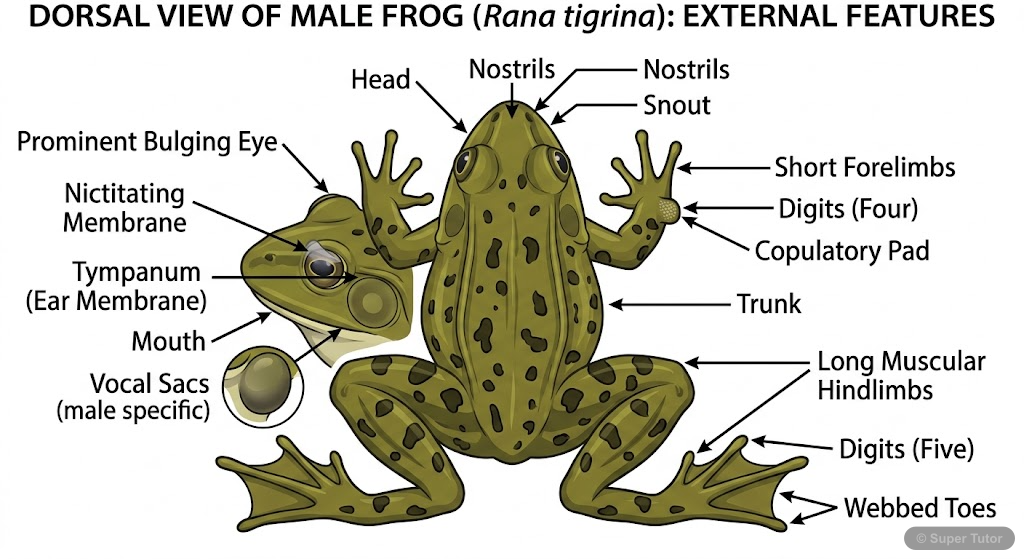
Learn better with visuals Super Tutor pairs illustrations like this with notes and quizzes for Structural Organisation in Animals (Frog).
Quick Quiz: Structural Organisation in Animals (Frog)
0/4Tap an answer to check it instantly. No sign-up needed for these 4.
What is the scientific name of the most common frog found in India, also known as the 'Indian bull frog'?
Frogs belong to which class of the animal kingdom?
What is the term used for the winter sleep of frogs when they take shelter in deep burrows to protect themselves from extreme cold?
Which membrane protects the eyes of the frog while it is in water?
Sample Questions
To which class does the frog (Rana tigrina) belong?
Show answer
Amphibia
Rana tigrina belongs to Class Amphibia. Frogs are amphibians — they can live both on land and in freshwater. They belong to Order Anura (without tail).
What is the scientific name of the Indian bull frog?
Show answer
Rana tigrina
The Indian bull frog is scientifically named Rana tigrina. It is the most common, largest, and most noisy species of frog found in India.
What is 'aestivation' in frogs?
Show answer
Summer sleep to escape heat
Aestivation (also called summer sleep) is a dormant state that frogs enter during peak summer to escape extreme heat. They take shelter in deep burrows. Hibernation is the corresponding winter sleep.
How many chambers does a frog's heart have?
Show answer
3
A frog's heart has 3 chambers: 2 auricles (atria) + 1 ventricle. This is unlike the mammalian heart which has 4 chambers (2 auricles + 2 ventricles). The frog's single ventricle leads to mixing of oxygenated and deoxygenated blood.
+86 more questions on Structural Organisation in Animals (Frog) (ICSE Class 11 Biology)
Practise AllFrequently Asked Questions
What are the important topics in Structural Organisation in Animals (Frog) for ICSE Class 11 Biology?
How many practice questions are there for Structural Organisation in Animals (Frog)?
Sources & Official References
Content is aligned to the official syllabus. Refer to the board website for the latest curriculum.
More resources for Structural Organisation in Animals (Frog)
Important Questions
Exam-style questions with answers
Revision Notes
Key points for last-minute revision
Chapter Summary
Understand the chapter at a glance
Concept Maps
See how topics connect
Study Plan
Step-by-step plan for this chapter
Flashcards
Quick-fire cards for active recall
Syllabus
What topics to cover
For serious students
Get the full Structural Organisation in Animals (Frog) chapter — start free.
Quizzes, flashcards, an AI doubt solver and a study plan for ICSE Class 11 Biology. Free to start, no card needed.