Biomolecules — Practice Quiz
ICSE · Class 11 · Biology
Try a 4-question quiz on Biomolecules for ICSE Class 11 Biology: tap an answer to check it and see why. 103 questions in the full chapter test.
Interactive on Super Tutor
Studying Biomolecules? Get the full interactive chapter.
Quizzes, flashcards, AI doubt-solver and a step-by-step study plan — built for practice quiz and more.
Free trial, no card needed.
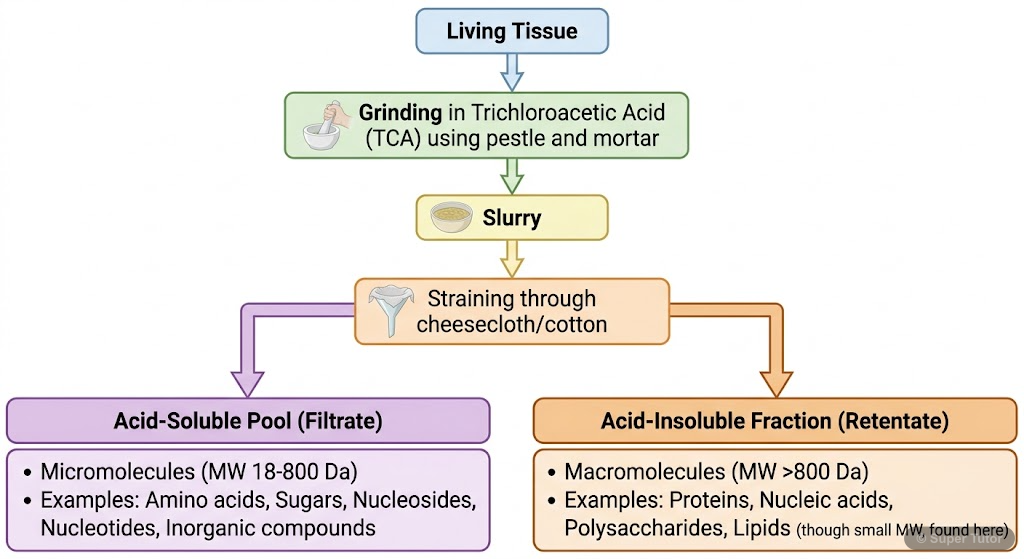
Learn better with visuals Super Tutor pairs illustrations like this with notes and quizzes for Biomolecules.
Quick Quiz: Biomolecules
0/4Tap an answer to check it instantly. No sign-up needed for these 4.
Which of the following correctly explains why sucrose is a non-reducing sugar while maltose is a reducing sugar?
Amylose gives a blue-black colour with iodine while amylopectin gives a red-purple colour. Which structural feature of amylose is responsible for this difference?
A patient with lactose intolerance lacks the enzyme lactase. Which correctly describes the consequence at the molecular level?
The Michaelis-Menten constant (Km) of enzyme A is 0.01 mM and that of enzyme B is 5 mM for the same substrate. Which conclusion is most accurate?
Sample Questions
Which of the following is a non-reducing sugar?
Show answer
Sucrose
Sucrose is the only common non-reducing disaccharide. Its glycosidic bond uses BOTH carbonyl (reducing) groups of glucose and fructose, leaving no free carbonyl group to reduce Fehling's or Benedict's solution.
Starch gives a blue-black colour with iodine because of its:
Show answer
Amylose component
Amylose (the straight-chain component of starch, 15-20%) forms a helical structure that traps iodine molecules, producing a blue-black complex. Amylopectin gives red-purple; glycogen gives purple-red.
Which of the following is the animal storage polysaccharide?
Show answer
Glycogen
Glycogen is the animal storage carbohydrate, stored mainly in the liver and muscles. Starch is the plant equivalent. Cellulose and chitin are structural polysaccharides.
The term "enzyme" was coined by:
Show answer
Friedrich Wilhelm Kuhne
Kuhne (1878) coined the term "enzyme" from the Greek words "en" (in) and "zyma" (yeast). Sumner (1926) isolated the first enzyme (urease) in crystalline form and proved enzymes are proteins.
+99 more questions on Biomolecules (ICSE Class 11 Biology)
Practise AllFrequently Asked Questions
What are the important topics in Biomolecules for ICSE Class 11 Biology?
How many practice questions are there for Biomolecules?
Sources & Official References
Content is aligned to the official syllabus. Refer to the board website for the latest curriculum.
More resources for Biomolecules
Important Questions
Exam-style questions with answers
Revision Notes
Key points for last-minute revision
Formula Sheet
The chapter's formulas in one place
Chapter Summary
Understand the chapter at a glance
Concept Maps
See how topics connect
Study Plan
Step-by-step plan for this chapter
Flashcards
Quick-fire cards for active recall
Syllabus
What topics to cover
For serious students
Get the full Biomolecules chapter — start free.
Quizzes, flashcards, an AI doubt solver and a study plan for ICSE Class 11 Biology. Free to start, no card needed.