Anatomy of Flowering Plants — Chapter Summary
ICSE · Class 11 · Biology
Summary of Anatomy of Flowering Plants for ICSE Class 11 Biology. Part of the ICSE Class 11 Biology syllabus. Anatomy is the study of internal structure.
Interactive on Super Tutor
Studying Anatomy of Flowering Plants? Get the full interactive chapter.
Quizzes, flashcards, AI doubt-solver and a step-by-step study plan — built for chapter summary and more.
Free trial, no card needed.
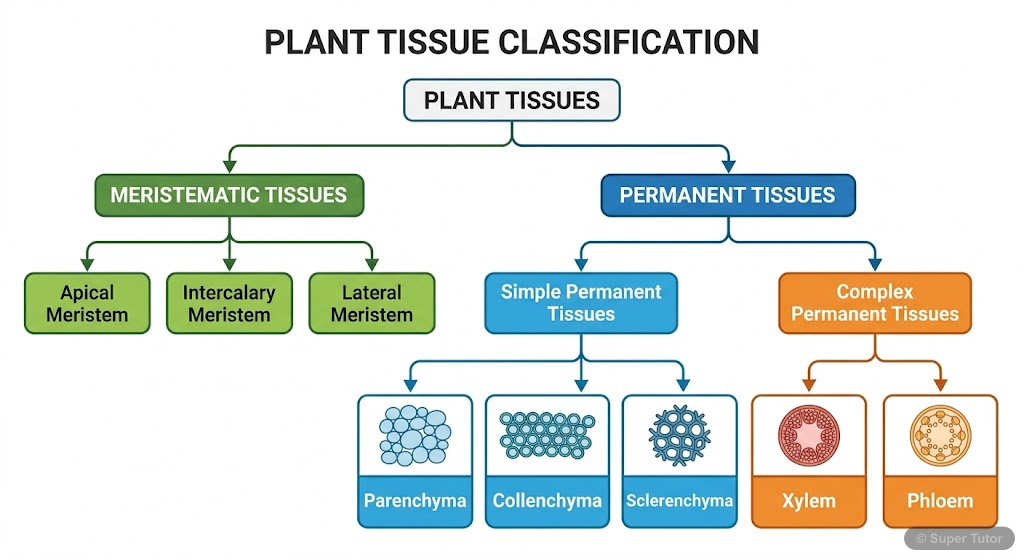
Learn better with visuals Super Tutor pairs illustrations like this with notes and quizzes for Anatomy of Flowering Plants.
Overview
Anatomy is the study of internal structure in plants. Flowering plants show an organised body made of tissues that are specialised for growth, support, transport, protection and storage. The chapter covers meristematic tissue, permanent tissue, tissue systems, and the internal structure of roots, st
Key Concepts
A tissue is a group
A tissue is a group of similar or dissimilar cells with a common origin that performs the same function. Meristematic tissue is made of living, thin-w
Meristems are classified by origin into
Meristems are classified by origin into promeristem, primary meristem and secondary meristem. By location, they are apical, intercalary and lateral. A
Parenchyma is a simple permanent tissue
Parenchyma is a simple permanent tissue of living, isodiametric, thin-walled cells with intercellular spaces. Modified forms include aerenchyma, chlor
Collenchyma is a living supporting tissue
Collenchyma is a living supporting tissue found mainly below the epidermis in petiole, leaves and stems of herbaceous dicots. Its walls are unevenly t
Sclerenchyma is a dead
Sclerenchyma is a dead, thick-walled, lignified supporting tissue. It consists of fibres and sclereids. Fibres are long and strong, while sclereids ar
Learning Objectives
- Understand the meaning of tissue and anatomy in plants
- Identify the main features of meristematic tissue
- Classify meristems by origin and by location
- Describe the structure and functions of parenchyma, collenchyma and sclerenchyma
- Explain the components and functions of xylem and phloem
Frequently Asked Questions
What are the important topics in Anatomy of Flowering Plants for ICSE Class 11 Biology?
How should I revise Anatomy of Flowering Plants for Class 11 exams?
Sources & Official References
Content is aligned to the official syllabus. Refer to the board website for the latest curriculum.
More resources for Anatomy of Flowering Plants
For serious students
Get the full Anatomy of Flowering Plants chapter — start free.
Quizzes, flashcards, an AI doubt solver and a study plan for ICSE Class 11 Biology. Free to start, no card needed.