Biomolecules — Flashcards
ICSE · Class 11 · Biology
44 flashcards for Biomolecules (ICSE Class 11 Biology) to test yourself on key terms and facts. Sample: "What is the cellular pool in a cell?"
Interactive on Super Tutor
Studying Biomolecules? Get the full interactive chapter.
Quizzes, flashcards, AI doubt-solver and a step-by-step study plan — built for flashcards and more.
Free trial, no card needed.
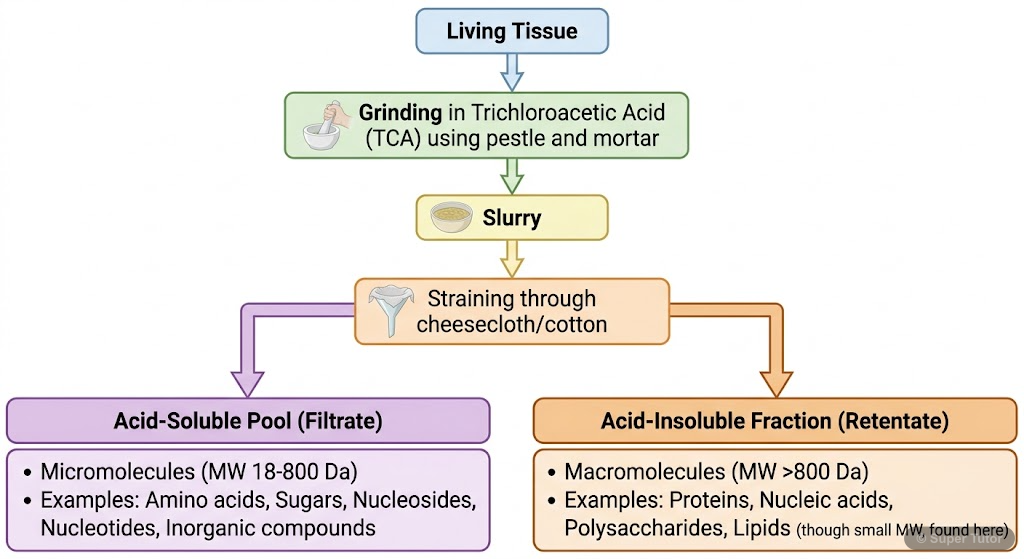
Learn better with visuals Super Tutor pairs illustrations like this with notes and quizzes for Biomolecules.
What is the cellular pool in a cell?
Answer
The collection of various types of molecules in a cell is called cellular pool. It includes inorganic materials such as water, salts, and mineral ions, and organic compounds such as carbohydrates, lip…
How are micromolecules and macromolecules different?
Answer
Micromolecules have molecular weight less than one thousand dalton and are usually small and more soluble. Macromolecules have molecular size above 10,000 dalton. Proteins, nucleic acids, and many car…
What are primary metabolites and secondary metabolites?
Answer
Primary metabolites are direct products of metabolism and have known roles in normal life processes. Examples are carbohydrates, fats, amino acids, proteins, and nucleic acids. Secondary metabolites a…
State the general formula of carbohydrates.
Answer
General formula of carbohydrates: C_x(H_2O)_y [x, y = number of carbon and water-equivalent units]. Many carbohydrates fit this pattern, but not all do.
Why do deoxyribose and rhamnose need special attention in carbohydrate classification?
Answer
Deoxyribose has the molecular formula C5H10O4 and rhamnose has the molecular formula C6H12O5. These are carbohydrates, but they do not fit the general Cx(H2O)y ratio. This shows that the hydrate-of-ca…
What are monosaccharides?
Answer
Monosaccharides, often called simple sugars, are compounds which possess a free aldehyde (-CHO) or ketonic (=CO) group and two or more hydroxyl (-OH) groups. Their general formula is C_n(H_2O)_n [n = …
Classify monosaccharides by carbon number with one example each.
Answer
Monosaccharides may be trioses, tetroses, pentoses, hexoses, heptoses, and so on. Examples: trioses such as glyceraldehyde and dihydroxyacetone; tetroses such as erythrose and erythrulose; pentoses su…
What are oligosaccharides? Give examples.
Answer
Oligosaccharides are composed of usually 2 to 9 monosaccharide units joined by glycosidic linkage. A disaccharide yields two monosaccharides on hydrolysis, a trisaccharide yields three, and so on. Exa…
+36 more flashcards
Practise AllFrequently Asked Questions
What are the important topics in Biomolecules for ICSE Class 11 Biology?
How many flashcards are available for Biomolecules?
How should I revise Biomolecules for Class 11 exams?
Sources & Official References
Content is aligned to the official syllabus. Refer to the board website for the latest curriculum.
More resources for Biomolecules
Practice Quiz
Test yourself with a quick quiz
Important Questions
Exam-style questions with answers
Revision Notes
Key points for last-minute revision
Formula Sheet
The chapter's formulas in one place
Chapter Summary
Understand the chapter at a glance
Concept Maps
See how topics connect
Study Plan
Step-by-step plan for this chapter
Syllabus
What topics to cover
For serious students
Get the full Biomolecules chapter — start free.
Quizzes, flashcards, an AI doubt solver and a study plan for ICSE Class 11 Biology. Free to start, no card needed.