Biomolecules — Revision Notes
ICSE · Class 11 · Biology
Biomolecules revision notes for ICSE Class 11 Biology: 4 topics in quick points. Part of the ICSE Class 11 Biology syllabus.
Interactive on Super Tutor
Studying Biomolecules? Get the full interactive chapter.
Quizzes, flashcards, AI doubt-solver and a step-by-step study plan — built for revision notes and more.
Free trial, no card needed.
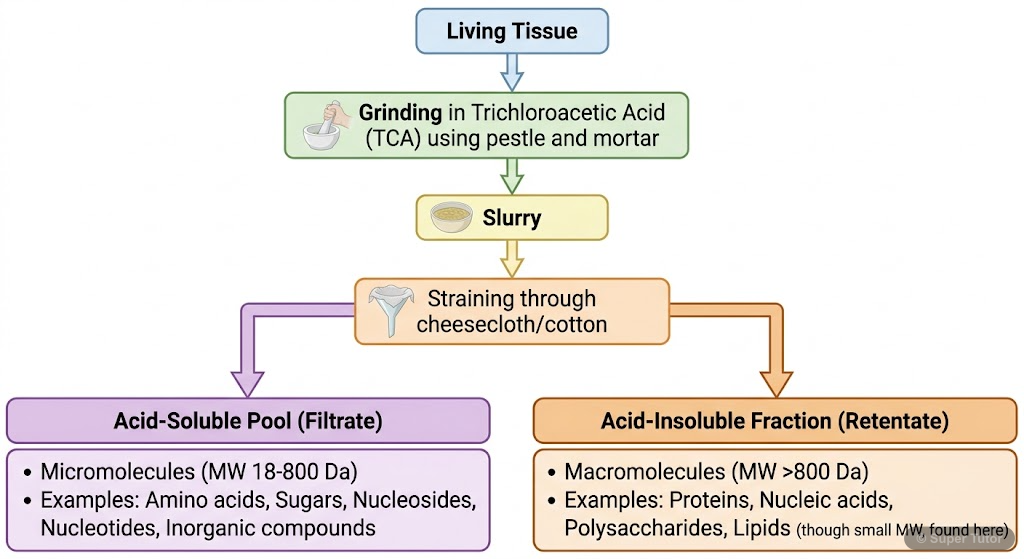
Learn better with visuals Super Tutor pairs illustrations like this with notes and quizzes for Biomolecules.
Key Topics to Revise
1. Cellular Pool and Chemical Composition of Cells
- The collection of various types of molecules in a cell is called cellular pool.
- The cellular pool contains inorganic materials such as water, salts and mineral ions, and organic compounds such as carbohydrates, lipids, amino acids, proteins, nucleotides, nucleic acids and vitamin
- Nearly 93% of cellular material is made up of carbon, hydrogen and oxygen; about 5% is major metals; and about 2% is non-metals.
2. Carbohydrates
- Carbohydrates are widely distributed in plants and animals and are major sources of energy.
- They are broadly defined as polyhydroxy aldehydes or ketones and their derivatives, or substances that yield one of these compounds on hydrolysis.
- The general formula of carbohydrates is Cx(H2O)y.
3. Amino Acids and Proteins
- Amino acids are the fundamental building blocks of proteins.
- Alpha-amino acids contain an amino group and a carboxyl group at the alpha-carbon atom.
- Twenty amino acids are universally found in proteins.
4. Lipids
- Lipids are a heterogeneous group of compounds including fats and fat-like substances.
- They are sparingly soluble in water but soluble in organic solvents such as ether, chloroform, benzene and petroleum ether.
- Lipids are rich in carbon and hydrogen and generally have less oxygen than carbohydrates.
Get complete notes with diagrams and examples
Full NotesKey Concepts
Frequently Asked Questions
What are the important topics in Biomolecules for ICSE Class 11 Biology?
How should I revise Biomolecules for Class 11 exams?
Sources & Official References
Content is aligned to the official syllabus. Refer to the board website for the latest curriculum.
More resources for Biomolecules
Practice Quiz
Test yourself with a quick quiz
Important Questions
Exam-style questions with answers
Formula Sheet
The chapter's formulas in one place
Chapter Summary
Understand the chapter at a glance
Concept Maps
See how topics connect
Study Plan
Step-by-step plan for this chapter
Flashcards
Quick-fire cards for active recall
Syllabus
What topics to cover
For serious students
Get the full Biomolecules chapter — start free.
Quizzes, flashcards, an AI doubt solver and a study plan for ICSE Class 11 Biology. Free to start, no card needed.