Structural Organisation in Animals (Frog) — Flashcards
ICSE · Class 11 · Biology
40 flashcards for Structural Organisation in Animals (Frog) (ICSE Class 11 Biology) to test yourself on key terms and facts.
Interactive on Super Tutor
Studying Structural Organisation in Animals (Frog)? Get the full interactive chapter.
Quizzes, flashcards, AI doubt-solver and a step-by-step study plan — built for flashcards and more.
Free trial, no card needed.
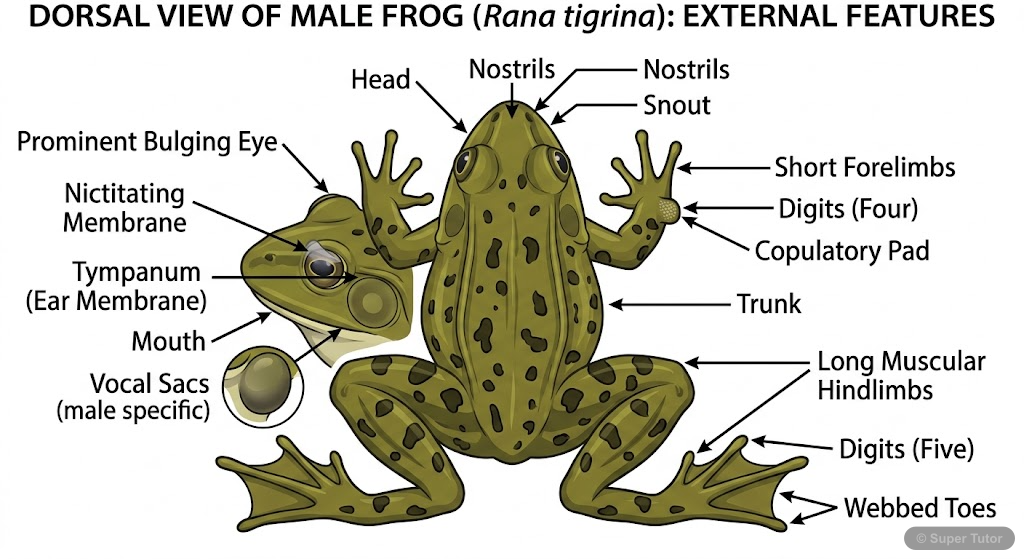
Learn better with visuals Super Tutor pairs illustrations like this with notes and quizzes for Structural Organisation in Animals (Frog).
What is the classification of Rana tigrina?
Answer
Rana tigrina belongs to Phylum Chordata, Subphylum Vertebrata, Superclass Tetrapoda, Class Amphibia, Order Anura, Genus Rana, and Species tigrina. It is the common Indian bull frog.
Why is frog called an amphibian?
Answer
A frog is amphibious because it can live both on land and in freshwater. It cannot survive in brackish or saltwater conditions. Its life depends on water for breeding and early development.
What are the main external features of a frog?
Answer
The frog body is moderate in size, about 12 to 20 cm long, spindle-shaped, dorsoventrally flattened, and streamlined. It has a head and trunk, but no neck and no tail in the adult stage. The skin is t…
How does frog skin help in survival?
Answer
Frog skin is thin, smooth, moist, and slippery because of mucus secreted by mucous glands. This skin helps in respiration and water absorption. The frog never drinks water; it absorbs water through th…
What is camouflage in frogs?
Answer
Camouflage is the ability of a frog to change body colour to hide from enemies. The dorsal side is generally olive green with dark spots, while the ventral side is uniformly pale yellow.
Why do frogs take shelter in deep burrows during extreme heat and cold?
Answer
Frogs are cold-blooded animals, so body temperature changes with the environment. During extreme heat and cold, they take shelter in deep burrows. This is called summer sleep or aestivation in heat an…
How does a frog move on land and in water?
Answer
On land, a frog moves by hopping and leaping. At rest, the long hind limbs remain folded in the form of the letter Z. In water, the hind limbs move alternately and the webbed toes push water backward …
What kind of feeding adaptation do frogs show?
Answer
Frogs are carnivorous and feed on live earthworms, snails, insects, spiders, fishes, and small frogs. Prey is captured by a long, extensible, sticky tongue that flicks out quickly and pulls the prey i…
+32 more flashcards
Practise AllFrequently Asked Questions
What are the important topics in Structural Organisation in Animals (Frog) for ICSE Class 11 Biology?
How many flashcards are available for Structural Organisation in Animals (Frog)?
How should I revise Structural Organisation in Animals (Frog) for Class 11 exams?
Sources & Official References
Content is aligned to the official syllabus. Refer to the board website for the latest curriculum.
More resources for Structural Organisation in Animals (Frog)
Practice Quiz
Test yourself with a quick quiz
Important Questions
Exam-style questions with answers
Revision Notes
Key points for last-minute revision
Chapter Summary
Understand the chapter at a glance
Concept Maps
See how topics connect
Study Plan
Step-by-step plan for this chapter
Syllabus
What topics to cover
For serious students
Get the full Structural Organisation in Animals (Frog) chapter — start free.
Quizzes, flashcards, an AI doubt solver and a study plan for ICSE Class 11 Biology. Free to start, no card needed.