Chapter 7 of 19
Revision Notes
Structural Organisation in Animals (Frog) — Revision Notes
ICSE · Class 11 · Biology
Structural Organisation in Animals (Frog) revision notes for ICSE Class 11 Biology: 4 topics in quick points. Part of the ICSE Class 11 Biology syllabus.
90 questions40 flashcards5 concepts
Interactive on Super Tutor
Studying Structural Organisation in Animals (Frog)? Get the full interactive chapter.
Quizzes, flashcards, AI doubt-solver and a step-by-step study plan — built for revision notes and more.
Free trial, no card needed.
Super Tutor
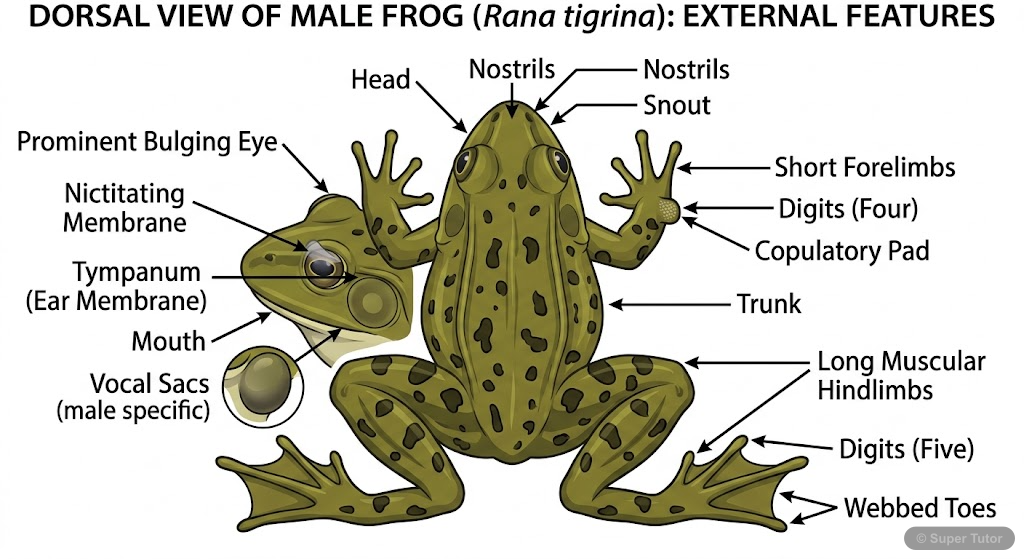
Learn better with visuals Super Tutor pairs illustrations like this with notes and quizzes for Structural Organisation in Animals (Frog).
Key Topics to Revise
1
1. Classification, Habitat and External Features
- Rana tigrina belongs to Phylum Chordata, Subphylum Vertebrata, Superclass Tetrapoda, Class Amphibia, Order Anura, Genus Rana and Species tigrina.
- Frogs are amphibious and cannot survive in brackish or salt water.
- They are found in freshwater bodies such as ponds, lakes, ditches, pools and slow running streams, as well as in moist grassy land near water.
2
2. Feeding, Mouth and Alimentary Canal
- Frogs are carnivorous and feed on insects, spiders, earthworms, snails, fishes and small frogs.
- Prey is captured by the long, extensible and sticky tongue.
- The tongue is posteriorly bifid and free, with its front end attached to the floor of the mouth.
3
3. Digestive Glands and Digestion
- The liver is the largest digestive gland and is reddish brown.
- It lies in the anterior part of the body cavity and has a large left lobe and a smaller right lobe.
- The gall bladder lies between the liver lobes and stores bile.
4
4. Circulatory System and Heart
- The blood vascular system of frog is closed type.
- It includes heart, blood vessels and blood.
- The heart is red, triangular and muscular, and lies in the anterior part of the body cavity at the level of the forelegs.
Get complete notes with diagrams and examples
Full NotesKey Concepts
The frog discussed belongs to PhylumThe frog has a moderate bodyAdult frogs respire through moist skinThe digestive system includes mouthThe blood vascular system is closed
Frequently Asked Questions
What are the important topics in Structural Organisation in Animals (Frog) for ICSE Class 11 Biology?
Key topics in Structural Organisation in Animals (Frog) include Classification, Habitat and External Features, Feeding, Mouth and Alimentary Canal, Digestive Glands and Digestion, Circulatory System and Heart. Study these first, then practise questions on each for Class 11 exams.
How should I revise Structural Organisation in Animals (Frog) for Class 11 exams?
Learn the core ideas first, then work through the 90 practice questions on Structural Organisation in Animals (Frog). Revise definitions regularly and use flashcards for quick recall before the exam.
Sources & Official References
Content is aligned to the official syllabus. Refer to the board website for the latest curriculum.
More resources for Structural Organisation in Animals (Frog)
For serious students
Get the full Structural Organisation in Animals (Frog) chapter — start free.
Quizzes, flashcards, an AI doubt solver and a study plan for ICSE Class 11 Biology. Free to start, no card needed.