Structural Organisation in Animals (Frog) — Chapter Summary
ICSE · Class 11 · Biology
Summary of Structural Organisation in Animals (Frog) for ICSE Class 11 Biology. Part of the ICSE Class 11 Biology syllabus.
Interactive on Super Tutor
Studying Structural Organisation in Animals (Frog)? Get the full interactive chapter.
Quizzes, flashcards, AI doubt-solver and a step-by-step study plan — built for chapter summary and more.
Free trial, no card needed.
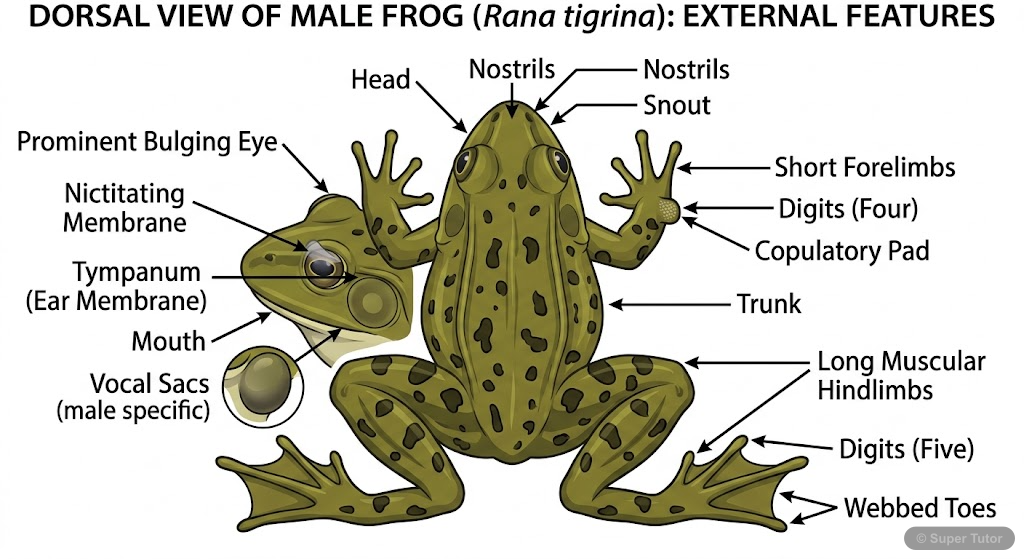
Learn better with visuals Super Tutor pairs illustrations like this with notes and quizzes for Structural Organisation in Animals (Frog).
Overview
Frog is a carnivorous, tailless amphibian that lives both on land and in freshwater. Its body structure, internal organs, and body functions show clear adaptations for an amphibious life. The chapter covers the external form of the frog, digestive, circulatory, respiratory, nervous, and reproductive
Key Concepts
The frog discussed belongs to Phylum
The frog discussed belongs to Phylum Chordata, Subphylum Vertebrata, Superclass Tetrapoda, Class Amphibia, Order Anura, Genus Rana, and Species tigrin
The frog has a moderate body
The frog has a moderate body length of 12 to 20 cm, a spindle-shaped and streamlined body, no neck, and no tail in the adult stage. The skin is thin,
Adult frogs respire through moist skin
Adult frogs respire through moist skin, bucco-pharyngeal lining, and lungs. Cutaneous respiration is continuous, buccopharyngeal respiration occurs th
The digestive system includes mouth
The digestive system includes mouth, buccopharyngeal cavity, oesophagus, stomach, intestine, cloaca, and digestive glands such as liver and pancreas.
The blood vascular system is closed
The blood vascular system is closed. The heart has three chambers: two atria and one ventricle. Blood flows through arteries, veins, and capillaries.
Learning Objectives
- Identify the classification and external features of Rana tigrina.
- Describe the skin, body form, limbs, head, eyes, tympanum, and cloacal aperture of frog.
- Explain the structure and functions of digestive organs and digestive glands.
- Describe the frog heart, blood vessels, portal systems, and lymphatic system.
- Explain cutaneous, buccopharyngeal, and pulmonary respiration in frog.
Frequently Asked Questions
What are the important topics in Structural Organisation in Animals (Frog) for ICSE Class 11 Biology?
How should I revise Structural Organisation in Animals (Frog) for Class 11 exams?
Sources & Official References
Content is aligned to the official syllabus. Refer to the board website for the latest curriculum.
More resources for Structural Organisation in Animals (Frog)
For serious students
Get the full Structural Organisation in Animals (Frog) chapter — start free.
Quizzes, flashcards, an AI doubt solver and a study plan for ICSE Class 11 Biology. Free to start, no card needed.