Animal Kingdom — Chapter Summary
ICSE · Class 11 · Biology
Summary of Animal Kingdom for ICSE Class 11 Biology. Key concepts: Animal bodies follow three, Sponges have cellular and Animals may be asymmetrical.
Interactive on Super Tutor
Studying Animal Kingdom? Get the full interactive chapter.
Quizzes, flashcards, AI doubt-solver and a step-by-step study plan — built for chapter summary and more.
Free trial, no card needed.
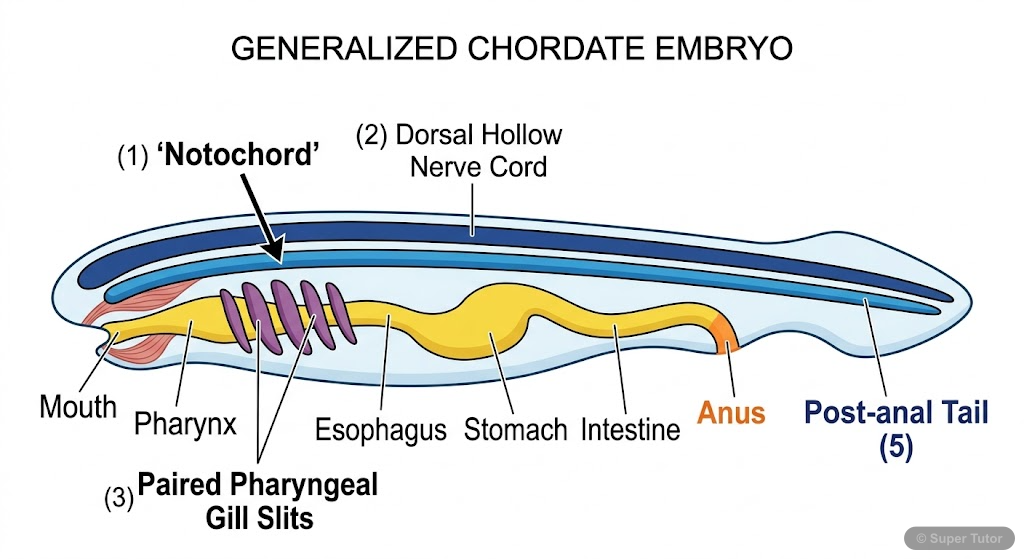
Learn better with visuals Super Tutor pairs illustrations like this with notes and quizzes for Animal Kingdom.
Overview
Animal Kingdom includes the major body plans, symmetry types, body cavity patterns, developmental layers, segmentation, and the main animal phyla. Animals are multicellular eukaryotic heterotrophs that ingest organic material, and their cells lack cell walls. Most animals show movement and a sensory
Key Concepts
Animal bodies follow three basic plans
Animal bodies follow three basic plans: cell aggregate plan, blind-sac plan, and tube-within-a-tube plan. Sponges show the cell aggregate plan, coelen
Sponges have cellular organisation
Sponges have cellular organisation, coelenterates have tissue organisation, platyhelminthes show organ and organ-system tendency, and annelids, arthro
Animals may be asymmetrical
Animals may be asymmetrical, spherical, radial, or bilateral. Sponges are asymmetrical, Actinomma shows spherical symmetry, coelenterates, ctenophores
A coelom is a fluid
A coelom is a fluid-filled body cavity between gut and outer body wall. Acoelomates lack it, pseudocoelomates have a pseudocoelom, coelomates have a t
Diploblastic animals have ectoderm and endoderm
Diploblastic animals have ectoderm and endoderm separated by mesogloea. Triploblastic animals also have mesoderm, which allows larger body size and fo
Learning Objectives
- Understand the main body plans in animals
- Distinguish between cellular, tissue, organ, and organ system levels of organisation
- Compare asymmetry, spherical symmetry, radial symmetry, and bilateral symmetry
- Explain acoelomate, pseudocoelomate, coelomate, and haemocoelomate conditions
- Differentiate diploblastic and triploblastic animals
Frequently Asked Questions
What are the important topics in Animal Kingdom for ICSE Class 11 Biology?
How should I revise Animal Kingdom for Class 11 exams?
Sources & Official References
Content is aligned to the official syllabus. Refer to the board website for the latest curriculum.
More resources for Animal Kingdom
For serious students
Get the full Animal Kingdom chapter — start free.
Quizzes, flashcards, an AI doubt solver and a study plan for ICSE Class 11 Biology. Free to start, no card needed.