Chapter 4 of 19
Revision Notes
Animal Kingdom — Revision Notes
ICSE · Class 11 · Biology
Animal Kingdom revision notes for ICSE Class 11 Biology: 4 topics in quick points. Part of the ICSE Class 11 Biology syllabus.
103 questions48 flashcards5 concepts
Interactive on Super Tutor
Studying Animal Kingdom? Get the full interactive chapter.
Quizzes, flashcards, AI doubt-solver and a step-by-step study plan — built for revision notes and more.
Free trial, no card needed.
Super Tutor
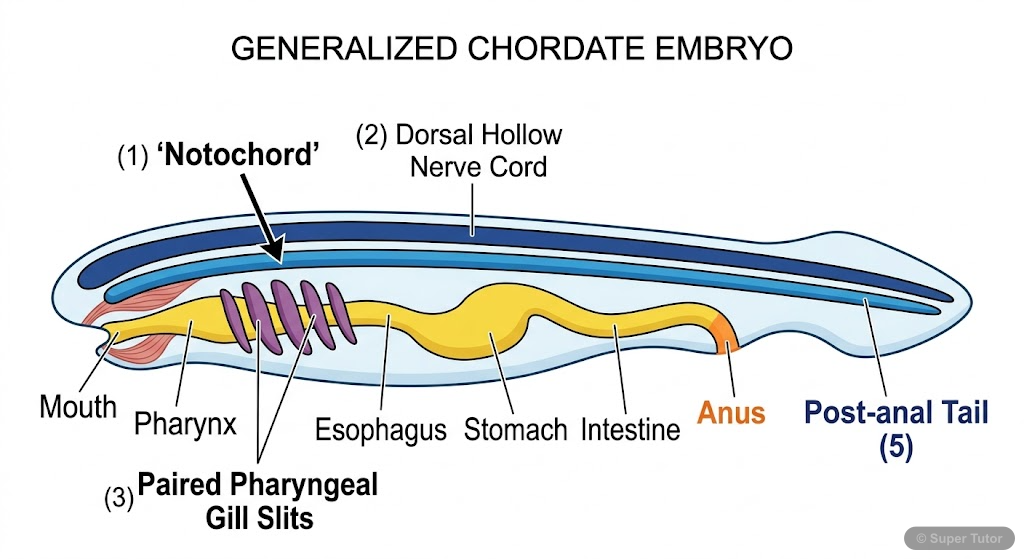
Learn better with visuals Super Tutor pairs illustrations like this with notes and quizzes for Animal Kingdom.
Key Topics to Revise
1
Animal Construction and Basic Body Plans
- Animals are multicellular eukaryotic heterotrophs that ingest organic matter for energy and raw materials.
- Animals lack cell walls in their cells.
- The animal kingdom has over a million species.
2
Coelom, Development, and Segmentation
- Coelom is a fluid-filled cavity between the gut and outer body wall.
- Coelom acts as a hydrostatic skeleton, shock absorber, space for organ enlargement, and circulatory medium.
- Coelom allows body wall and gut to work independently.
3
Phylum Porifera, Coelenterata, and Ctenophora
- Porifera are pore-bearing sedentary aquatic animals, mainly marine, with cellular level of organisation.
- Porifera body wall is diploblastic with outer pinacocytes and inner choanocytes, separated by mesenchyme.
- Porifera body has ostia and osculum, and a canal system for water flow.
4
Platyhelminthes, Nematoda, and Annelida
- Platyhelminthes are triploblastic, acoelomate, bilaterally symmetrical, dorsoventrally flattened worms.
- Platyhelminthes show tissue-organ grade of organisation.
- Platyhelminthes are soft-bodied and unsegmented; segmentation, if present, is pseudo-segmentation.
Get complete notes with diagrams and examples
Full NotesKey Concepts
Animal bodies follow three basic plansSponges have cellular organisationAnimals may be asymmetricalA coelom is a fluidDiploblastic animals have ectoderm and endoderm
Frequently Asked Questions
What are the important topics in Animal Kingdom for ICSE Class 11 Biology?
Key topics in Animal Kingdom include Animal Construction and Basic Body Plans, Coelom, Development, and Segmentation, Phylum Porifera, Coelenterata, and Ctenophora, Platyhelminthes, Nematoda, and Annelida. Study these first, then practise questions on each for Class 11 exams.
How should I revise Animal Kingdom for Class 11 exams?
Learn the core ideas first, then work through the 103 practice questions on Animal Kingdom. Revise definitions regularly and use flashcards for quick recall before the exam.
Sources & Official References
Content is aligned to the official syllabus. Refer to the board website for the latest curriculum.
More resources for Animal Kingdom
For serious students
Get the full Animal Kingdom chapter — start free.
Quizzes, flashcards, an AI doubt solver and a study plan for ICSE Class 11 Biology. Free to start, no card needed.