The Living World — Syllabus
ICSE · Class 11 · Biology
What The Living World covers in ICSE Class 11 Biology: 4 topics, for the 2026-27 session. Part of the ICSE Class 11 Biology syllabus.
Interactive on Super Tutor
Studying The Living World? Get the full interactive chapter.
Quizzes, flashcards, AI doubt-solver and a step-by-step study plan — built for syllabus and more.
Free trial, no card needed.
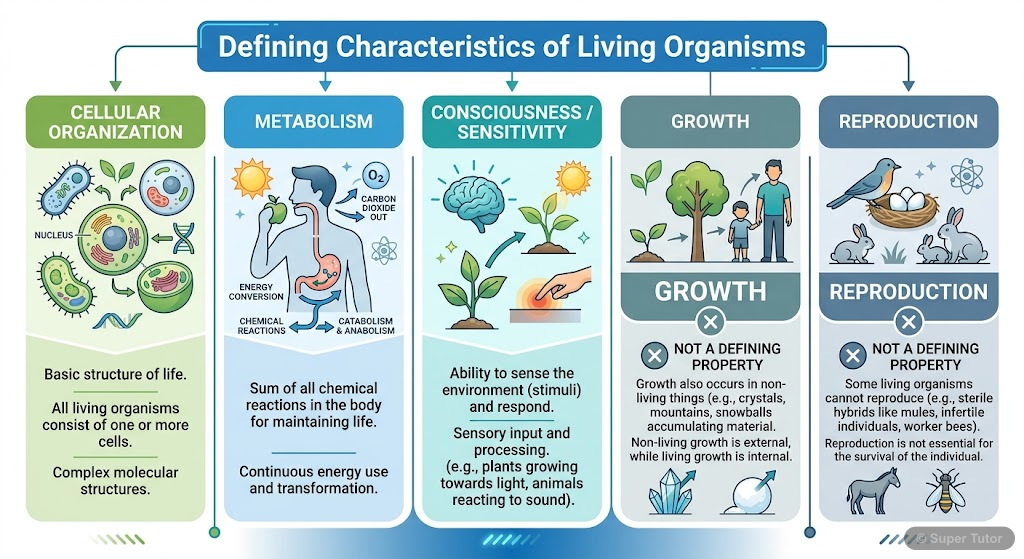
Learn better with visuals Super Tutor pairs illustrations like this with notes and quizzes for The Living World.
Topics in The Living World
1. Nature of Living Organisms
- Living organisms are self-replicating, evolving and self-regulating interactive systems capable of responding to external stimuli.
- Living substance is made of macromolecules such as proteins, lipids, nucleic acids and polysaccharides, along with smaller organic and inorganic molecules.
- All living forms show certain characteristics, but not every characteristic is defining for all living beings.
2. Classification, Taxonomy and Systematics
- Classification groups living organisms into identifiable groups or categories based on observable characters.
- Taxa is the scientific term for categories used in classification.
- Classification helps organize the huge diversity of plants and animals, makes identification easier, shows evolutionary relationships, helps interpret fossils, and allows comparison of unknown organis
3. Concept of Species
- Species is a natural population of individuals which resemble one another in all essential morphological and reproductive characters.
- Members of a species can interbreed freely and produce fertile offspring.
- Species are the basic units of classification.
4. Binomial Nomenclature
- The binomial system of nomenclature was first introduced in 1753 by Carl von Linne, known as Linnaeus, in Systema Naturae.
- A scientific name has two Latin or Latinised words: the first is the generic name and the second is the specific epithet.
- The generic name begins with a capital letter; the specific epithet begins with a lowercase letter.
Key Concepts
Central concept: The Living World
Work through every topic in The Living World with notes and quizzes
Start This ChapterFrequently Asked Questions
What are the important topics in The Living World for ICSE Class 11 Biology?
How should I revise The Living World for Class 11 exams?
Sources & Official References
Content is aligned to the official syllabus. Refer to the board website for the latest curriculum.
More resources for The Living World
Practice Quiz
Test yourself with a quick quiz
Important Questions
Exam-style questions with answers
Revision Notes
Key points for last-minute revision
Chapter Summary
Understand the chapter at a glance
Concept Maps
See how topics connect
Study Plan
Step-by-step plan for this chapter
Flashcards
Quick-fire cards for active recall
For serious students
Get the full The Living World chapter — start free.
Quizzes, flashcards, an AI doubt solver and a study plan for ICSE Class 11 Biology. Free to start, no card needed.