Breathing and Exchange of Gases — Syllabus
ICSE · Class 11 · Biology
What Breathing and Exchange of Gases covers in ICSE Class 11 Biology: 4 topics, for the 2026-27 session. Part of the ICSE Class 11 Biology syllabus.
Interactive on Super Tutor
Studying Breathing and Exchange of Gases? Get the full interactive chapter.
Quizzes, flashcards, AI doubt-solver and a step-by-step study plan — built for syllabus and more.
Free trial, no card needed.
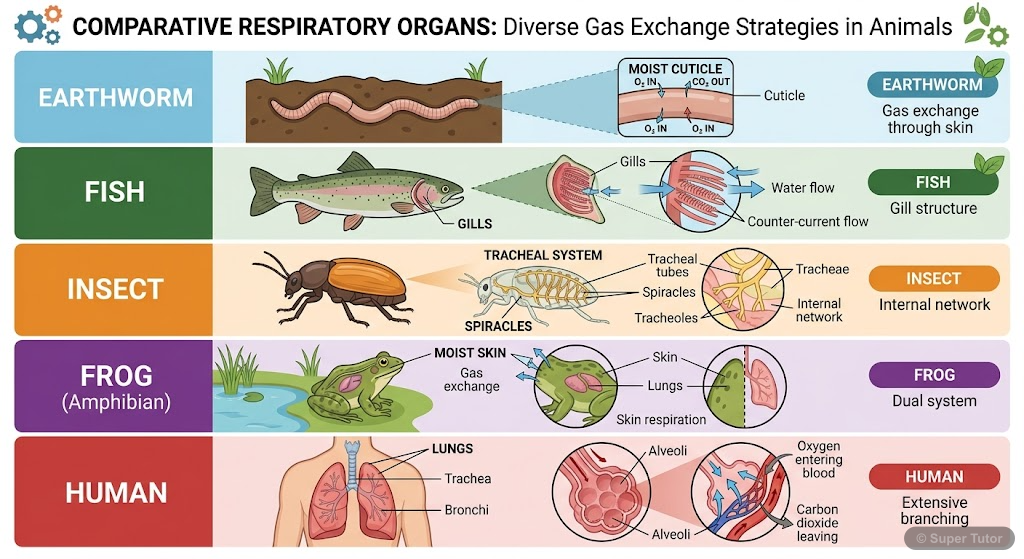
One of 12 illustrations for Breathing and Exchange of Gases in Super Tutor — alongside flashcards, concept maps and practice questions.
Topics in Breathing and Exchange of Gases
1. Respiratory organs in animals
- Respiratory organs are the organs concerned with gaseous exchange, that is, intake of oxygen and output of carbon dioxide.
- In unicellular organisms such as Amoeba, gaseous exchange occurs through the general body surface or plasmalemma.
- In Sycon and Hydra, gas exchange takes place by simple diffusion between flowing water and individual cells.
2. Human respiratory system
- The human respiratory system has two main components: the lungs and the respiratory tract.
- The respiratory tract includes nostrils, nasal cavity, nasopharynx, larynx, trachea, bronchi, and bronchioles.
- Nostrils are the openings of the nasal cavities.
3. Mechanism of breathing and gas exchange
- Breathing is the mechanical process of taking fresh air into the lungs and expelling foul air from the lungs.
- Inspiration is active and expiration is passive.
- Breathing is involuntary and normally occurs at a constant rate of 12 to 14 per minute in a resting person.
4. Transport of oxygen and carbon dioxide
- About 97 per cent of oxygen is transported by RBCs and about 3 per cent is carried dissolved in plasma.
- In arterial blood, about 19 mL of oxygen is present per 100 mL blood; 0.3 mL is dissolved in plasma and 18.7 mL is bound to haemoglobin.
- Haemoglobin is an iron-containing respiratory pigment in RBCs.
Key Concepts
Central concept: Respiration and gaseous exchange in animals and humans
Work through every topic in Breathing and Exchange of Gases with notes and quizzes
Start This ChapterFrequently Asked Questions
What are the important topics in Breathing and Exchange of Gases for ICSE Class 11 Biology?
How should I revise Breathing and Exchange of Gases for Class 11 exams?
Sources & Official References
Content is aligned to the official syllabus. Refer to the board website for the latest curriculum.
More resources for Breathing and Exchange of Gases
Practice Quiz
Test yourself with a quick quiz
Important Questions
Exam-style questions with answers
Revision Notes
Key points for last-minute revision
Formula Sheet
The chapter's formulas in one place
Chapter Summary
Understand the chapter at a glance
Concept Maps
See how topics connect
Study Plan
Step-by-step plan for this chapter
Flashcards
Quick-fire cards for active recall
For serious students
Get the full Breathing and Exchange of Gases chapter — start free.
Quizzes, flashcards, an AI doubt solver and a study plan for ICSE Class 11 Biology. Free to start, no card needed.