Chemical Coordination and Integration — Syllabus
ICSE · Class 11 · Biology
What Chemical Coordination and Integration covers in ICSE Class 11 Biology: 4 topics, for the 2026-27 session. Part of the ICSE Class 11 Biology syllabus.
Interactive on Super Tutor
Studying Chemical Coordination and Integration? Get the full interactive chapter.
Quizzes, flashcards, AI doubt-solver and a step-by-step study plan — built for syllabus and more.
Free trial, no card needed.
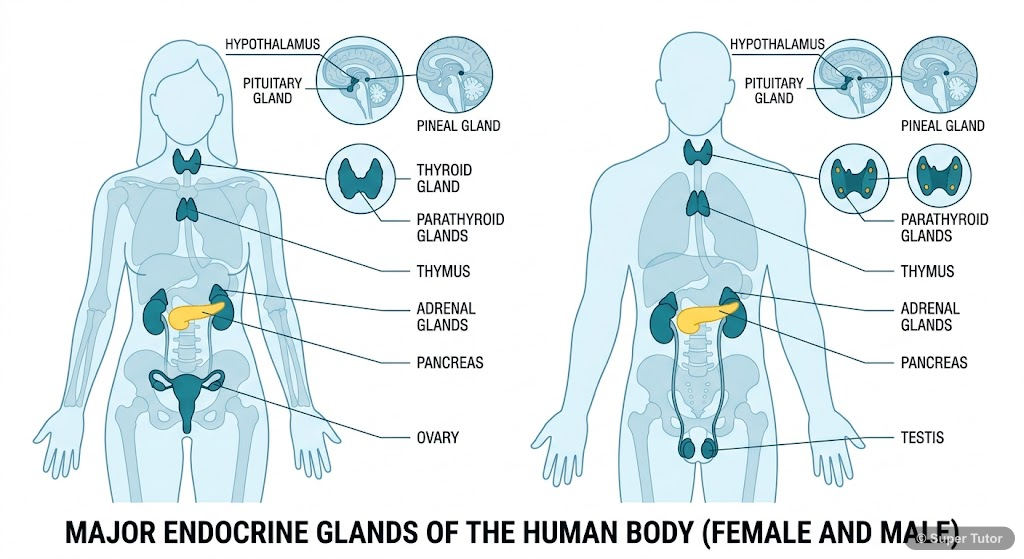
Learn better with visuals Super Tutor pairs illustrations like this with notes and quizzes for Chemical Coordination and Integration.
Topics in Chemical Coordination and Integration
1. Endocrine System and Hormones
- Endocrine glands are ductless glands that release hormones directly into the blood.
- Exocrine glands release their products through ducts to the outside of the body or into body cavities.
- Some glands, such as the pancreas, have both exocrine and endocrine parts.
2. Hypothalamus and Pituitary Gland
- The pituitary gland weighs about 0.5–1.0 g in man and is suspended by the infundibulum in the sella turcica of the sphenoid bone.
- The pituitary has two major parts: anterior pituitary and posterior pituitary, with an intermediate zone called pars intermedia.
- The adenohypophysis comprises about 3/4th of the pituitary, while the posterior pituitary comprises about 1/4th.
3. Pineal Gland and Thymus
- The pineal gland is a tiny, greyish-red, hollow cone-shaped gland on the dorsal side of the midbrain between the superior colliculi.
- It secretes melatonin.
- Melatonin is most active in darkness and regulates circadian rhythm.
4. Thyroid Gland and Parathyroids
- The thyroid is the largest endocrine gland and weighs around 20 g.
- It is butterfly-shaped and lies inferior to the larynx.
- The two lobes are joined by a narrow band called isthmus.
Key Concepts
Central concept: Chemical coordination by hormones and the integration of body functions through the endocrine system
Work through every topic in Chemical Coordination and Integration with notes and quizzes
Start This ChapterFrequently Asked Questions
What are the important topics in Chemical Coordination and Integration for ICSE Class 11 Biology?
How should I revise Chemical Coordination and Integration for Class 11 exams?
Sources & Official References
Content is aligned to the official syllabus. Refer to the board website for the latest curriculum.
More resources for Chemical Coordination and Integration
Practice Quiz
Test yourself with a quick quiz
Important Questions
Exam-style questions with answers
Revision Notes
Key points for last-minute revision
Chapter Summary
Understand the chapter at a glance
Concept Maps
See how topics connect
Study Plan
Step-by-step plan for this chapter
Flashcards
Quick-fire cards for active recall
For serious students
Get the full Chemical Coordination and Integration chapter — start free.
Quizzes, flashcards, an AI doubt solver and a study plan for ICSE Class 11 Biology. Free to start, no card needed.