Chemical Bonding and Molecular Structure — Concept Maps
ICSE · Class 11 · Chemistry
4 concept maps of Chemical Bonding and Molecular Structure for ICSE Class 11 Chemistry, each also written out as a text outline.
Interactive on Super Tutor
Studying Chemical Bonding and Molecular Structure? Get the full interactive chapter.
Quizzes, flashcards, AI doubt-solver and a step-by-step study plan — built for concept maps and more.
Free trial, no card needed.
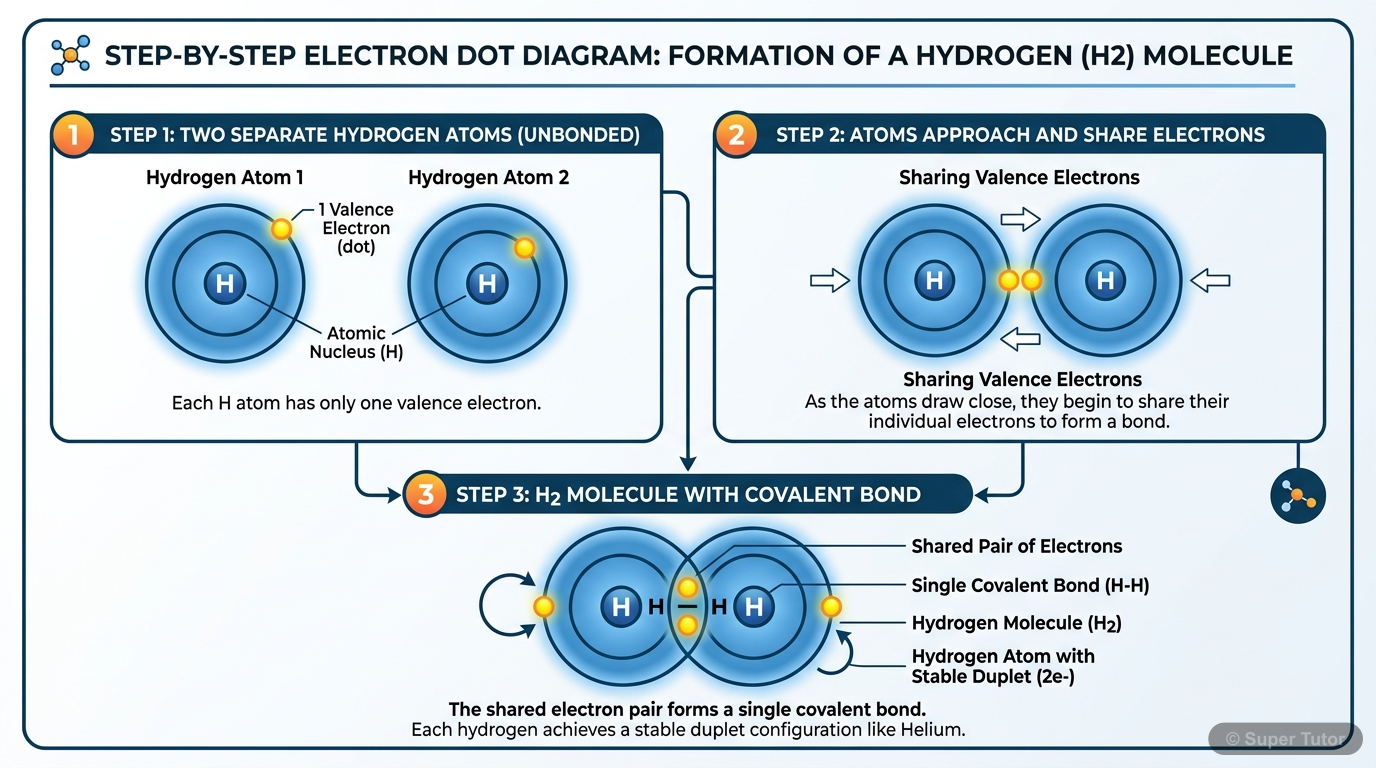
Learn better with visuals Super Tutor pairs illustrations like this with notes and quizzes for Chemical Bonding and Molecular Structure.
Mind map comparing properties of covalent compounds
The map in words
- Properties of Covalent Compounds
- Physical State
- Can be gas liquid or solid
- Weak intermolecular forces
- Discrete molecules
- Thermal Properties
- Low melting points
- Low boiling points
- Exception: Network covalent
- Mechanical Properties
- Soft and waxy
- Exception: Network solids hard
- Not brittle
- Chemical Properties
- Insoluble in water
- Soluble in nonpolar solvents
- Slow reactions
- Electrical Properties
- Poor conductivity
- No mobile ions
- Molecular interactions
- Physical State
Flowchart showing Born-Haber cycle for NaCl formation
The map in words
- Na(s) + 1/2 Cl2(g)
- Sublimation ΔH_sub
- Na(g) + 1/2 Cl2(g)
- Ionization IE
- Na+(g) + 1/2 Cl2(g) + e-
- Dissociation 1/2 ΔH_diss
- Na+(g) + Cl(g) + e-
- Electron Affinity ΔH_eg
- Na+(g) + Cl-(g)
- Lattice Energy -U
- NaCl(s)
- Lattice Energy -U
- Na+(g) + Cl-(g)
- Electron Affinity ΔH_eg
- Na+(g) + Cl(g) + e-
- Dissociation 1/2 ΔH_diss
- Na+(g) + 1/2 Cl2(g) + e-
- Ionization IE
- Na(g) + 1/2 Cl2(g)
- Sublimation ΔH_sub
Flowchart showing Born-Haber cycle for NaCl formation
The map in words
- Na(s) + 1/2 Cl2(g)
- Sublimation ΔH_sub
- Na(g) + 1/2 Cl2(g)
- Ionization IE
- Na+(g) + 1/2 Cl2(g) + e-
- Dissociation 1/2 ΔH_diss
- Na+(g) + Cl(g) + e-
- Electron Affinity ΔH_eg
- Na+(g) + Cl-(g)
- Lattice Energy -U
- NaCl(s)
- Lattice Energy -U
- Na+(g) + Cl-(g)
- Electron Affinity ΔH_eg
- Na+(g) + Cl(g) + e-
- Dissociation 1/2 ΔH_diss
- Na+(g) + 1/2 Cl2(g) + e-
- Ionization IE
- Na(g) + 1/2 Cl2(g)
- Sublimation ΔH_sub
Chemical bonding as the force that holds atoms, ions, and molecules together through electron transfer, sharing, delocalisation, and orbital overlap to achieve stability
The map in words
- Chemical bonding as the force that holds atoms, ions, and molecules together through electron transfer, sharing, delocalisation, and orbital overlap to achieve stability
- Cause of chemical combination
- Electronic theory of valency
- Lewis symbols and valency
- Ionic bond
- Covalent bond
- Variable electrovalency and covalency
- Polarity in covalent bonds
- Covalent character in ionic bonds
Explore these maps interactively
Explore DiagramsFrequently Asked Questions
What are the important topics in Chemical Bonding and Molecular Structure for ICSE Class 11 Chemistry?
What do the concept maps for Chemical Bonding and Molecular Structure show?
How should I revise Chemical Bonding and Molecular Structure for Class 11 exams?
Sources & Official References
Content is aligned to the official syllabus. Refer to the board website for the latest curriculum.
More resources for Chemical Bonding and Molecular Structure
Practice Quiz
Test yourself with a quick quiz
Important Questions
Exam-style questions with answers
Revision Notes
Key points for last-minute revision
Formula Sheet
The chapter's formulas in one place
Chapter Summary
Understand the chapter at a glance
Study Plan
Step-by-step plan for this chapter
Flashcards
Quick-fire cards for active recall
Syllabus
What topics to cover
For serious students
Get the full Chemical Bonding and Molecular Structure chapter — start free.
Quizzes, flashcards, an AI doubt solver and a study plan for ICSE Class 11 Chemistry. Free to start, no card needed.