Chemical Bonding and Molecular Structure — Chapter Summary
ICSE · Class 11 · Chemistry
Summary of Chemical Bonding and Molecular Structure for ICSE Class 11 Chemistry. Part of the ICSE Class 11 Chemistry syllabus.
Interactive on Super Tutor
Studying Chemical Bonding and Molecular Structure? Get the full interactive chapter.
Quizzes, flashcards, AI doubt-solver and a step-by-step study plan — built for chapter summary and more.
Free trial, no card needed.
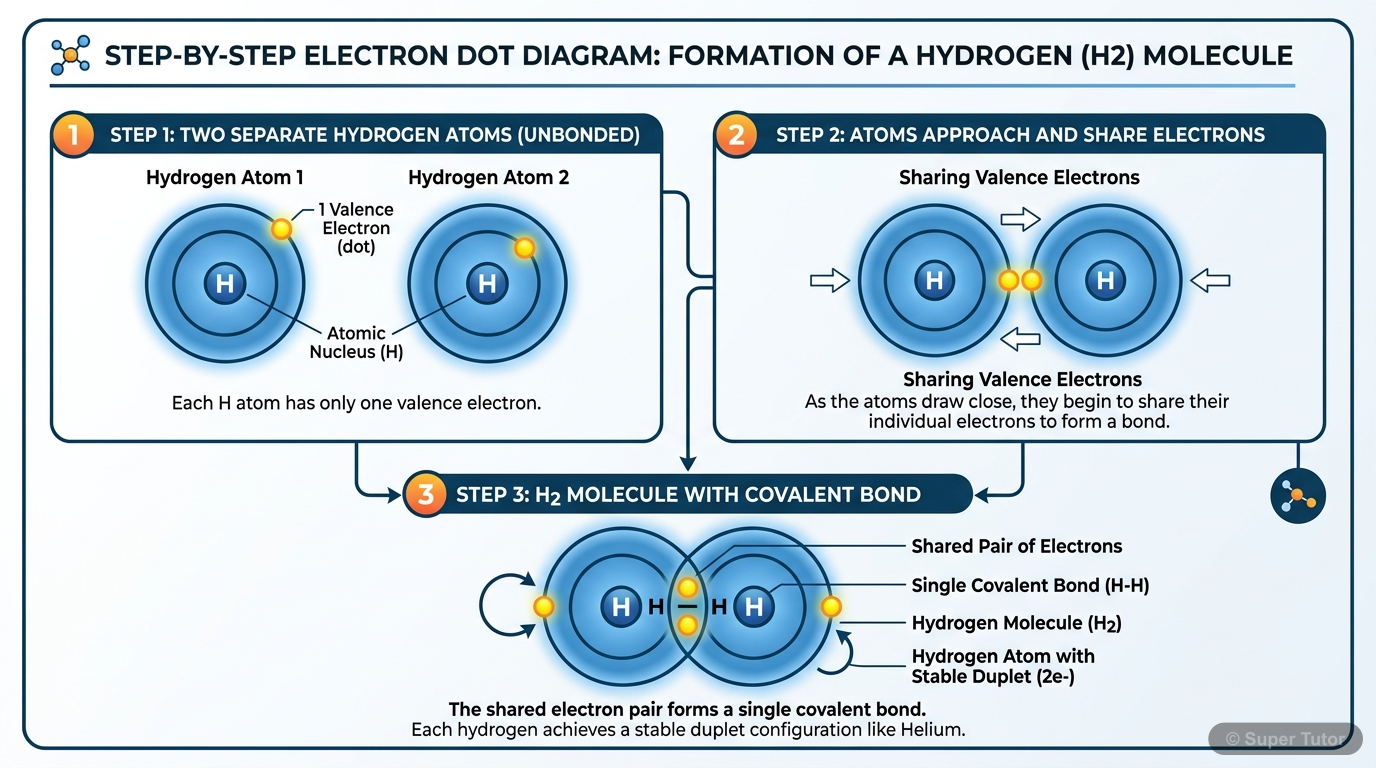
Learn better with visuals Super Tutor pairs illustrations like this with notes and quizzes for Chemical Bonding and Molecular Structure.
Overview
Chemical bonding explains why atoms combine and how they form stable substances. Atoms combine to reach lower potential energy and a more stable electronic arrangement, usually similar to noble gases. The chapter covers ionic bonding, covalent bonding, coordinate bonding, polarity, resonance, hydrog
Key Concepts
Atoms combine because a bonded system
Atoms combine because a bonded system has lower potential energy and greater stability. Most atoms try to achieve a noble gas-like configuration by ga
During bond formation
During bond formation, an atom gains, loses, or shares electrons until it has eight electrons in its valence shell. Hydrogen and lithium are exception
An ionic bond is the electrostatic
An ionic bond is the electrostatic force of attraction between ions formed by complete transfer of electrons from an electropositive atom to an electr
A covalent bond forms by mutual
A covalent bond forms by mutual sharing of electron pairs between atoms of similar or nearly similar electronegativities. Single, double, and triple b
A coordinate covalent bond is
A coordinate covalent bond is a covalent bond in which both electrons of the shared pair come from one atom. It is often represented by an arrow.
Learning Objectives
- Explain why atoms combine to form chemical bonds
- Describe ionic, covalent, coordinate, metallic, and hydrogen bonding
- Apply the octet rule and identify its exceptions
- Predict polarity using electronegativity and dipole moment
- Use formal charge to compare Lewis structures
Frequently Asked Questions
What are the important topics in Chemical Bonding and Molecular Structure for ICSE Class 11 Chemistry?
How should I revise Chemical Bonding and Molecular Structure for Class 11 exams?
Sources & Official References
Content is aligned to the official syllabus. Refer to the board website for the latest curriculum.
More resources for Chemical Bonding and Molecular Structure
Practice Quiz
Test yourself with a quick quiz
Important Questions
Exam-style questions with answers
Revision Notes
Key points for last-minute revision
Formula Sheet
The chapter's formulas in one place
Concept Maps
See how topics connect
Study Plan
Step-by-step plan for this chapter
Flashcards
Quick-fire cards for active recall
Syllabus
What topics to cover
For serious students
Get the full Chemical Bonding and Molecular Structure chapter — start free.
Quizzes, flashcards, an AI doubt solver and a study plan for ICSE Class 11 Chemistry. Free to start, no card needed.