Equilibrium
ICSE · Class 11 · Chemistry
Most important questions from Equilibrium for ICSE Class 11 Chemistry board exam 2026. MCQs, short answer, and long answer questions with marks.
Interactive on Super Tutor
Studying Equilibrium? Get the full interactive chapter.
Quizzes, flashcards, AI doubt-solver and a step-by-step study plan — built for important questions and more.
1,000+ Class 11 students started this chapter today
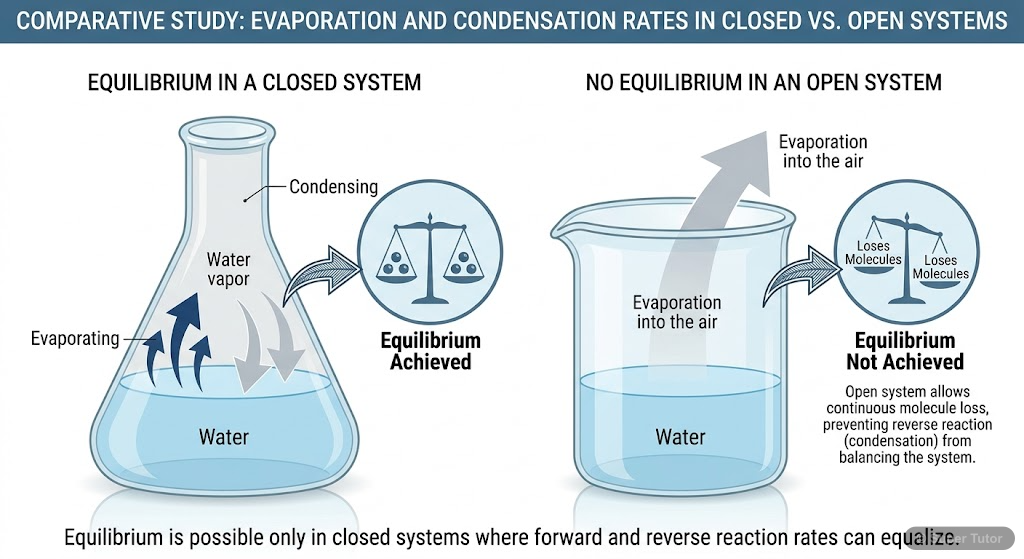
This is just one of 24+ visuals inside Super Tutor's Equilibrium chapter
Explore the full setSample Questions
According to Bronsted-Lowry concept, which of the following is the conjugate base of H₂PO₄⁻?
Show answer
HPO₄²⁻
Step 1: According to Bronsted-Lowry theory, an acid donates a proton (H⁺) to form its conjugate base. Step 2: H₂PO₄⁻ acting as an acid: H₂PO₄⁻ → H⁺ + HPO₄²⁻. Step 3: So HPO₄²⁻ is the conjugate base of H₂PO₄⁻ (it has one fewer proton). Step 4: H₃PO₄ is the conjugate acid of H₂PO₄⁻ (has one more proton). PO₄³⁻ would be formed by removing two protons — that is not its direct conjugate base. Option D has a wrong formula (incorrect charge).
What is the pH of a 0.001 M HCl solution at 298 K, assuming complete dissociation?
Show answer
3
Step 1: HCl is a strong acid and completely dissociates: HCl → H⁺ + Cl⁻. Step 2: Since [HCl] = 0.001 M = 1.0 × 10⁻³ M, [H⁺] = 1.0 × 10⁻³ mol L⁻¹. Step 3: pH = −log₁₀[H⁺] = −log₁₀(1.0 × 10⁻³) = −(−3) = 3. Step 4: Option B (pH = 11) would be the pOH, a common mistake of confusing pH and pOH. Option C (pH = 4) is wrong — that would correspond to [H⁺] = 10⁻⁴ M. Option D (pH = 7) is for neutral water.
In the manufacture of ammonia by Haber's process (N₂ + 3H₂ ⇌ 2NH₃ + heat), which set of conditions gives the maximum yield of ammonia?
Show answer
Low temperature and high pressure
Step 1: The reaction is exothermic (releases heat). By Le-Chatelier's principle, lowering temperature shifts equilibrium to the right (forward direction) to release more heat, favouring NH₃ formation. Step 2: The reaction involves a decrease in moles of gas: 4 moles → 2 moles. Increasing pressure shifts equilibrium towards the side with fewer moles (right), again favouring NH₃. Step 3: Therefore, low temperature and high pressure give maximum yield. Step 4: In practice, very low temperatures reduce reaction rate, so a moderate temperature (~450°C) with a catalyst (iron + molybdenum) is used as
Which of the following is correctly written as the equilibrium constant expression (Kc) for the reaction: CaCO₃(s) ⇌ CaO(s) + CO₂(g)?
Show answer
Kc = [CO₂]
Step 1: This is a heterogeneous equilibrium involving both solid and gaseous phases. Step 2: By convention, the active mass (concentration) of a pure solid is taken as unity (constant) and is NOT included in the Kc expression. Step 3: Both CaCO₃(s) and CaO(s) are pure solids, so [CaCO₃] = 1 and [CaO] = 1. Step 4: Therefore, Kc = [CaO][CO₂]/[CaCO₃] simplifies to Kc = [CO₂]. This is a very important result — the decomposition of CaCO₃ depends only on the CO₂ pressure, not on the amounts of solid present.
+77 more questions available
Practice AllFrequently Asked Questions
What are the important topics in Equilibrium for ICSE Class 11 Chemistry?
How to score full marks in Equilibrium — ICSE Class 11 Chemistry?
How many important questions are there in Equilibrium?
Sources & Official References
Content is aligned to the official syllabus. Refer to the board website for the latest curriculum.
More resources for Equilibrium
Practice Quiz
Test yourself with a quick quiz
Revision Notes
Key points for last-minute revision
Formula Sheet
All formulas in one place
Chapter Summary
Understand the chapter at a glance
Concept Maps
See how topics connect visually
Study Plan
Step-by-step plan to ace this chapter
Flashcards
Quick-fire cards for active recall
Syllabus
What topics to cover
NCERT Solutions
Every textbook question solved step by step
For serious students
Get the full Equilibrium chapter — for free.
Quizzes, flashcards, AI doubt-solver and a step-by-step study plan for ICSE Class 11 Chemistry.