Equilibrium — Chapter Summary
ICSE · Class 11 · Chemistry
Summary of Equilibrium for ICSE Class 11 Chemistry. Key concepts: Equilibrium in physical, A reversible reaction reaches and At constant temperature.
Interactive on Super Tutor
Studying Equilibrium? Get the full interactive chapter.
Quizzes, flashcards, AI doubt-solver and a step-by-step study plan — built for chapter summary and more.
Free trial, no card needed.
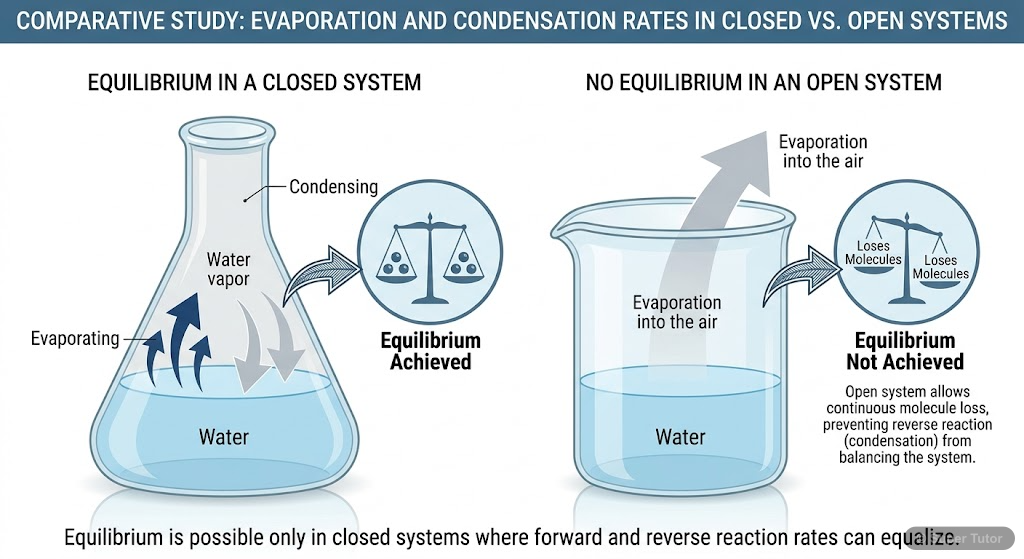
Learn better with visuals Super Tutor pairs illustrations like this with notes and quizzes for Equilibrium.
Overview
Chemical equilibrium is the state reached by many reversible reactions in a closed vessel when the forward and backward reactions occur at the same rate and the concentrations of reactants and products remain constant. Physical equilibria such as solid-liquid, liquid-vapour, and solid-vapour systems
Key Concepts
Equilibrium in physical processes appears
Equilibrium in physical processes appears in systems like solid-liquid, liquid-vapour, and solid-vapour changes. The two opposite processes continue t
A reversible reaction reaches chemical equilibrium
A reversible reaction reaches chemical equilibrium when forward and backward reaction rates become equal and the concentrations of all species stop ch
At constant temperature
At constant temperature, the rate of a reaction is proportional to the product of active masses of reacting species, each raised to its stoichiometric
Kc is written using equilibrium concentrations
Kc is written using equilibrium concentrations, while Kp uses equilibrium partial pressures. For gaseous reactions, Kp and Kc are related by Kp = Kc(R
Q has the same form as
Q has the same form as the equilibrium constant expression but is calculated at any stage of the reaction. If Q=K, the system is at equilibrium; if Q<
Learning Objectives
- Understand the meaning of physical and chemical equilibrium
- Distinguish between irreversible and reversible reactions
- Explain the dynamic nature and characteristics of equilibrium
- Write equilibrium constant expressions using concentrations and partial pressures
- Use the reaction quotient Q to predict the direction of a reaction
Frequently Asked Questions
What are the important topics in Equilibrium for ICSE Class 11 Chemistry?
How should I revise Equilibrium for Class 11 exams?
Sources & Official References
Content is aligned to the official syllabus. Refer to the board website for the latest curriculum.
More resources for Equilibrium
Practice Quiz
Test yourself with a quick quiz
Important Questions
Exam-style questions with answers
Revision Notes
Key points for last-minute revision
Formula Sheet
The chapter's formulas in one place
Concept Maps
See how topics connect
Study Plan
Step-by-step plan for this chapter
Flashcards
Quick-fire cards for active recall
Syllabus
What topics to cover
For serious students
Get the full Equilibrium chapter — start free.
Quizzes, flashcards, an AI doubt solver and a study plan for ICSE Class 11 Chemistry. Free to start, no card needed.