Equilibrium — Concept Maps
ICSE · Class 11 · Chemistry
4 concept maps of Equilibrium for ICSE Class 11 Chemistry, each also written out as a text outline. Part of the ICSE Class 11 Chemistry syllabus.
Interactive on Super Tutor
Studying Equilibrium? Get the full interactive chapter.
Quizzes, flashcards, AI doubt-solver and a step-by-step study plan — built for concept maps and more.
Free trial, no card needed.
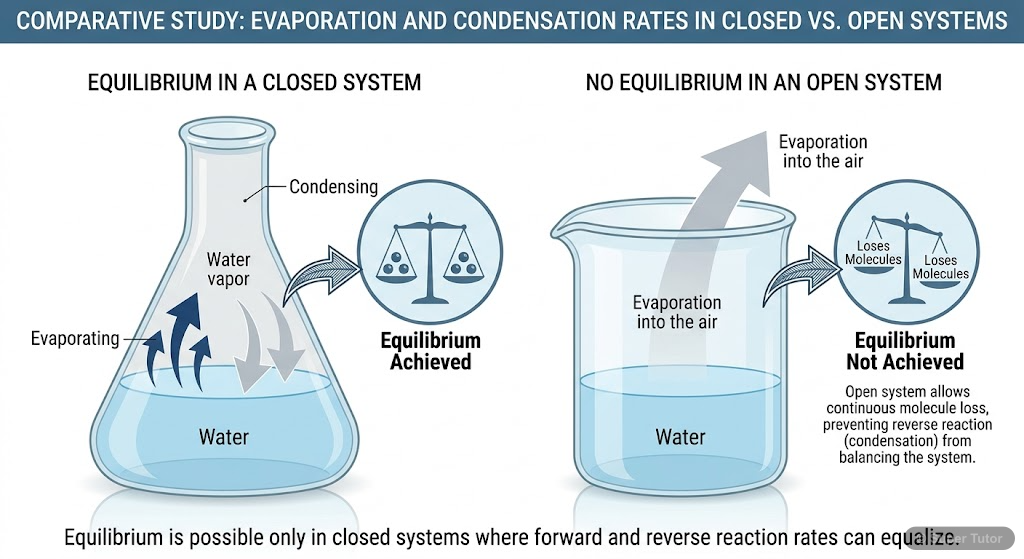
Learn better with visuals Super Tutor pairs illustrations like this with notes and quizzes for Equilibrium.
Equilibrium: Comprehensive Concept Overview
The map in words
- EQUILIBRIUM
- Physical Equilibrium
- Solid-Liquid
- Ice-Water at 273K
- Melting Point
- Liquid-Gas
- Vapor Pressure
- Boiling Point
- Solid-Gas
- Sublimation
- Iodine sublimation
- Solid-Liquid
- Chemical Equilibrium
- Definition
- Forward = Backward rates
- Constant concentrations
- Characteristics
- Dynamic nature
- Closed system required
- Attained from either side
- Driving Factors
- Temperature
- Pressure
- Concentration
- Definition
- Equilibrium Constant
- Kc Expression
- Products over Reactants
- Raised to coefficients
- Kp Expression
- Partial pressures
- Kp = Kc(RT)^Δn
- Magnitude Meaning
- K >> 1: Favors products
- K << 1: Favors reactants
- Kc Expression
- Le-Chatelier's Principle
- Stress Responses
- Concentration change
- Pressure change
- Temperature change
- Equilibrium Shift
- Counteracts the stress
- Restores K value
- Industrial Application
- Haber process
- Contact process
- Stress Responses
- Ionic Equilibria
- Weak Electrolytes
- Partial ionization
- Ka and Kb constants
- Degree of dissociation
- Water Ionization
- Kw = 10^-14 at 298K
- pH scale definition
- Acid-Base Chemistry
- Bronsted-Lowry theory
- Conjugate pairs
- Buffer solutions
- Weak Electrolytes
- Quantitative Applications
- Solubility Product
- Ksp calculations
- Precipitation prediction
- Salt Hydrolysis
- Weak acid/base formation
- pH predictions
- Titrations
- Indicator selection
- Equivalence point
- Solubility Product
- Physical Equilibrium
Equilibrium Concepts Overview
The map in words
- Equilibrium
- Physical Equilibrium
- Solid-Liquid
- Liquid-Vapor
- Solid-Vapor
- Chemical Equilibrium
- Reversible Reactions
- Equilibrium Constants
- Le Chatelier Principle
- Ionic Equilibrium
- Weak Acids and Bases
- pH Scale
- Buffer Solutions
- Salt Hydrolysis
- Solubility Equilibrium
- Ksp
- Common Ion Effect
- Precipitation
- Physical Equilibrium
Process for optimizing industrial chemical equilibrium
The map in words
- Industrial Process
- Identify Equilibrium
- Calculate K
- Analyze ΔH
- Choose Conditions
- Optimize:
- Temperature: Rate vs. Yield
- Pressure: Moles vs. Yield
- Catalyst: Faster Equilibrium
- Separation: Continuous Removal
- Optimize:
- Choose Conditions
- Analyze ΔH
- Calculate K
- Identify Equilibrium
Dynamic equilibrium in chemical and physical processes
The map in words
- Dynamic equilibrium in chemical and physical processes
- Physical equilibrium
- Chemical equilibrium
- Law of mass action
- Equilibrium constant
- Reaction quotient
- Le-Chatelier's principle
- Ionic equilibrium
- Acid-base concepts
Explore these maps interactively
Explore DiagramsFrequently Asked Questions
What are the important topics in Equilibrium for ICSE Class 11 Chemistry?
What do the concept maps for Equilibrium show?
How should I revise Equilibrium for Class 11 exams?
Sources & Official References
Content is aligned to the official syllabus. Refer to the board website for the latest curriculum.
More resources for Equilibrium
Practice Quiz
Test yourself with a quick quiz
Important Questions
Exam-style questions with answers
Revision Notes
Key points for last-minute revision
Formula Sheet
The chapter's formulas in one place
Chapter Summary
Understand the chapter at a glance
Study Plan
Step-by-step plan for this chapter
Flashcards
Quick-fire cards for active recall
Syllabus
What topics to cover
For serious students
Get the full Equilibrium chapter — start free.
Quizzes, flashcards, an AI doubt solver and a study plan for ICSE Class 11 Chemistry. Free to start, no card needed.