Gandhian Nationalism (1916-1922) — Chapter Summary
ICSE · Class 11 · History
Summary of Gandhian Nationalism (1916-1922) for ICSE Class 11 History. Part of the ICSE Class 11 History syllabus.
Interactive on Super Tutor
Studying Gandhian Nationalism (1916-1922)? Get the full interactive chapter.
Quizzes, flashcards, AI doubt-solver and a step-by-step study plan — built for chapter summary and more.
Free trial, no card needed.
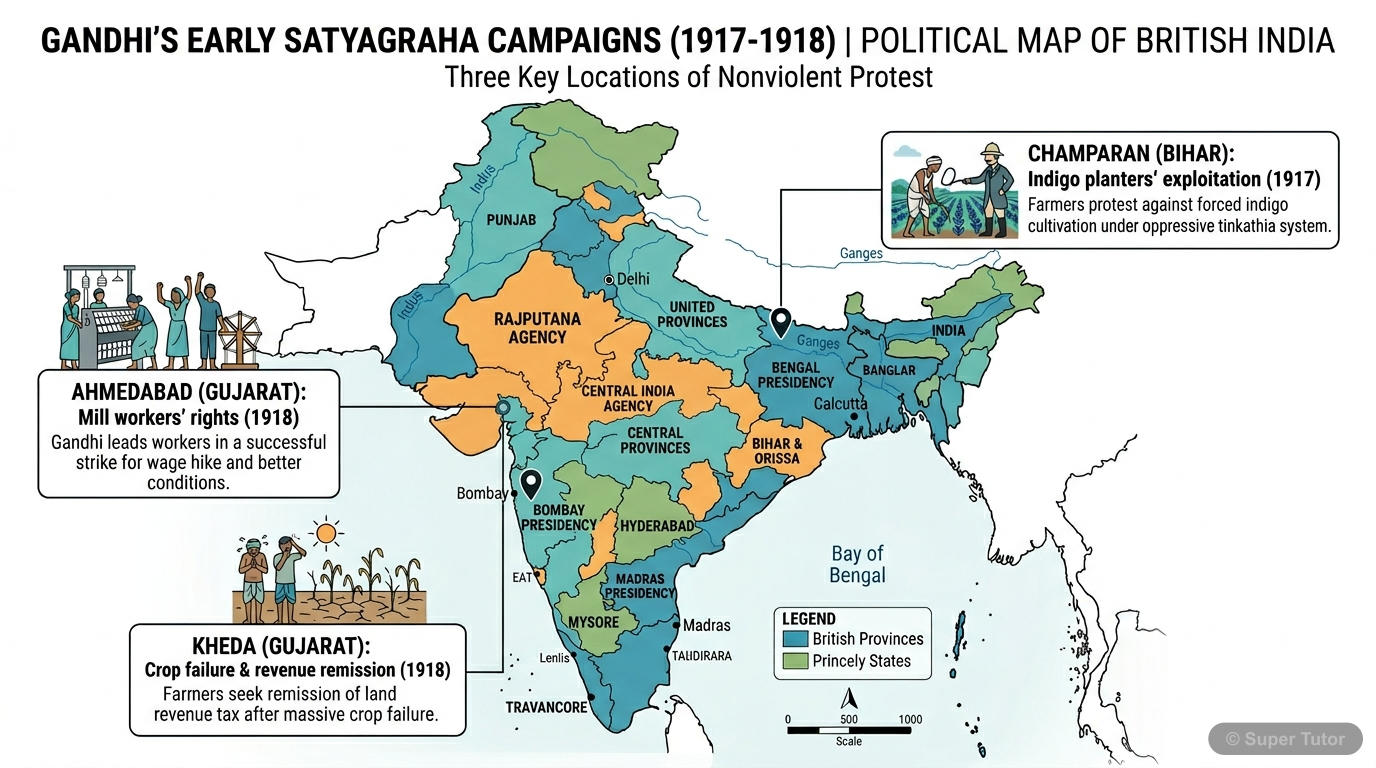
One of 4 illustrations for Gandhian Nationalism (1916-1922) in Super Tutor — alongside flashcards, concept maps and practice questions.
Overview
Gandhian nationalism began a new phase in the Indian freedom struggle by turning mass political action into a broad national movement. Gandhi introduced satyagraha, or non-violent resistance, and used it first against the Rowlatt Act, then after the Jallianwala Bagh massacre in the wider struggle ag
Key Concepts
Satyagraha was Gandhi's method of passive
Satyagraha was Gandhi's method of passive resistance based on truth and non-violence. He used it first in South Africa and then applied it in India as
The Rowlatt Act was repressive wartime
The Rowlatt Act was repressive wartime legislation made permanent. It allowed detention without trial for up to two years and targeted nationalist act
On 13 April 1919
On 13 April 1919, General Dyer ordered troops to fire without warning on an unarmed crowd at Jallianwala Bagh in Amritsar. Officially 379 people were
The Khilafat Movement arose from Muslim
The Khilafat Movement arose from Muslim concern over the fate of the Khalifa of Turkey after World War I. It later merged with Indian nationalist poli
The Non
The Non-Cooperation Movement combined boycott of schools, courts, foreign goods, titles, and councils with support for national schools, khadi, and ar
Learning Objectives
- Understand why Gandhian methods became important in Indian nationalism.
- Explain the Rowlatt Act agitation and its impact on public opinion.
- Describe the Jallianwala Bagh massacre and its political and emotional consequences.
- Understand the Khilafat issue and its link with Non-Cooperation.
- Trace the main phases of the Non-Cooperation Movement.
Frequently Asked Questions
What are the important topics in Gandhian Nationalism (1916-1922) for ICSE Class 11 History?
How should I revise Gandhian Nationalism (1916-1922) for Class 11 exams?
Sources & Official References
Content is aligned to the official syllabus. Refer to the board website for the latest curriculum.
More resources for Gandhian Nationalism (1916-1922)
For serious students
Get the full Gandhian Nationalism (1916-1922) chapter — start free.
Quizzes, flashcards, an AI doubt solver and a study plan for ICSE Class 11 History. Free to start, no card needed.