Gandhian Nationalism (1927-1937) — Chapter Summary
ICSE · Class 11 · History
Summary of Gandhian Nationalism (1927-1937) for ICSE Class 11 History. Part of the ICSE Class 11 History syllabus.
Interactive on Super Tutor
Studying Gandhian Nationalism (1927-1937)? Get the full interactive chapter.
Quizzes, flashcards, AI doubt-solver and a step-by-step study plan — built for chapter summary and more.
Free trial, no card needed.
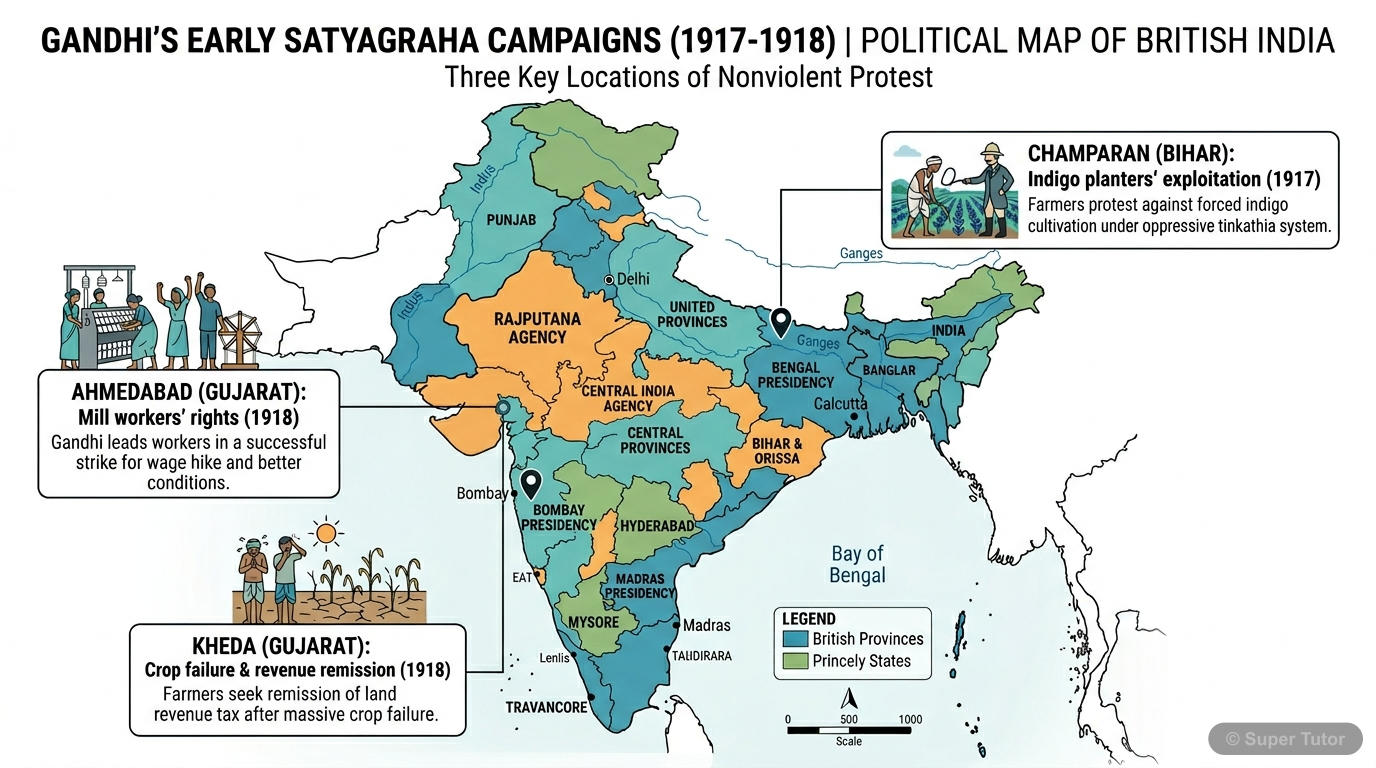
One of 3 illustrations for Gandhian Nationalism (1927-1937) in Super Tutor — alongside flashcards, concept maps and practice questions.
Overview
Gandhian nationalism during 1927-1937 moved through three major phases: opposition to the Simon Commission, the demand for Dominion Status, and the Civil Disobedience Movement led by Gandhiji. The period began with Congress debate over strategy after the decline of Non-Cooperation, passed through th
Key Concepts
The Simon Commission was appointed
The Simon Commission was appointed in November 1927 with Sir John Simon as president. It was an all-white commission with no Indian members, so Indian
After the decline of Non
After the decline of Non-Cooperation, Congress split over strategy. Chittaranjan Das and Motilal Nehru led the Pro-Changers, who wanted to enter counc
The Nehru Report was drafted by
The Nehru Report was drafted by a committee headed by Motilal Nehru after the All-Parties Conference at Lucknow in August 1928. It demanded Dominion S
By 1929
By 1929, the younger Congress leaders, led by Jawaharlal Nehru and Subhas Chandra Bose, demanded complete independence instead of Dominion Status. The
Civil Disobedience began after Gandhiji placed
Civil Disobedience began after Gandhiji placed Eleven Points of Administrative Reform before the government. When the proposals were rejected, he star
Learning Objectives
- Understand why the Simon Commission was boycotted and how it revived nationalist unity.
- Explain the rise of Pro-Changers and No-Changers after the suspension of Non-Cooperation.
- Describe the Nehru Report and the shift from Dominion Status to Poorna Swaraj.
- Trace the causes, course, and impact of the Civil Disobedience Movement.
- Understand the Gandhi-Irwin Pact, the Round Table Conferences, and the Poona Pact.
Frequently Asked Questions
What are the important topics in Gandhian Nationalism (1927-1937) for ICSE Class 11 History?
How should I revise Gandhian Nationalism (1927-1937) for Class 11 exams?
Sources & Official References
Content is aligned to the official syllabus. Refer to the board website for the latest curriculum.
More resources for Gandhian Nationalism (1927-1937)
For serious students
Get the full Gandhian Nationalism (1927-1937) chapter — start free.
Quizzes, flashcards, an AI doubt solver and a study plan for ICSE Class 11 History. Free to start, no card needed.