Chapter 6 of 13
Revision Notes
Gandhian Nationalism (1927-1937) — Revision Notes
ICSE · Class 11 · History
Gandhian Nationalism (1927-1937) revision notes for ICSE Class 11 History: 4 topics in quick points. Part of the ICSE Class 11 History syllabus.
45 questions33 flashcards5 concepts
Interactive on Super Tutor
Studying Gandhian Nationalism (1927-1937)? Get the full interactive chapter.
Quizzes, flashcards, AI doubt-solver and a step-by-step study plan — built for revision notes and more.
Free trial, no card needed.
Super Tutor
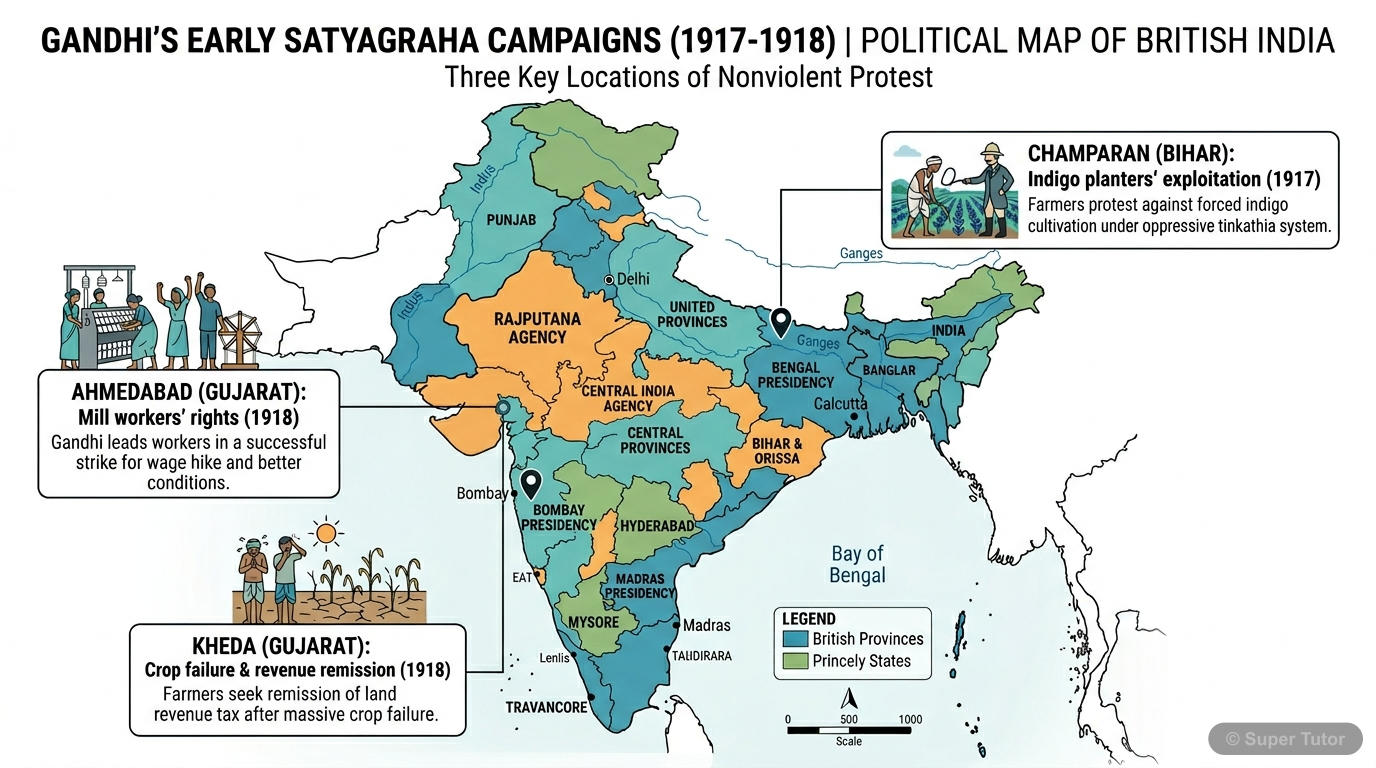
One of 3 illustrations for Gandhian Nationalism (1927-1937) in Super Tutor — alongside flashcards, concept maps and practice questions.
Key Topics to Revise
1
1. From Non-Cooperation to New Political Alignments
- The suspension of the Non-Cooperation Movement after Chauri Chaura created a political vacuum.
- Chittaranjan Das and Motilal Nehru led the Pro-Changers, who wanted to contest elections to the Legislative Councils and wreck the Reforms Act of 1919 from within.
- The Pro-Changers formed the Swarajya Party on 1 January 1932.
2
2. Simon Commission and the Nehru Report
- The Simon Commission was appointed in November 1927.
- It was an all-white commission with no Indian members, so almost all Indian political parties boycotted it.
- Congress decided to boycott the Simon Commission at its Madras Session in 1927.
3
3. Poorna Swaraj and the Shift to Mass Struggle
- At the Congress Annual Session at Calcutta in 1928, the younger leaders led by Subhas Chandra Bose and Jawaharlal Nehru demanded complete independence.
- Jawaharlal Nehru later became the central face of the Poorna Swaraj phase.
- Lord Irwin declared that Dominion Status was the natural issue of India's constitutional progress on 31 October 1929.
4
4. Civil Disobedience Movement and the Salt Satyagraha
- Gandhiji decided to launch Civil Disobedience after the government gave a negative response to his Eleven Points of Administrative Reform.
- On 12 March 1930, Gandhiji started the Dandi March from Sabarmati Ashram with 78 chosen followers.
- He reached Dandi and broke the salt law on 6 April 1930.
Get complete notes with diagrams and examples
Full NotesKey Concepts
The Simon Commission was appointedAfter the decline of NonThe Nehru Report was drafted byBy 1929Civil Disobedience began after Gandhiji placed
Frequently Asked Questions
What are the important topics in Gandhian Nationalism (1927-1937) for ICSE Class 11 History?
Key topics in Gandhian Nationalism (1927-1937) include From Non-Cooperation to New Political Alignments, Simon Commission and the Nehru Report, Poorna Swaraj and the Shift to Mass Struggle, Civil Disobedience Movement and the Salt Satyagraha. Study these first, then practise questions on each for Class 11 exams.
How should I revise Gandhian Nationalism (1927-1937) for Class 11 exams?
Learn the core ideas first, then work through the 45 practice questions on Gandhian Nationalism (1927-1937). Revise definitions regularly and use flashcards for quick recall before the exam.
Sources & Official References
Content is aligned to the official syllabus. Refer to the board website for the latest curriculum.
More resources for Gandhian Nationalism (1927-1937)
For serious students
Get the full Gandhian Nationalism (1927-1937) chapter — start free.
Quizzes, flashcards, an AI doubt solver and a study plan for ICSE Class 11 History. Free to start, no card needed.