Gandhian Nationalism (1927-1937) — Syllabus
ICSE · Class 11 · History
What Gandhian Nationalism (1927-1937) covers in ICSE Class 11 History: 4 topics, for the 2026-27 session. Part of the ICSE Class 11 History syllabus.
Interactive on Super Tutor
Studying Gandhian Nationalism (1927-1937)? Get the full interactive chapter.
Quizzes, flashcards, AI doubt-solver and a step-by-step study plan — built for syllabus and more.
Free trial, no card needed.
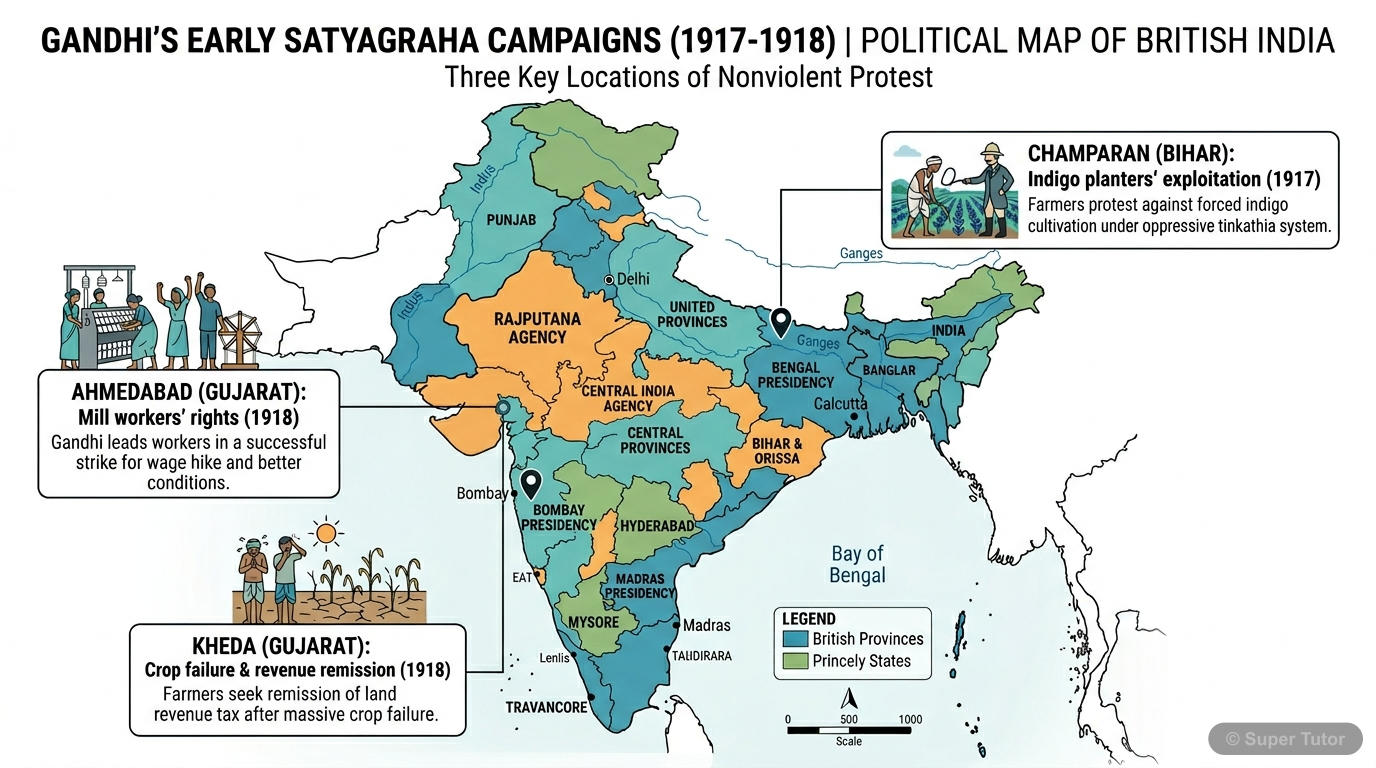
One of 3 illustrations for Gandhian Nationalism (1927-1937) in Super Tutor — alongside flashcards, concept maps and practice questions.
Topics in Gandhian Nationalism (1927-1937)
1. From Non-Cooperation to New Political Alignments
- The suspension of the Non-Cooperation Movement after Chauri Chaura created a political vacuum.
- Chittaranjan Das and Motilal Nehru led the Pro-Changers, who wanted to contest elections to the Legislative Councils and wreck the Reforms Act of 1919 from within.
- The Pro-Changers formed the Swarajya Party on 1 January 1932.
2. Simon Commission and the Nehru Report
- The Simon Commission was appointed in November 1927.
- It was an all-white commission with no Indian members, so almost all Indian political parties boycotted it.
- Congress decided to boycott the Simon Commission at its Madras Session in 1927.
3. Poorna Swaraj and the Shift to Mass Struggle
- At the Congress Annual Session at Calcutta in 1928, the younger leaders led by Subhas Chandra Bose and Jawaharlal Nehru demanded complete independence.
- Jawaharlal Nehru later became the central face of the Poorna Swaraj phase.
- Lord Irwin declared that Dominion Status was the natural issue of India's constitutional progress on 31 October 1929.
4. Civil Disobedience Movement and the Salt Satyagraha
- Gandhiji decided to launch Civil Disobedience after the government gave a negative response to his Eleven Points of Administrative Reform.
- On 12 March 1930, Gandhiji started the Dandi March from Sabarmati Ashram with 78 chosen followers.
- He reached Dandi and broke the salt law on 6 April 1930.
Key Concepts
Central concept: Gandhian nationalism and the mass political struggle for freedom between 1927 and 1937
Work through every topic in Gandhian Nationalism (1927-1937) with notes and quizzes
Start This ChapterFrequently Asked Questions
What are the important topics in Gandhian Nationalism (1927-1937) for ICSE Class 11 History?
How should I revise Gandhian Nationalism (1927-1937) for Class 11 exams?
Sources & Official References
Content is aligned to the official syllabus. Refer to the board website for the latest curriculum.
More resources for Gandhian Nationalism (1927-1937)
Practice Quiz
Test yourself with a quick quiz
Important Questions
Exam-style questions with answers
Revision Notes
Key points for last-minute revision
Chapter Summary
Understand the chapter at a glance
Concept Maps
See how topics connect
Study Plan
Step-by-step plan for this chapter
Flashcards
Quick-fire cards for active recall
For serious students
Get the full Gandhian Nationalism (1927-1937) chapter — start free.
Quizzes, flashcards, an AI doubt solver and a study plan for ICSE Class 11 History. Free to start, no card needed.