Chapter 5 of 13
Revision Notes
Gandhian Nationalism (1916-1922) — Revision Notes
ICSE · Class 11 · History
Gandhian Nationalism (1916-1922) revision notes for ICSE Class 11 History: 4 topics in quick points. Part of the ICSE Class 11 History syllabus.
45 questions40 flashcards5 concepts
Interactive on Super Tutor
Studying Gandhian Nationalism (1916-1922)? Get the full interactive chapter.
Quizzes, flashcards, AI doubt-solver and a step-by-step study plan — built for revision notes and more.
Free trial, no card needed.
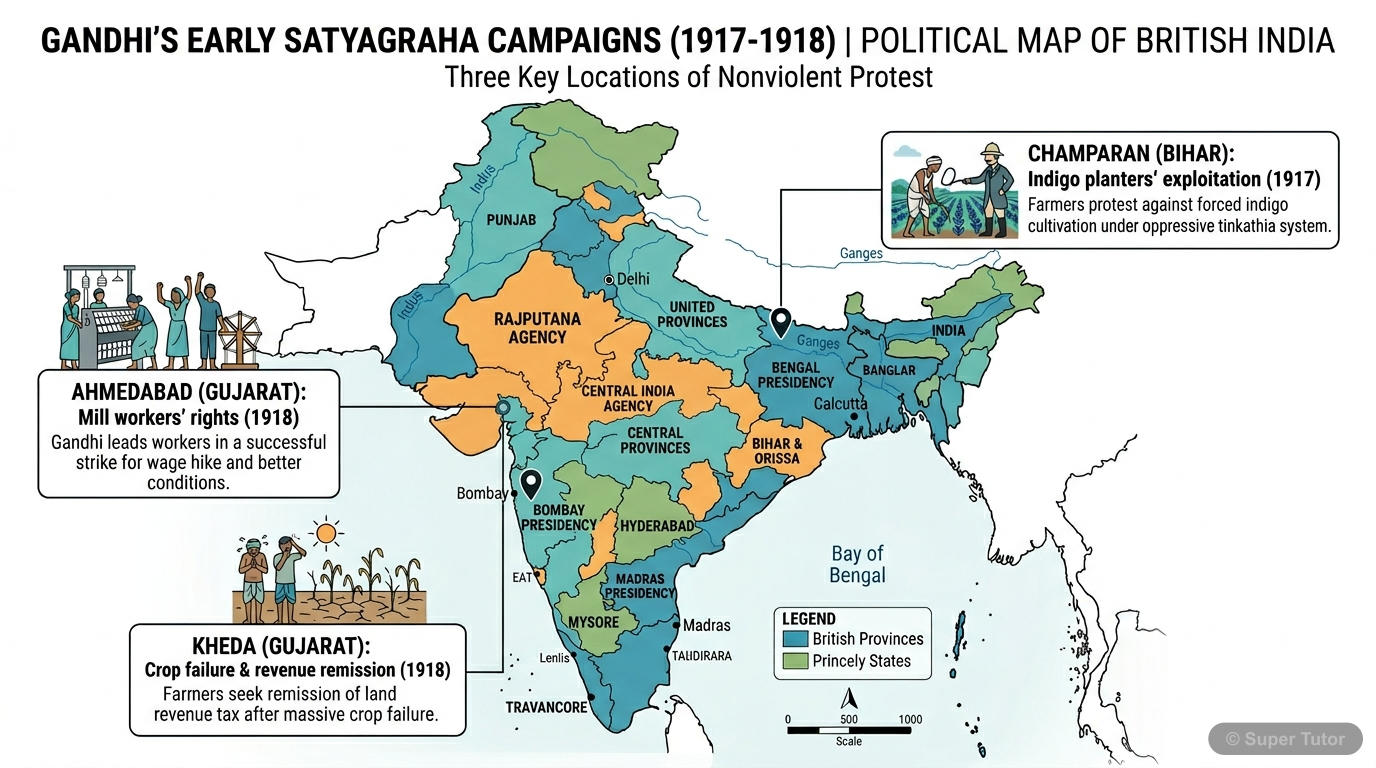
Super Tutor
One of 4 illustrations for Gandhian Nationalism (1916-1922) in Super Tutor — alongside flashcards, concept maps and practice questions.
Key Topics to Revise
1
1. Gandhiji's Entry and Satyagraha
- Gandhiji returned to India in January 1915 and gradually became a national leader.
- He introduced passive resistance, also called Satyagraha, which had been practised earlier in South Africa.
- Gandhiji founded the Satyagraha Ashram near Ahmedabad in 1915 to spread the idea of Satyagraha.
2
2. Rowlatt Act and Rowlatt Satyagraha, 1919
- The Rowlatt Committee was appointed in 1917 under Justice Sydney Rowlatt to investigate revolutionary crime.
- Its recommendations led to the Rowlatt Act, a repressive war-time legislation made permanent.
- The law allowed detention without trial for up to two years.
3
3. Jallianwala Bagh Massacre and Its Impact
- Dr. Kichlew and Dr. Satyapal were arrested on 10 April 1919, which triggered the Jallianwala Bagh gathering.
- The Jallianwala Bagh massacre took place on 13 April 1919.
- General Dyer ordered troops to fire without warning on an unarmed crowd.
4
4. Khilafat Movement and the Growth of Hindu-Muslim Unity
- During the First World War, Turkey was part of the Central Powers.
- After the war, the Allied powers took a stern attitude towards Turkey and the Khalifa was removed from power.
- Indian Muslims started the Khilafat Movement to protect the Khalifa and the holy places of Islam.
Get complete notes with diagrams and examples
Full NotesKey Concepts
Satyagraha was Gandhi's method of passiveThe Rowlatt Act was repressive wartimeOn 13 April 1919The Khilafat Movement arose from MuslimThe Non
Frequently Asked Questions
What are the important topics in Gandhian Nationalism (1916-1922) for ICSE Class 11 History?
Key topics in Gandhian Nationalism (1916-1922) include Gandhiji's Entry and Satyagraha, Rowlatt Act and Rowlatt Satyagraha, 1919, Jallianwala Bagh Massacre and Its Impact, Khilafat Movement and the Growth of Hindu-Muslim Unity. Study these first, then practise questions on each for Class 11 exams.
How should I revise Gandhian Nationalism (1916-1922) for Class 11 exams?
Learn the core ideas first, then work through the 45 practice questions on Gandhian Nationalism (1916-1922). Revise definitions regularly and use flashcards for quick recall before the exam.
Sources & Official References
Content is aligned to the official syllabus. Refer to the board website for the latest curriculum.
More resources for Gandhian Nationalism (1916-1922)
For serious students
Get the full Gandhian Nationalism (1916-1922) chapter — start free.
Quizzes, flashcards, an AI doubt solver and a study plan for ICSE Class 11 History. Free to start, no card needed.