Gandhian Nationalism (1916-1922) — Flashcards
ICSE · Class 11 · History
40 flashcards for Gandhian Nationalism (1916-1922) (ICSE Class 11 History) to test yourself on key terms and facts.
Interactive on Super Tutor
Studying Gandhian Nationalism (1916-1922)? Get the full interactive chapter.
Quizzes, flashcards, AI doubt-solver and a step-by-step study plan — built for flashcards and more.
Free trial, no card needed.
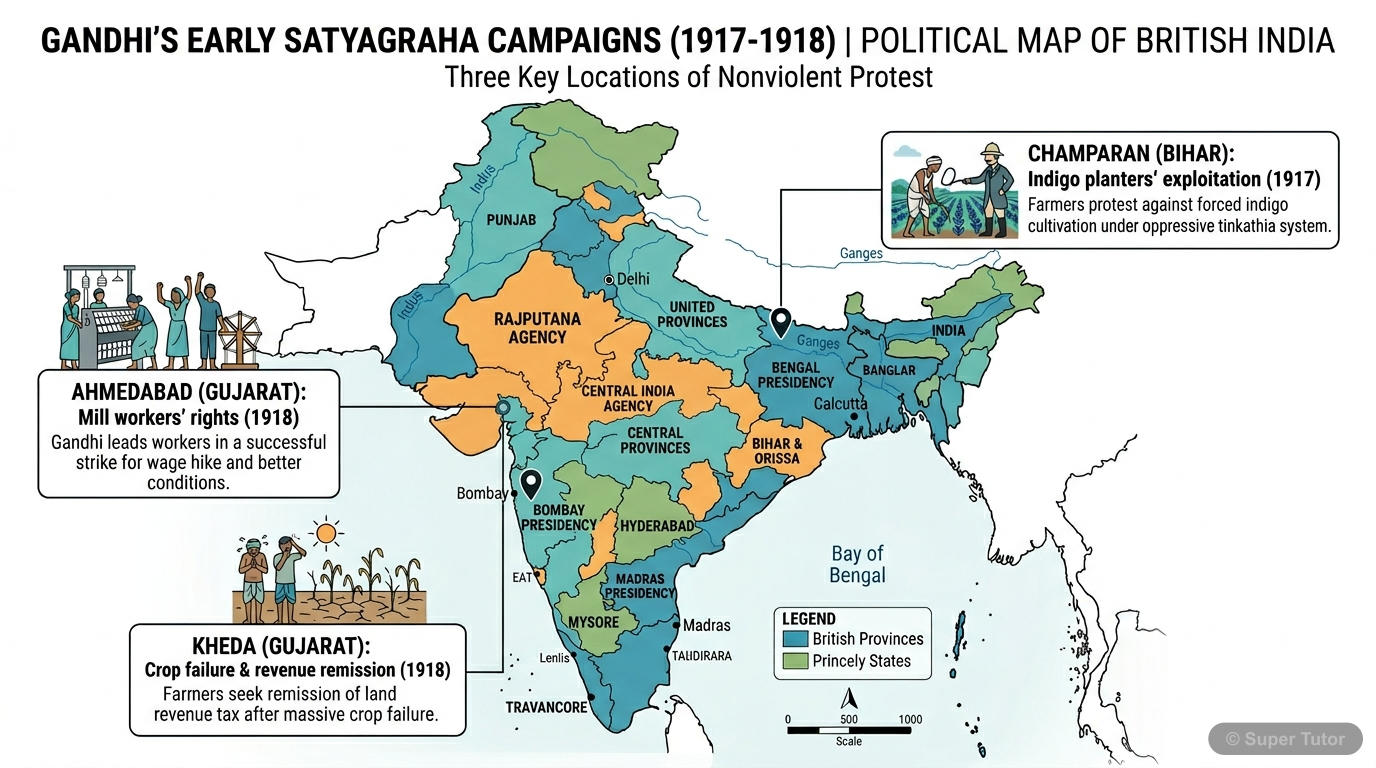
One of 4 illustrations for Gandhian Nationalism (1916-1922) in Super Tutor — alongside flashcards, concept maps and practice questions.
What was the Rowlatt Act and why was it opposed?
Answer
The Rowlatt Act was repressive war-time legislation made permanent. It allowed detention without trial for up to two years, so nationalists opposed it as anti-democratic and aimed at suppressing disse…
Why did Gandhiji describe the Rowlatt Act with the words "No appeal, no Vakil and no Law"?
Answer
He used this phrase to show that the Act denied basic legal rights. There was no proper appeal, no lawyer, and no lawful protection for the arrested person.
What was the Satyagraha Sabha, and when was it formed?
Answer
The Satyagraha Sabha was formed by Gandhiji in Bombay on 24 February 1919 to protest against the Rowlatt Bill. It helped organize resistance through non-violent protest.
What change was made in the hartal call during the Rowlatt agitation?
Answer
The hartal was first called for 30 March 1919 and later changed to 6 April 1919. The protest spread widely across India.
What happened in Delhi during the hartal on 30 March 1919?
Answer
Ten people were killed in police firing in Delhi on 30 March 1919 during the hartal. This showed how tense the situation had become.
Which books were proscribed by the Bombay government during the agitation?
Answer
Four books were proscribed, including Gandhi's Hind Swaraj. This was part of the effort to suppress nationalist thought and protest literature.
Why did the Rowlatt agitation fail to remain fully peaceful?
Answer
The movement lacked proper organization and central coordination. It was also stronger in cities than in rural areas, and in several places local grievances and anger turned the protest toward violenc…
What was the Jallianwala Bagh massacre?
Answer
On 13 April 1919, General Dyer ordered troops to fire without warning on an unarmed crowd at Jallianwala Bagh in Amritsar. Officially 379 persons were killed, while unofficial accounts gave nearly thr…
+32 more flashcards
Practise AllFrequently Asked Questions
What are the important topics in Gandhian Nationalism (1916-1922) for ICSE Class 11 History?
How many flashcards are available for Gandhian Nationalism (1916-1922)?
How should I revise Gandhian Nationalism (1916-1922) for Class 11 exams?
Sources & Official References
Content is aligned to the official syllabus. Refer to the board website for the latest curriculum.
More resources for Gandhian Nationalism (1916-1922)
Practice Quiz
Test yourself with a quick quiz
Important Questions
Exam-style questions with answers
Revision Notes
Key points for last-minute revision
Chapter Summary
Understand the chapter at a glance
Concept Maps
See how topics connect
Study Plan
Step-by-step plan for this chapter
Syllabus
What topics to cover
For serious students
Get the full Gandhian Nationalism (1916-1922) chapter — start free.
Quizzes, flashcards, an AI doubt solver and a study plan for ICSE Class 11 History. Free to start, no card needed.