Straight Lines — Flashcards
ICSE · Class 11 · Mathematics
28 flashcards for Straight Lines (ICSE Class 11 Mathematics) to test yourself on key terms and facts. Part of the ICSE Class 11 Mathematics syllabus.
Interactive on Super Tutor
Studying Straight Lines? Get the full interactive chapter.
Quizzes, flashcards, AI doubt-solver and a step-by-step study plan — built for flashcards and more.
Free trial, no card needed.
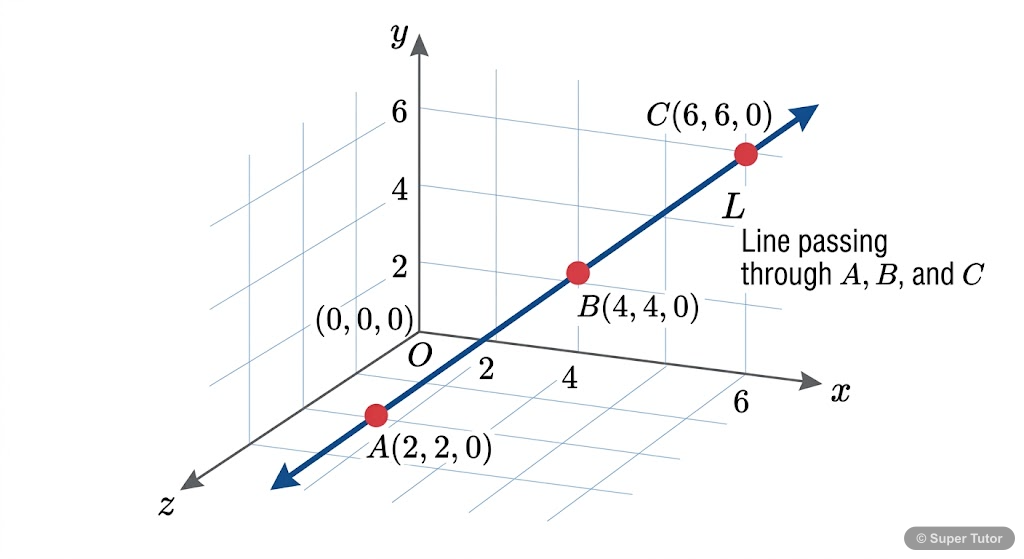
Learn better with visuals Super Tutor pairs illustrations like this with notes and quizzes for Straight Lines.
Find the distance between A(2,1) and B(-3,0).
Answer
Step 1: Use the distance formula: AB = √((x2 - x1)^2 + (y2 - y1)^2) Step 2: Substitute A(2,1) and B(-3,0): AB = √(( -3 - 2 )^2 + (0 - 1)^2) Step 3: AB = √(( -5 )^2 + ( -1 )^2) = √(25 + 1) Step 4: AB =…
A point P(x,0) on the x-axis is equidistant from (7,6) and (3,4). Find P.
Answer
Step 1: Since P is equidistant from both points, set the distances equal. Step 2: Use distance formula: √((x - 7)^2 + (0 - 6)^2) = √((x - 3)^2 + (0 - 4)^2) Step 3: Square both sides: (x - 7)^2 + 36 = …
Use the section formula to find the point dividing A(4,-1) and B(-2,3) internally in the ratio 1:3.
Answer
Step 1: Use the section formula: R = ((m x2 + n x1)/(m+n), (m y2 + n y1)/(m+n)) Step 2: Here, m = 1 and n = 3, A(x1,y1) = (4,-1), B(x2,y2) = (-2,3) Step 3: Substitute: R = ((1·(-2) + 3·4)/(1+3), (1·3 …
Find the midpoint of the line segment joining A(-1,4) and B(3,-2).
Answer
Step 1: Midpoint is the special case of section formula when m = n. Step 2: Use midpoint formula: M = ((x1 + x2)/2, (y1 + y2)/2) Step 3: Substitute A(-1,4) and B(3,-2): M = ((-1 + 3)/2, (4 - 2)/2) Ste…
Find the centroid of the triangle with vertices (5,6), (1,2), and (3,0).
Answer
Step 1: Use the centroid formula: G = ((x1 + x2 + x3)/3, (y1 + y2 + y3)/3) Step 2: Substitute the three vertices: G = ((5 + 1 + 3)/3, (6 + 2 + 0)/3) Step 3: Simplify: G = (9/3, 8/3) Answer: (3, 8/3) Q…
Find the incentre of the triangle with vertices A(20,7), B(-36,7), and C(0,-8).
Answer
Step 1: Find side lengths opposite the vertices. BC = √((0 + 36)^2 + (-8 - 7)^2) = √(1296 + 225) = 39 CA = √((20 - 0)^2 + (7 + 8)^2) = √(400 + 225) = 25 AB = √((-36 - 20)^2 + (7 - 7)^2) = √(3136) = 56…
Find the area of the triangle with vertices A(-3,16), B(4,4), and C(3,-2).
Answer
Step 1: Use the area formula: Area = (1/2) |x1(y2 - y3) + x2(y3 - y1) + x3(y1 - y2)| Step 2: Substitute: Area = (1/2) |(-3)(4 - (-2)) + 4((-2) - 16) + 3(16 - 4)| Step 3: Simplify inside the modulus: A…
Why is the area of a triangle unchanged when the origin is shifted?
Answer
Step 1: Shifting the origin changes coordinates, not the shape or size of the triangle. Step 2: If the origin shifts to (h,k), then x' = x - h and y' = y - k. Step 3: In the area formula, the extra te…
+20 more flashcards
Practise AllFrequently Asked Questions
What are the important topics in Straight Lines for ICSE Class 11 Mathematics?
How many flashcards are available for Straight Lines?
How should I revise Straight Lines for Class 11 exams?
Sources & Official References
Content is aligned to the official syllabus. Refer to the board website for the latest curriculum.
More resources for Straight Lines
Practice Quiz
Test yourself with a quick quiz
Important Questions
Exam-style questions with answers
Revision Notes
Key points for last-minute revision
Formula Sheet
The chapter's formulas in one place
Chapter Summary
Understand the chapter at a glance
Concept Maps
See how topics connect
Study Plan
Step-by-step plan for this chapter
Syllabus
What topics to cover
For serious students
Get the full Straight Lines chapter — start free.
Quizzes, flashcards, an AI doubt solver and a study plan for ICSE Class 11 Mathematics. Free to start, no card needed.