Sequences and Series — Flashcards
ICSE · Class 11 · Mathematics
35 flashcards for Sequences and Series (ICSE Class 11 Mathematics) to test yourself on key terms and facts. Part of the ICSE Class 11 Mathematics syllabus.
Interactive on Super Tutor
Studying Sequences and Series? Get the full interactive chapter.
Quizzes, flashcards, AI doubt-solver and a step-by-step study plan — built for flashcards and more.
Free trial, no card needed.
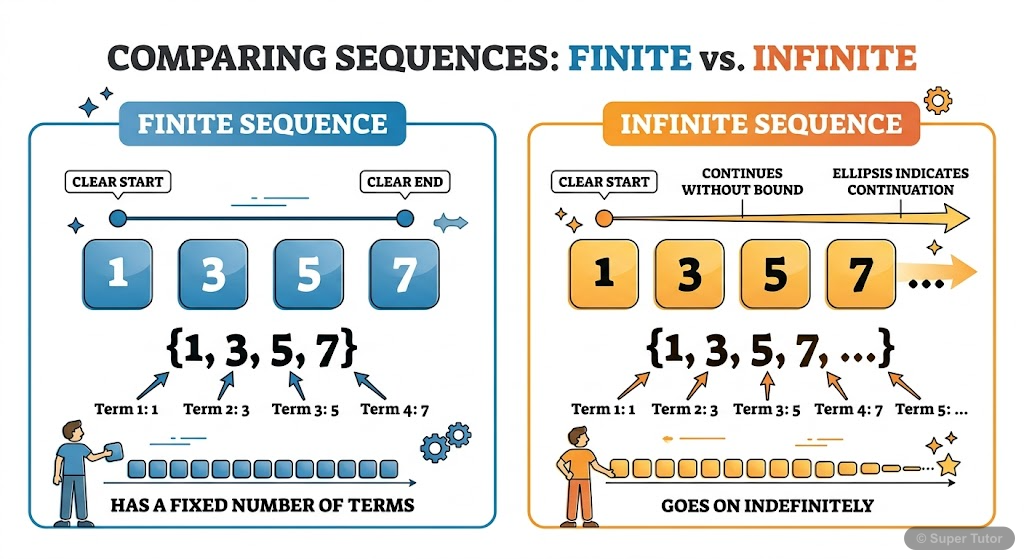
One of 10 illustrations for Sequences and Series in Super Tutor — alongside flashcards, concept maps and practice questions.
A sequence has nth term a_n = n^2. Write the first four terms and the corresponding ordered list.
Answer
Step 1: Put n = 1, 2, 3, 4. Step 2: a_1 = 1^2 = 1 Step 3: a_2 = 2^2 = 4 Step 4: a_3 = 3^2 = 9 Step 5: a_4 = 4^2 = 16 Answer: The sequence is 1, 4, 9, 16, ...
Show that the sequence 2, 4, 6, 8, ... is a progression and find its nth term.
Answer
Step 1: Check whether an explicit formula exists. Step 2: The terms are even natural numbers. Step 3: The nth term is a_n = 2n. Answer: It is a progression because the terms can be written by an expli…
Why is 2, 3, 5, 7, 11, ... a sequence but not a progression?
Answer
A progression needs an explicit formula for the nth term. The prime-number sequence is an ordered list, so it is a sequence. A known explicit formula for the nth prime number is not available here, so…
Write the first five terms of the sequence with nth term a_n = (n - 3)/4.
Answer
Step 1: Substitute n = 1, 2, 3, 4, 5. Step 2: a_1 = (1 - 3)/4 = -1/2 Step 3: a_2 = (2 - 3)/4 = -1/4 Step 4: a_3 = (3 - 3)/4 = 0 Step 5: a_4 = (4 - 3)/4 = 1/4 Step 6: a_5 = (5 - 3)/4 = 1/2 Answer: -1/2…
Find the 20th term of the sequence a_n = (n - 1)(2 - n)(3 + n).
Answer
Step 1: Put n = 20. Step 2: a_20 = (20 - 1)(2 - 20)(3 + 20) Step 3: a_20 = 19 × (-18) × 23 Step 4: 19 × 18 = 342, and 342 × 23 = 7866 Step 5: Sign is negative. Answer: a_20 = -7866…
A sequence starts with a_1 = 1 and a_n = a_(n-1) + 2 for n >= 2. Find the first five terms.
Answer
Step 1: a_1 = 1 Step 2: a_2 = a_1 + 2 = 3 Step 3: a_3 = a_2 + 2 = 5 Step 4: a_4 = 7 Step 5: a_5 = 9 Answer: 1, 3, 5, 7, 9…
What is the recursive rule of the Fibonacci sequence?
Answer
The sequence starts with a_1 = 1 and a_2 = 1. For n >= 3, a_n = a_(n-1) + a_(n-2). Example: 1, 1, 2, 3, 5, 8, ...
Find the first six terms of the Fibonacci sequence.
Answer
Step 1: a_1 = 1, a_2 = 1 Step 2: a_3 = 1 + 1 = 2 Step 3: a_4 = 2 + 1 = 3 Step 4: a_5 = 3 + 2 = 5 Step 5: a_6 = 5 + 3 = 8 Answer: 1, 1, 2, 3, 5, 8…
+27 more flashcards
Practise AllFrequently Asked Questions
What are the important topics in Sequences and Series for ICSE Class 11 Mathematics?
How many flashcards are available for Sequences and Series?
How should I revise Sequences and Series for Class 11 exams?
Sources & Official References
Content is aligned to the official syllabus. Refer to the board website for the latest curriculum.
More resources for Sequences and Series
Practice Quiz
Test yourself with a quick quiz
Important Questions
Exam-style questions with answers
Revision Notes
Key points for last-minute revision
Formula Sheet
The chapter's formulas in one place
Chapter Summary
Understand the chapter at a glance
Concept Maps
See how topics connect
Study Plan
Step-by-step plan for this chapter
Syllabus
What topics to cover
For serious students
Get the full Sequences and Series chapter — start free.
Quizzes, flashcards, an AI doubt solver and a study plan for ICSE Class 11 Mathematics. Free to start, no card needed.