Relations and Functions — Flashcards
ICSE · Class 11 · Mathematics
32 flashcards for Relations and Functions (ICSE Class 11 Mathematics) to test yourself on key terms and facts. Covers Graphical Test and Revision Triggers.
Interactive on Super Tutor
Studying Relations and Functions? Get the full interactive chapter.
Quizzes, flashcards, AI doubt-solver and a step-by-step study plan — built for flashcards and more.
Free trial, no card needed.
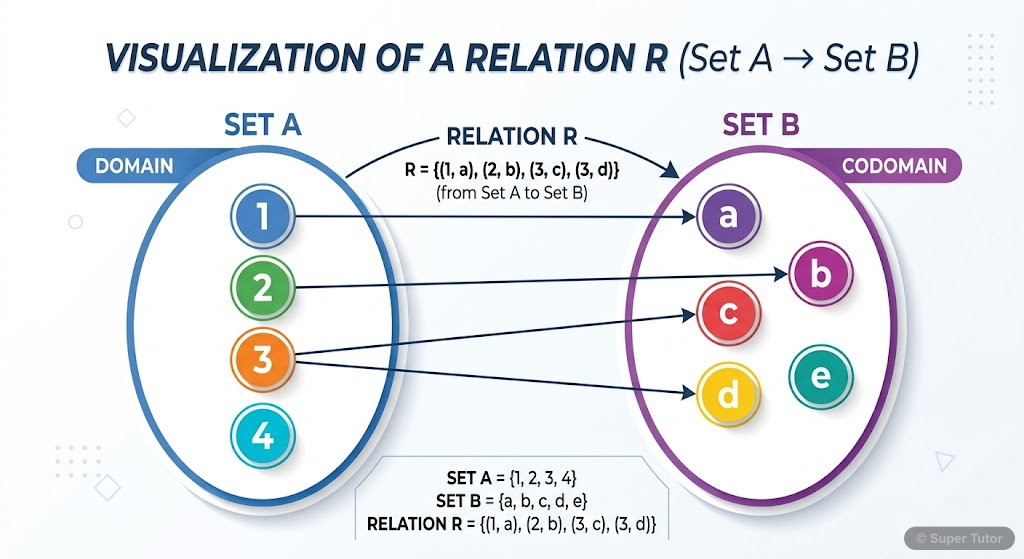
Learn better with visuals Super Tutor pairs illustrations like this with notes and quizzes for Relations and Functions.
Find A × B when A = {1, 2} and B = {a, b}.
Answer
Step 1: Use the Cartesian product rule: A × B = {(x, y): x ∈ A and y ∈ B}. Step 2: Pair each element of A with each element of B. A × B = {(1, a), (1, b), (2, a), (2, b)}. Answer: {(1, a), (1, b), (2,…
Find B × A when A = {1, 2} and B = {a, b}.
Answer
Step 1: Switch the order of the sets. Step 2: Form ordered pairs with first element from B and second element from A. B × A = {(a, 1), (a, 2), (b, 1), (b, 2)}. Step 3: Compare with A × B. A × B ≠ B × …
If n(A) = 3 and n(B) = 4, find n(A × B).
Answer
Step 1: Use the formula n(A × B) = pq. Here, p = 3 and q = 4. Step 2: Multiply. n(A × B) = 3 × 4 = 12. Answer: 12…
If A = {a, b, c} and B = {x, y}, how many ordered pairs are in A × B?
Answer
Step 1: Count elements in each set. n(A) = 3, n(B) = 2. Step 2: Use n(A × B) = pq. n(A × B) = 3 × 2 = 6. Step 3: The pairs are (a, x), (a, y), (b, x), (b, y), (c, x), (c, y). Answer: 6 ordered pairs…
Find A × (B ∩ C) when A = {1, 2, 3}, B = {3, 4}, and C = {4, 5, 6}.
Answer
Step 1: Find the intersection. B ∩ C = {4}. Step 2: Form the Cartesian product with A. A × (B ∩ C) = A × {4}. Step 3: Write all ordered pairs. A × (B ∩ C) = {(1, 4), (2, 4), (3, 4)}. Answer: {(1, 4), …
Show that A × (B ∪ C) = (A × B) ∪ (A × C) using A = {1, 2, 3}, B = {3, 4}, C = {4, 5, 6}.
Answer
Step 1: Find the union. B ∪ C = {3, 4, 5, 6}. Step 2: Form A × (B ∪ C). A × (B ∪ C) = {(1, 3), (1, 4), (1, 5), (1, 6), (2, 3), (2, 4), (2, 5), (2, 6), (3, 3), (3, 4), (3, 5), (3, 6)}. Step 3: Form A ×…
Is R = {(1, a), (2, c)} a function from A = {1, 2, 3} to B = {a, b, c}?
Answer
Step 1: Check whether every element of A has exactly one image. Step 2: Element 1 has one image and element 2 has one image. Step 3: Element 3 has no image. A function must give each element of A exac…
Is R = {(1, a), (1, b), (3, c)} a function from A = {1, 2, 3} to B = {a, b, c}?
Answer
Step 1: Check the images of each element of A. Step 2: Element 1 has two images: a and b. Step 3: A function cannot give more than one image to the same element. Answer: No, it is not a function.
+24 more flashcards
Practise AllFrequently Asked Questions
What are the important topics in Relations and Functions for ICSE Class 11 Mathematics?
How many flashcards are available for Relations and Functions?
How should I revise Relations and Functions for Class 11 exams?
Sources & Official References
Content is aligned to the official syllabus. Refer to the board website for the latest curriculum.
More resources for Relations and Functions
Practice Quiz
Test yourself with a quick quiz
Important Questions
Exam-style questions with answers
Revision Notes
Key points for last-minute revision
Formula Sheet
The chapter's formulas in one place
Chapter Summary
Understand the chapter at a glance
Concept Maps
See how topics connect
Study Plan
Step-by-step plan for this chapter
Syllabus
What topics to cover
For serious students
Get the full Relations and Functions chapter — start free.
Quizzes, flashcards, an AI doubt solver and a study plan for ICSE Class 11 Mathematics. Free to start, no card needed.