Work, Energy and Power — Concept Maps
ICSE · Class 11 · Physics
4 concept maps of Work, Energy and Power for ICSE Class 11 Physics, each also written out as a text outline. Part of the ICSE Class 11 Physics syllabus.
Interactive on Super Tutor
Studying Work, Energy and Power? Get the full interactive chapter.
Quizzes, flashcards, AI doubt-solver and a step-by-step study plan — built for concept maps and more.
Free trial, no card needed.
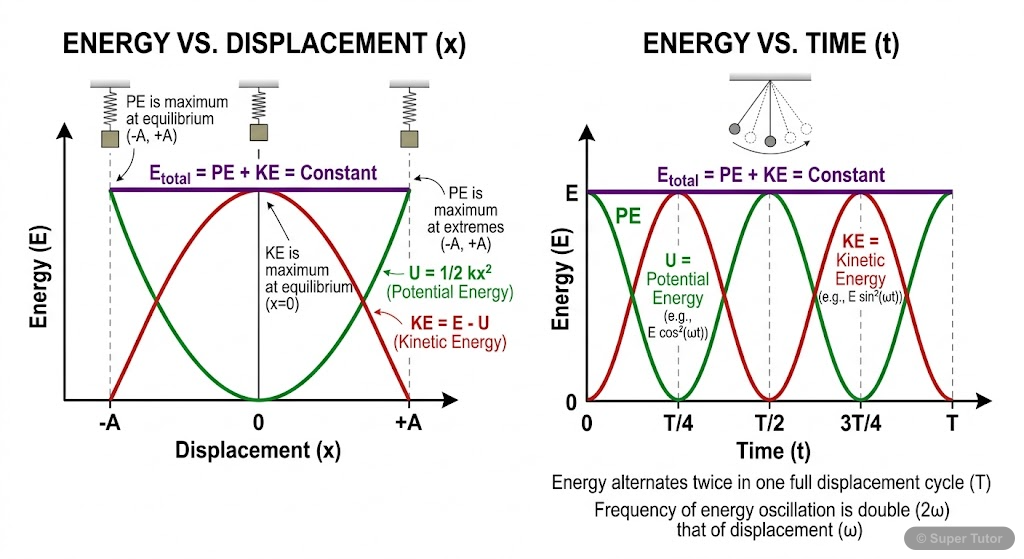
Learn better with visuals Super Tutor pairs illustrations like this with notes and quizzes for Work, Energy and Power.
Work, Energy and Power - Concept Hierarchy
The map in words
- Work Energy Power
- Work
- Constant Force
- W = F·s·cos θ
- Positive Work
- Negative Work
- Zero Work
- Variable Force
- Integration Method
- Graphical Method
- Spring Examples
- Conservative Forces
- Path Independent
- Gravity
- Elastic Force
- Non-Conservative
- Path Dependent
- Friction
- Air Resistance
- Constant Force
- Energy
- Kinetic Energy
- K = ½mv²
- Motion Based
- Velocity Dependent
- Potential Energy
- Gravitational PE
- U = mgh
- Elastic PE
- U = ½kx²
- Position Based
- Gravitational PE
- Conservation
- Mechanical Energy
- K + U = constant
- Energy Transformation
- Kinetic Energy
- Power
- Definition
- Rate of Work
- P = W/t
- P = F·v
- Units
- W
- Joule/second
- Horsepower
- Applications
- Motors
- Lifting
- Vehicles
- Definition
- Collisions
- Elastic
- e = 1
- KE conserved
- Momentum conserved
- Inelastic
- 0 < e < 1
- KE lost
- Momentum conserved
- Perfectly Inelastic
- e = 0
- Objects stick
- Maximum KE loss
- Elastic
- Work
Work, Energy and Power - Complete Concept Map
The map in words
- Work, Energy and Power
- Work
- Constant Force
- W equals F dot s
- Units Joules
- Variable Force
- Integration Method
- Area under F-x curve
- Positive Negative Zero
- Force direction
- Displacement direction
- Constant Force
- Energy
- Kinetic Energy
- K equals half mv squared
- Depends on velocity
- Work-Energy Theorem
- Potential Energy
- Gravitational PE
- U equals mgh
- Elastic PE
- U equals half kx squared
- Springs and Deformation
- Gravitational PE
- Conservation
- Mechanical Energy
- E equals K plus U
- Conservative Fields
- Total Energy
- Includes Heat and Internal
- Non-conservative Losses
- Mechanical Energy
- Kinetic Energy
- Forces
- Conservative Forces
- Gravity Electrostatic Springs
- Path Independent Work
- PE can be Defined
- Non-conservative Forces
- Friction Air Resistance
- Path Dependent Work
- Energy Dissipation
- Conservative Forces
- Power
- Definition
- P equals W divided by t
- Rate of Energy Transfer
- Formula
- P equals F dot v
- Watts Units
- Applications
- Motor Rating
- Appliance Power
- Athlete Capability
- Definition
- Collisions
- Elastic Collisions
- e equals 1
- Both K and p conserved
- Momentum Exchanged
- Inelastic Collisions
- 0 less than e less than 1
- Only p conserved
- Energy Lost to Heat
- Perfectly Inelastic
- e equals 0
- Bodies Stick Together
- Maximum Energy Loss
- Coefficient of Restitution
- e formula
- Elasticity Measure
- Velocity Relationships
- Elastic Collisions
- Work
Work, Energy, and Power - Concept Map
The map in words
- Work Energy Power
- Work
- Constant Force
- W = F·s·cos(θ)
- Positive Work
- Negative Work
- Zero Work
- Variable Force
- Integration method
- Graphical method
- Area under F-x curve
- Conservative Forces
- Gravity
- Spring force
- Path independent
- Non-Conservative Forces
- Friction
- Air resistance
- Path dependent
- Constant Force
- Energy
- Kinetic Energy
- K = 1/2 m·v²
- Related to motion
- Velocity squared dependence
- Potential Energy
- Gravitational PE
- U = m·g·h
- Elastic PE
- U = 1/2 k·x²
- Position dependent
- Gravitational PE
- Mechanical Energy
- E = K + U
- Conservation in conservative fields
- Lost in non-conservative fields
- Kinetic Energy
- Power
- Definition
- P = W/t
- Rate of work
- Instantaneous
- P = F·v·cos(θ)
- Units
- J/s
- Horsepower
- Definition
- Collisions
- Elastic
- Momentum conserved
- KE conserved
- e = 1
- Inelastic
- Momentum conserved
- KE not conserved
- 0 < e < 1
- Perfectly Inelastic
- Objects stick
- Maximum KE loss
- e = 0
- Elastic
- Work
Work, Energy and Power as linked ideas that describe force, motion, stored energy, and the rate of doing work
The map in words
- Work, Energy and Power as linked ideas that describe force, motion, stored energy, and the rate of doing work
- Work
- Energy
- Kinetic Energy
- Potential Energy
- Conservative and Non-conservative Forces
- Power
- Collisions
- Energy Conservation
Explore these maps interactively
Explore DiagramsFrequently Asked Questions
What are the important topics in Work, Energy and Power for ICSE Class 11 Physics?
What do the concept maps for Work, Energy and Power show?
How should I revise Work, Energy and Power for Class 11 exams?
Sources & Official References
Content is aligned to the official syllabus. Refer to the board website for the latest curriculum.
More resources for Work, Energy and Power
Practice Quiz
Test yourself with a quick quiz
Important Questions
Exam-style questions with answers
Revision Notes
Key points for last-minute revision
Formula Sheet
The chapter's formulas in one place
Chapter Summary
Understand the chapter at a glance
Study Plan
Step-by-step plan for this chapter
Flashcards
Quick-fire cards for active recall
Syllabus
What topics to cover
For serious students
Get the full Work, Energy and Power chapter — start free.
Quizzes, flashcards, an AI doubt solver and a study plan for ICSE Class 11 Physics. Free to start, no card needed.