Work, Energy and Power — Practice Quiz
ICSE · Class 11 · Physics
Try a 4-question quiz on Work, Energy and Power for ICSE Class 11 Physics: tap an answer to check it and see why. 44 questions in the full chapter test.
Interactive on Super Tutor
Studying Work, Energy and Power? Get the full interactive chapter.
Quizzes, flashcards, AI doubt-solver and a step-by-step study plan — built for practice quiz and more.
Free trial, no card needed.
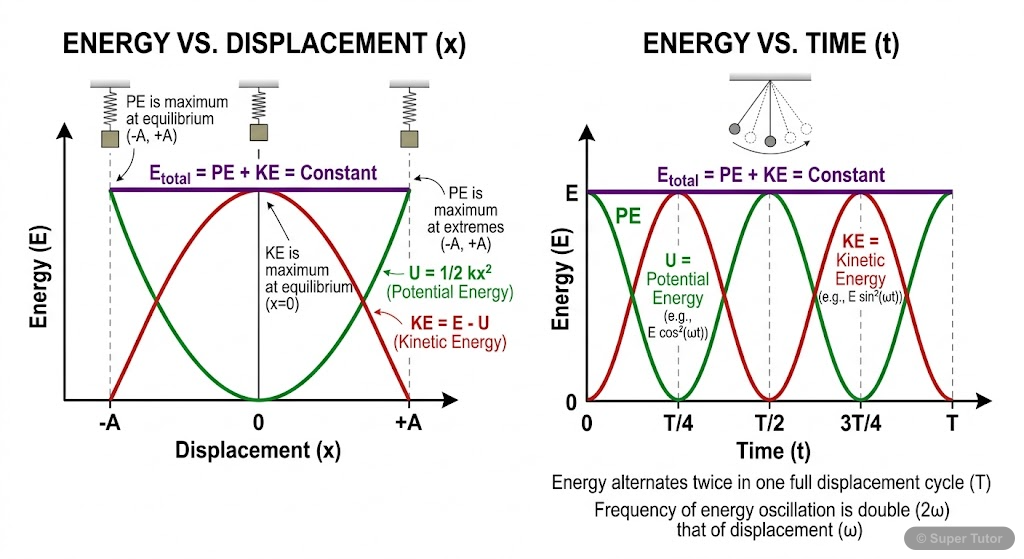
Learn better with visuals Super Tutor pairs illustrations like this with notes and quizzes for Work, Energy and Power.
Quick Quiz: Work, Energy and Power
0/4Tap an answer to check it instantly. No sign-up needed for these 4.
A force F = (3x² + 2x) N acts on a particle along the x-axis. What is the work done by the force as the particle moves from x = 1 m to x = 3 m?
Two bodies A and B of masses m and 3m respectively have the same kinetic energy. They are brought to rest by applying the same retarding force. The ratio of distances covered by A to B before coming to rest is:
A particle moves along the x-axis under a potential energy U(x) = (x² – 4x) J, where x is in metres. At which position is the particle in stable equilibrium and what is the minimum potential energy?
A ball of mass 0.5 kg is dropped from a height of 5 m on a floor. The coefficient of restitution is 0.8. What is the height attained by the ball after the second bounce? (Take g = 10 m/s²)
Sample Questions
In a head-on elastic collision, a body of mass m₁ = 1 kg moving at 6 m/s collides with a stationary body of mass m₂ = 3 kg. What fraction of the initial kinetic energy is transferred to the second body?
Show answer
3/4
Step 1: Use the formula for fraction of KE transferred in elastic collision (u₂ = 0): KE_transferred/KE_initial = 4m₁m₂/(m₁+m₂)². Step 2: Here m₁ = 1 kg, m₂ = 3 kg. Substituting: = 4(1)(3)/(1+3)² = 12/16 = 3/4. Step 3: Verify using velocities: v₂ = 2m₁u₁/(m₁+m₂) = 2(1)(6)/4 = 3 m/s. KE transferred = (1/2)(3)(3²) = 13.5 J. Initial KE = (1/2)(1)(6²) = 18 J. Fraction = 13.5/18 = 3/4 ✓. Step 4: Also, v₁ = (m₁–m₂)/(m₁+m₂)×u₁ = (1–3)/4 × 6 = –3 m/s (rebounds). KE retained = (1/2)(1)(9) = 4.5 J = 1/4 of initial KE. Step 5: Maximum KE transfer occurs when m₁ = m₂ (fraction = 1, i.e., 100% transfer).
The potential energy of a spring-mass system at maximum displacement x₀ is 8 J. When the displacement is x₀/2, the kinetic energy of the system is:
Show answer
6 J
Step 1: At maximum displacement x₀, velocity = 0, so all energy is potential: PE_max = (1/2)kx₀² = 8 J → Total mechanical energy E = 8 J. Step 2: At displacement x = x₀/2, PE = (1/2)k(x₀/2)² = (1/2)k(x₀²/4) = (1/4)×(1/2)kx₀² = (1/4) × 8 = 2 J. Step 3: By conservation of mechanical energy: KE + PE = E (total) → KE = E – PE = 8 – 2 = 6 J. Step 4: Common error: students often think KE = E/2 = 4 J (confusing with mean position where x = 0). At mean position KE = 8 J (maximum). Step 5: Note that PE is proportional to x², so halving the displacement reduces PE to 1/4th of its maximum, not 1/2.
An engine of power 9 kW pulls a train of mass 10,000 kg on a level track at a uniform speed. If the coefficient of friction is 0.02, what is the speed of the train? (Take g = 10 m/s²)
Show answer
4.5 m/s
Step 1: At uniform speed, the driving force equals the frictional (retarding) force. Step 2: Frictional force F = μ × mg = 0.02 × 10,000 × 10 = 2000 N. Step 3: Power P = F × v → v = P/F. Step 4: v = 9000/2000 = 4.5 m/s. Step 5: Common error: using P = mv²/2 (which gives KE, not power at constant speed). At uniform speed, power = Force × velocity, and the only force to overcome is friction on a level track. If the track were inclined, we would also include the component of gravity along the incline.
A bullet of mass 20 g moving at 500 m/s strikes a wooden block of mass 980 g at rest and gets embedded in it. What percentage of the initial kinetic energy is lost in the collision?
Show answer
98%
Step 1: This is a perfectly inelastic collision. m₁ = 0.02 kg, u₁ = 500 m/s, m₂ = 0.98 kg, u₂ = 0. Step 2: Common velocity after collision: v = m₁u₁/(m₁+m₂) = (0.02×500)/(0.02+0.98) = 10/1 = 10 m/s. Step 3: Initial KE = (1/2)(0.02)(500²) = (1/2)(0.02)(250000) = 2500 J. Step 4: Final KE = (1/2)(1)(10²) = 50 J. Loss = 2500 – 50 = 2450 J. Percentage loss = (2450/2500) × 100 = 98%. Step 5: Alternatively, use the formula: KE_loss/KE_initial = m₂/(m₁+m₂) = 0.98/1.00 = 0.98 = 98% (valid when m₂ is initially at rest). This shows that when a very light body embeds in a very heavy body, almost all kinet
+40 more questions on Work, Energy and Power (ICSE Class 11 Physics)
Practise AllFrequently Asked Questions
What are the important topics in Work, Energy and Power for ICSE Class 11 Physics?
How many practice questions are there for Work, Energy and Power?
Sources & Official References
Content is aligned to the official syllabus. Refer to the board website for the latest curriculum.
More resources for Work, Energy and Power
Important Questions
Exam-style questions with answers
Revision Notes
Key points for last-minute revision
Formula Sheet
The chapter's formulas in one place
Chapter Summary
Understand the chapter at a glance
Concept Maps
See how topics connect
Study Plan
Step-by-step plan for this chapter
Flashcards
Quick-fire cards for active recall
Syllabus
What topics to cover
For serious students
Get the full Work, Energy and Power chapter — start free.
Quizzes, flashcards, an AI doubt solver and a study plan for ICSE Class 11 Physics. Free to start, no card needed.