Heat Engine : Second Law of Thermodynamics — Concept Maps
ICSE · Class 11 · Physics
4 concept maps of Heat Engine : Second Law of Thermodynamics for ICSE Class 11 Physics, each also written out as a text outline.
Interactive on Super Tutor
Studying Heat Engine : Second Law of Thermodynamics? Get the full interactive chapter.
Quizzes, flashcards, AI doubt-solver and a step-by-step study plan — built for concept maps and more.
Free trial, no card needed.
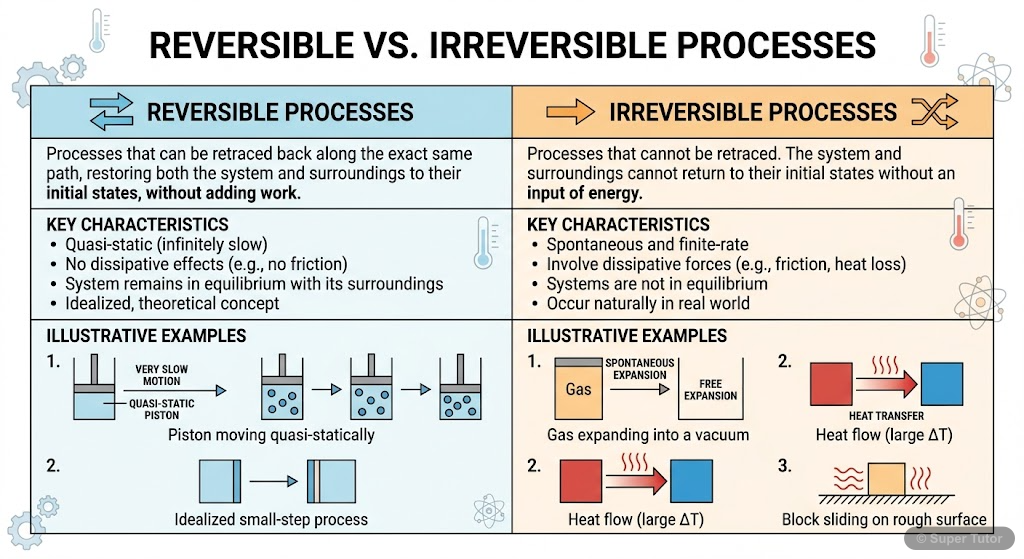
One of 3 illustrations for Heat Engine : Second Law of Thermodynamics in Super Tutor — alongside flashcards, concept maps and practice questions.
Chapter Overview: Second Law of Thermodynamics
The map in words
- Second Law of Thermodynamics
- Limitations of First Law
- No direction of heat flow
- No conversion conditions
- No distinction heat vs work
- Two Statements
- Kelvin-Planck
- Engine cannot convert all heat to work
- Sink is necessary
- Clausius
- No self-acting transfer cold to hot
- External work needed
- Both are Equivalent
- Kelvin-Planck
- Reversible vs Irreversible
- Reversible Process
- No dissipative forces
- Quasi-static
- Ideal concept only
- Irreversible Process
- All real processes
- Friction diffusion conduction
- Reversible Process
- Heat Engine
- Three Parts
- Source at T1
- Working Substance
- Sink at T2
- Efficiency
- eta = W divided by Q1
- eta = 1 minus Q2 divided by Q1
- Always less than 100 percent
- Three Parts
- Carnot Engine
- Four Processes
- AB Isothermal expansion at T1
- BC Adiabatic expansion
- CD Isothermal compression at T2
- DA Adiabatic compression
- Efficiency Formula
- eta = 1 minus T2 divided by T1
- Depends only on temperatures
- Maximum possible efficiency
- Carnots Theorem
- No engine more efficient than reversible engine
- Four Processes
- Carnot Refrigerator
- Heat Pump reverse engine
- COP K = Q2 divided by W
- K = T2 divided by T1 minus T2
- K always greater than 1
- Relation eta = 1 divided by 1 plus K
- Limitations of First Law
Heat Engine and Second Law of Thermodynamics - Concept Hierarchy
The map in words
- Heat Engine and Second Law
- First Law Limitations
- No direction of heat flow
- No conditions for conversion
- No information on source type
- Equivalence only
- Second Law Statements
- Kelvin-Planck Statement
- Cannot convert all heat to work
- Requires heat sink
- Efficiency less than 100 percent
- Clausius Statement
- Heat cannot flow cold to hot
- External work required
- Refrigerators need energy input
- Equivalence
- Both describe same principle
- Violation of one equals violation of other
- Kelvin-Planck Statement
- Heat Engine Fundamentals
- Components
- Source at T1
- Working substance
- Sink at T2
- Cycle Process
- Takes heat Q1
- Produces work W
- Rejects heat Q2
- Efficiency
- Definition eta equals W over Q1
- Formula eta equals 1 minus Q2 over Q1
- Limit less than 100 percent
- Components
- Reversible Processes
- Conditions
- No dissipative forces
- Infinitely slow process
- Reality
- Never achieved in practice
- Ideal conception only
- Contrast
- All real processes irreversible
- Irreversibility is rule
- Conditions
- Carnot Cycle
- Four Processes
- Isothermal Expansion AB
- Adiabatic Expansion BC
- Isothermal Compression CD
- Adiabatic Compression DA
- Relations
- Q1 over Q2 equals T1 over T2
- Efficiency eta equals 1 minus T2 over T1
- Properties
- Maximum efficiency
- Independent of substance
- Theoretical limit only
- Four Processes
- Refrigerator Heat Pump
- Operation
- Reversed Carnot cycle
- External work input needed
- Heat transfer cold to hot
- Performance
- Coefficient K equals Q2 over W
- Formula K equals T2 over T1 minus T2
- Inverse relation to engine efficiency
- Absolute Zero
- Unattainable in practice
- K approaches zero as T2 approaches zero
- Requires infinite work
- Operation
- First Law Limitations
Second Law of Thermodynamics: Concept Hierarchy
The map in words
- Second Law of Thermodynamics
- Statements
- Kelvin-Planck
- Heat engines
- Cannot 100% convert heat
- Clausius
- Refrigerators
- Heat needs work input
- Kelvin-Planck
- Process Types
- Reversible
- No dissipation
- Infinitely slow
- Irreversible
- Natural processes
- Has dissipation
- Reversible
- Heat Engines
- Efficiency formula
- eta = 1 - Q2/Q1
- Carnot Engine
- Maximum efficiency
- eta = 1 - T2/T1
- Efficiency formula
- Refrigerators
- Coefficient of Performance
- K = Q2/W
- Carnot Refrigerator
- K = T2/(T1-T2)
- Coefficient of Performance
- Practical Limits
- Real engines inefficient
- Absolute zero unattainable
- Temperature determines max efficiency
- Statements
Second law of thermodynamics applied to heat engines and refrigerators
The map in words
- Second law of thermodynamics applied to heat engines and refrigerators
- Limitations of the first law
- Second law of thermodynamics
- Kelvin-Planck statement
- Clausius statement
- Reversible process
- Irreversible process
- Heat engine
- Heat engine efficiency
Explore these maps interactively
Explore DiagramsFrequently Asked Questions
What are the important topics in Heat Engine : Second Law of Thermodynamics for ICSE Class 11 Physics?
What do the concept maps for Heat Engine : Second Law of Thermodynamics show?
How should I revise Heat Engine : Second Law of Thermodynamics for Class 11 exams?
Sources & Official References
Content is aligned to the official syllabus. Refer to the board website for the latest curriculum.
More resources for Heat Engine : Second Law of Thermodynamics
Practice Quiz
Test yourself with a quick quiz
Important Questions
Exam-style questions with answers
Revision Notes
Key points for last-minute revision
Formula Sheet
The chapter's formulas in one place
Chapter Summary
Understand the chapter at a glance
Study Plan
Step-by-step plan for this chapter
Flashcards
Quick-fire cards for active recall
Syllabus
What topics to cover
For serious students
Get the full Heat Engine : Second Law of Thermodynamics chapter — start free.
Quizzes, flashcards, an AI doubt solver and a study plan for ICSE Class 11 Physics. Free to start, no card needed.