Chapter 14 of 15
Revision Notes
Ecosystem — Revision Notes
ICSE · Class 12 · Biology
Ecosystem revision notes for ICSE Class 12 Biology: 4 topics in quick points. Part of the ICSE Class 12 Biology syllabus.
60 questions40 flashcards5 concepts
Interactive on Super Tutor
Studying Ecosystem? Get the full interactive chapter.
Quizzes, flashcards, AI doubt-solver and a step-by-step study plan — built for revision notes and more.
Free trial, no card needed.
Super Tutor
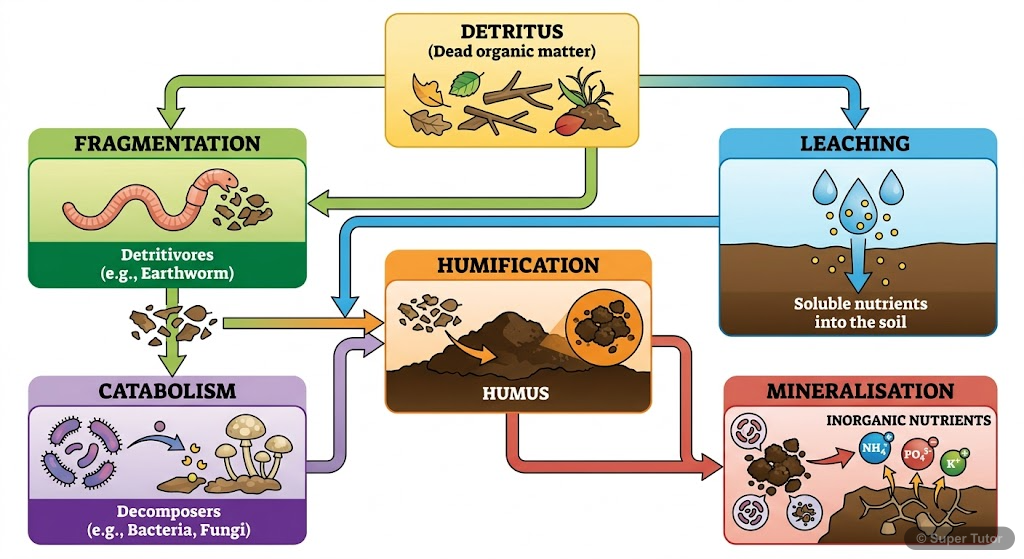
Learn better with visuals Super Tutor pairs illustrations like this with notes and quizzes for Ecosystem.
Key Topics to Revise
1
1. Meaning, Origin, and Types of Ecosystem
- The idea of ecosystem dates back to 1877 when Forbes and Mobius stated that the unit of study of ecology must include the whole tangled mixture of plants and animals and their physical surroundings.
- G. Tansley coined the term ecosystem in 1935 and defined it as the sum total of interaction between living and non-living components capable of independent existence.
- E. P. Odum defined ecosystem in 1962 as the basic functional unit of organisms and their environment, interacting with each other and with their own components.
2
2. Components of Ecosystem
- From the structural viewpoint, ecosystem has two components: biotic and abiotic.
- Biotic components include producers, consumers, and decomposers.
- Producers are green plants and other photosynthetic organisms that prepare food from carbon dioxide and water using sunlight.
3
3. Food Chain, Trophic Levels, and Food Web
- A food chain is the sequence of living organisms in an ecosystem in which one organism consumes another to transfer food energy.
- A food chain begins with producers and ends with the top consumer.
- Grazing food chain starts from living green plants, then herbivores, and then carnivores.
4
4. Standing Crop, Standing State, and Ecological Pyramids
- Standing crop is the amount of living material at different trophic levels or in a component population.
- Standing crop is usually expressed in terms of biomass.
- Standing state is the amount of inorganic matter present in an ecosystem.
Get complete notes with diagrams and examples
Full NotesKey Concepts
An ecosystem is the sum totalBiotic components are the living partsAbiotic components are the nonA food chain is the sequenceA grazing food chain starts
Frequently Asked Questions
What are the important topics in Ecosystem for ICSE Class 12 Biology?
Key topics in Ecosystem include Meaning, Origin, and Types of Ecosystem, Components of Ecosystem, Food Chain, Trophic Levels, and Food Web, Standing Crop, Standing State, and Ecological Pyramids. Study these first, then practise questions on each for the ICSE Class 12 board exam.
How should I revise Ecosystem for the ICSE Class 12 board exam?
Learn the core ideas first, then work through the 60 practice questions on Ecosystem. Revise definitions regularly and use flashcards for quick recall before the exam.
Sources & Official References
Content is aligned to the official syllabus. Refer to the board website for the latest curriculum.
More resources for Ecosystem
For serious students
Get the full Ecosystem chapter — start free.
Quizzes, flashcards, an AI doubt solver and a study plan for ICSE Class 12 Biology. Free to start, no card needed.