Climate — Syllabus
ICSE · Class 12 · Geography
What Climate covers in ICSE Class 12 Geography: 4 topics, for the 2026-27 session. Part of the ICSE Class 12 Geography syllabus.
Interactive on Super Tutor
Studying Climate? Get the full interactive chapter.
Quizzes, flashcards, AI doubt-solver and a step-by-step study plan — built for syllabus and more.
Free trial, no card needed.
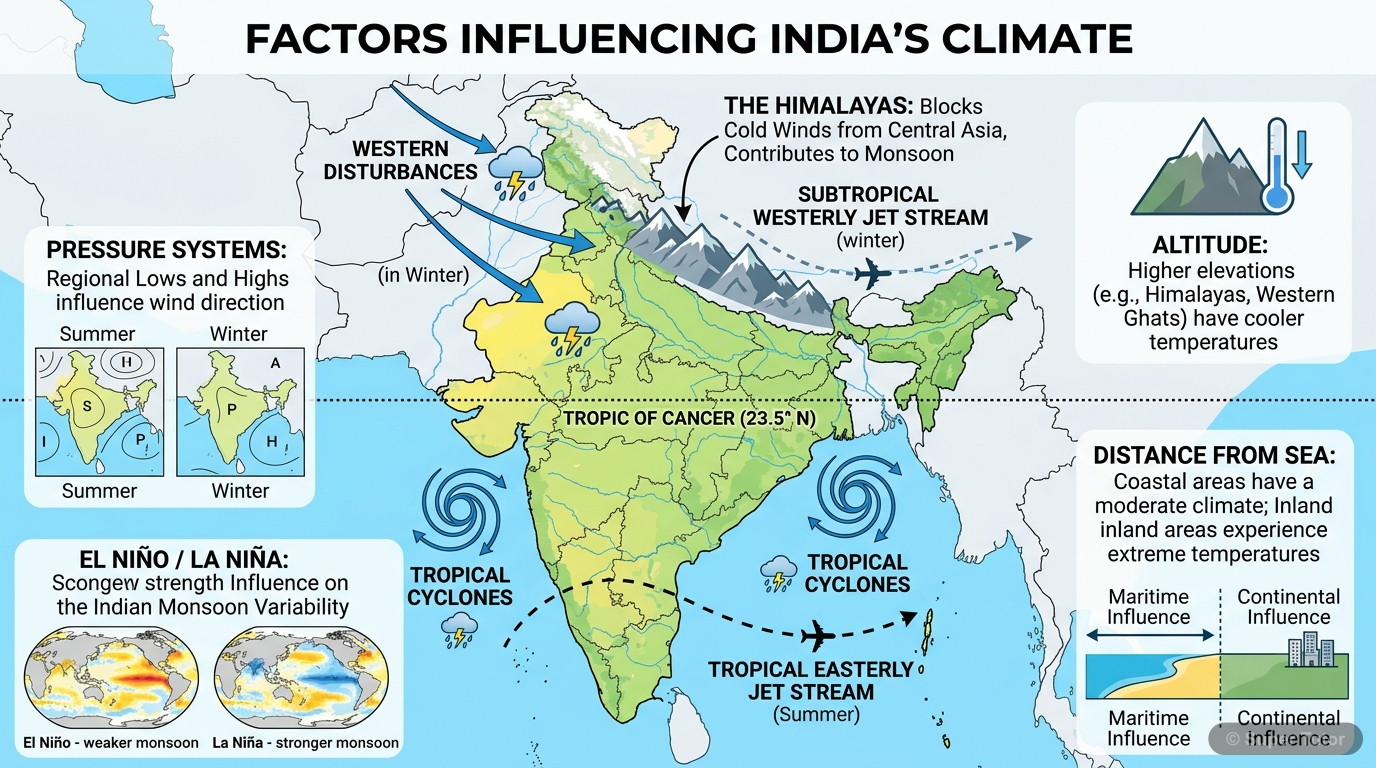
Learn better with visuals Super Tutor pairs illustrations like this with notes and quizzes for Climate.
Topics in Climate
1. Basic idea of monsoon climate
- Monsoon means seasonal reversal of winds during the course of the year.
- India’s climate changes with the season because winds, pressure, rainfall, and temperature all shift together.
- Most rainfall in India comes in the summer season when moist south-west monsoon winds blow from sea to land.
2. Factors affecting India’s weather and climate
- India lies roughly between 6° to 37°N latitudes, and the Tropic of Cancer passes through the middle of the country.
- Southern India is closer to the Equator, so it remains warmer through the year.
- Northern India lies in the warm temperate zone and has colder winters.
3. Theories and mechanism of monsoon
- Sir Edmund Halley explained monsoon as the result of differential heating of land and sea.
- Flohn criticized that view and explained monsoon through seasonal shift of pressure and wind belts.
- The Inter-Tropical Convergence Zone is the zone near the equator where north-east trade winds and south-east trade winds meet.
4. Monsoon onset, advance, break, and retreat
- The south-west monsoon sets in over the Kerala coast by 1 June.
- It reaches Mumbai and Kolkata by 10-13 June.
- It spreads over the entire sub-continent by 15 July.
Key Concepts
Central concept: India's monsoon type of climate and its controlling factors, seasonal rhythm, rainfall pattern, variability, droughts, and floods
Work through every topic in Climate with notes and quizzes
Start This ChapterFrequently Asked Questions
What are the important topics in Climate for ICSE Class 12 Geography?
How should I revise Climate for the ICSE Class 12 board exam?
Sources & Official References
Content is aligned to the official syllabus. Refer to the board website for the latest curriculum.
More resources for Climate
Practice Quiz
Test yourself with a quick quiz
Important Questions
Exam-style questions with answers
Revision Notes
Key points for last-minute revision
Chapter Summary
Understand the chapter at a glance
Concept Maps
See how topics connect
Study Plan
Step-by-step plan for this chapter
Flashcards
Quick-fire cards for active recall
For serious students
Get the full Climate chapter — start free.
Quizzes, flashcards, an AI doubt solver and a study plan for ICSE Class 12 Geography. Free to start, no card needed.