Water — Concept Maps
ICSE · Class 9 · Chemistry
4 concept maps of Water for ICSE Class 9 Chemistry, each also written out as a text outline. Part of the ICSE Class 9 Chemistry syllabus.
Interactive on Super Tutor
Studying Water? Get the full interactive chapter.
Quizzes, flashcards, AI doubt-solver and a step-by-step study plan — built for concept maps and more.
Free trial, no card needed.
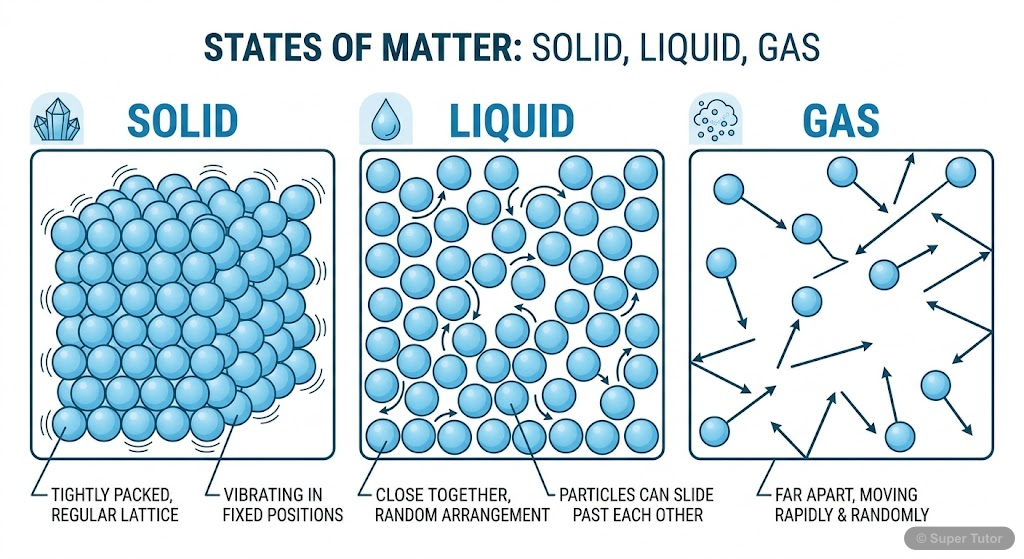
One of 17 illustrations for Water in Super Tutor — alongside flashcards, concept maps and practice questions.
Correct Classification of Water Absorption and Loss Phenomena
The map in words
- Substance Exposed to Air
- Does it gain or lose water?
- Gains Water: How much water absorbed?
- Absorbs moisture stays solid: HYGROSCOPY
- Example: Conc H2SO4 and P2O5
- Absorbs until dissolves completely: DELIQUESCENCE
- Example: NaOH KOH CaCl2 FeCl3
- Absorbs moisture stays solid: HYGROSCOPY
- Loses Water: EFFLORESCENCE
- Example: Na2CO3 10H2O becomes powder
- Gains Water: How much water absorbed?
- Does it gain or lose water?
Chapter Overview: Water — Key Concepts
The map in words
- Water
- Universal Solvent
- Dissolves Solids
- Dissolves Gases
- Dissolves Liquids
- High Dielectric Constant
- Solutions
- Solute plus Solvent
- Saturated
- Unsaturated
- Supersaturated
- Concentration
- Mass Percent
- Volume Percent
- Solubility
- Factors
- Particle Size
- Stirring
- Temperature
- Solubility Curves
- Henrys Law for Gases
- Factors
- Hydrated Substances
- Water of Crystallisation
- Examples
- Blue Vitriol CuSO4 5H2O
- Washing Soda Na2CO3 10H2O
- Gypsum CaSO4 2H2O
- Properties
- Efflorescence
- Loses Water to Dry Air
- eg Washing Soda
- Deliquescence
- Absorbs Water from Air
- eg NaOH CaCl2
- Hygroscopy
- Absorbs Water Vapour
- eg Conc H2SO4
- Efflorescence
- Drying Agents
- Anhydrous CaCl2
- Conc H2SO4
- P2O5
- Hard and Soft Water
- Soft Water
- Forms Lather Easily
- eg Distilled Rain Water
- Hard Water
- Does Not Form Lather
- Temporary Hardness
- Bicarbonates of Ca Mg
- Removed by Boiling
- Removed by Washing Soda
- Permanent Hardness
- Sulphates Chlorides of Ca Mg
- Removed by Washing Soda
- Permutit Process
- Soft Water
- Universal Solvent
Chapter Water — Complete Concept Map
The map in words
- WATER H2O
- Physical Properties
- Boiling Point 100 degrees C
- Freezing Point 0 degrees C
- Max Density at 4 degrees C
- Anomalous Expansion
- Specific Heat 4.2 J per g
- Latent Heat Fusion 80 cal per g
- Latent Heat Vaporization 540 cal per g
- Universal Solvent
- Dissolves Solids
- Dissolves Gases
- Aqueous Solutions
- Dissolved Salts in Tap Water
- Dissolved Air in Water
- Solutions
- Saturated Solution
- Unsaturated Solution
- Supersaturated Solution
- Concentration
- Mass Percent
- Volume Percent
- Solubility
- Henry Law Gases
- Solubility Curves
- KNO3 steep increase
- NaCl slight increase
- CaSO4 decreases
- Hydrated Substances
- Water of Crystallization
- Blue Vitriol CuSO4 5H2O
- Washing Soda Na2CO3 10H2O
- Gypsum CaSO4 2H2O
- Efflorescence Exits water
- Deliquescence Drinks water
- Hygroscopy Holds moisture
- Drying Agents
- CaCl2 anhydrous
- P2O5
- Conc H2SO4
- Dehydrating Agent H2SO4
- Hard and Soft Water
- Soft Water lathers easily
- Hard Water no lather
- Temporary Hardness bicarbonates
- Permanent Hardness sulphates chlorides
- Remove Temporary by Boiling
- Remove by Washing Soda
- Boiler Scale problem
- Soap Scum problem
- Physical Properties
Water as a natural resource, universal solvent, and substance with important physical and chemical behavior
The map in words
- Water as a natural resource, universal solvent, and substance with important physical and chemical behavior
- Water composition and identity
- Water in nature
- Physical properties of water
- Water as a universal solvent
- Solutions
- Solubility
- Air dissolved in water
- Water of crystallization
Explore these maps interactively
Explore DiagramsFrequently Asked Questions
What are the important topics in Water for ICSE Class 9 Chemistry?
What do the concept maps for Water show?
How should I revise Water for Class 9 exams?
Sources & Official References
Content is aligned to the official syllabus. Refer to the board website for the latest curriculum.
More resources for Water
Practice Quiz
Test yourself with a quick quiz
Important Questions
Exam-style questions with answers
Revision Notes
Key points for last-minute revision
Formula Sheet
The chapter's formulas in one place
Chapter Summary
Understand the chapter at a glance
Study Plan
Step-by-step plan for this chapter
Flashcards
Quick-fire cards for active recall
Syllabus
What topics to cover
For serious students
Get the full Water chapter — start free.
Quizzes, flashcards, an AI doubt solver and a study plan for ICSE Class 9 Chemistry. Free to start, no card needed.