Landforms of the Earth — Chapter Summary
ICSE · Class 9 · Geography
Summary of Landforms of the Earth for ICSE Class 9 Geography. Key concepts: Geomorphology is, A mountain is a portion and Orogenesis is the process.
Interactive on Super Tutor
Studying Landforms of the Earth? Get the full interactive chapter.
Quizzes, flashcards, AI doubt-solver and a step-by-step study plan — built for chapter summary and more.
Free trial, no card needed.
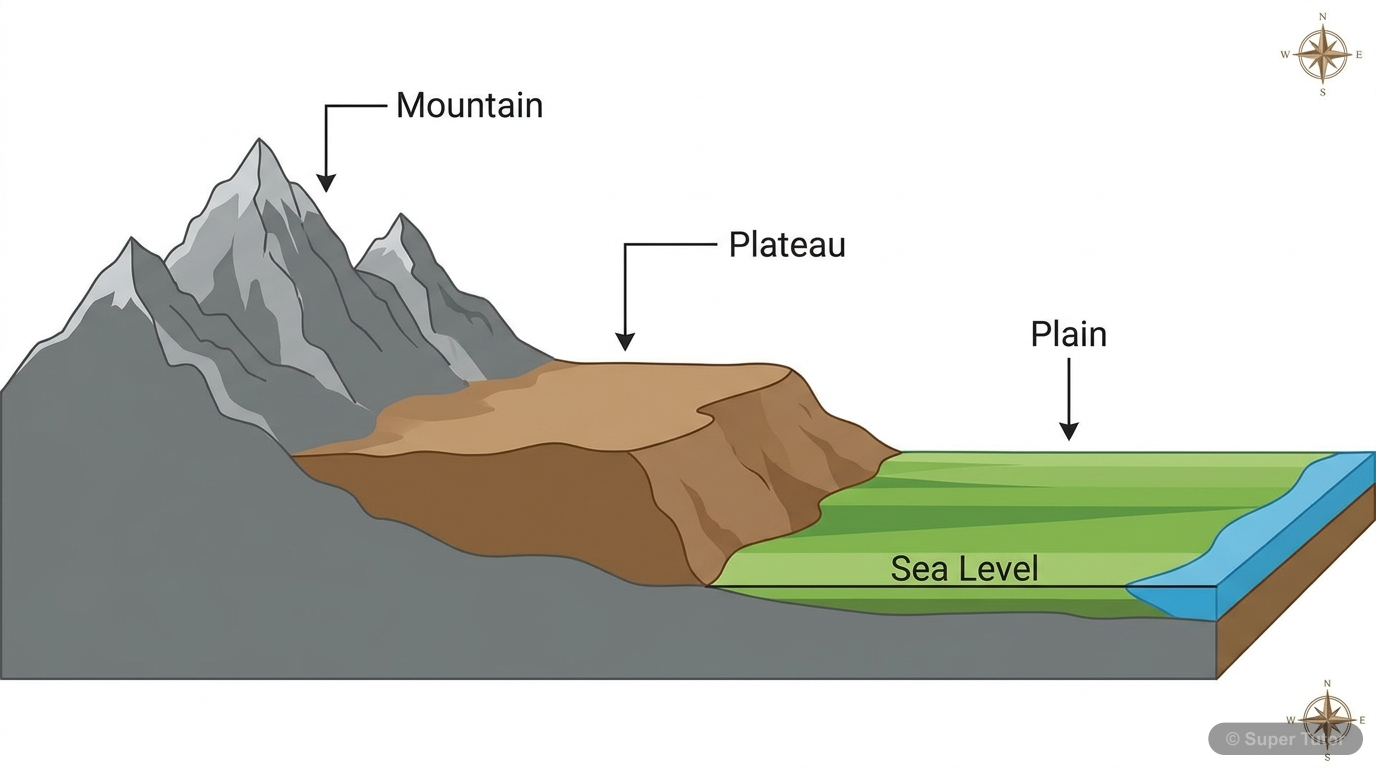
Learn better with visuals Super Tutor pairs illustrations like this with notes and quizzes for Landforms of the Earth.
Overview
Geomorphology is the systematic study of Earth's relief features. Landforms shape climate, settlement, transport, farming, and daily life. Mountains, plateaus, and plains are the major landforms, and each has distinct features, formation processes, and examples.
Key Concepts
Geomorphology is the systematic study
Geomorphology is the systematic study of Earth's relief features, including landforms such as mountains, plateaus, and plains.
A mountain is a portion
A mountain is a portion of land surface rising considerably above the surrounding area, either as a single eminence or in a range or chain. A mountain
Orogenesis is the process or group
Orogenesis is the process or group of processes that collectively produce a mountain system. It is the birth of mountains.
Fold mountains are caused by horizontal
Fold mountains are caused by horizontal crustal movements that wrinkle the Earth's crust like a pushed tablecloth. The upfolds are anticlines and the
Young fold mountains are high
Young fold mountains are high, rugged, and recently folded. Older fold mountains such as Pennines, Appalachians, Cape ranges of South Africa, and the
Learning Objectives
- Define geomorphology, mountains, plateaus, and plains.
- Identify the main types of mountains, plateaus, and plains.
- Explain how fold mountains, block mountains, residual mountains, intermontane plateaus, volcanic plateaus, structural plains, and depositional plains are formed.
- Recognize important examples from India and the world.
- Understand how landforms influence human life, climate, agriculture, and transport.
Frequently Asked Questions
What are the important topics in Landforms of the Earth for ICSE Class 9 Geography?
How should I revise Landforms of the Earth for Class 9 exams?
Sources & Official References
Content is aligned to the official syllabus. Refer to the board website for the latest curriculum.
More resources for Landforms of the Earth
For serious students
Get the full Landforms of the Earth chapter — start free.
Quizzes, flashcards, an AI doubt solver and a study plan for ICSE Class 9 Geography. Free to start, no card needed.