Humidity — Chapter Summary
ICSE · Class 9 · Geography
Summary of Humidity for ICSE Class 9 Geography. Key concepts: Humidity means the amount, Relative humidity is the ratio and Absolute humidity is.
Interactive on Super Tutor
Studying Humidity? Get the full interactive chapter.
Quizzes, flashcards, AI doubt-solver and a step-by-step study plan — built for chapter summary and more.
Free trial, no card needed.
Learn better with visuals Super Tutor pairs illustrations like this with notes and quizzes for Humidity.
Overview
Humidity is the amount of water vapour present in the air at a particular time and place. It changes from place to place and with temperature. Warm air can hold more moisture than cold air, so humidity is usually higher in warm regions and lower in cold dry air. Humidity is closely linked with conde
Key Concepts
Humidity means the amount of water
Humidity means the amount of water vapour present in the air at a particular time and place. Its percentage can vary from zero in cold dry air to as m
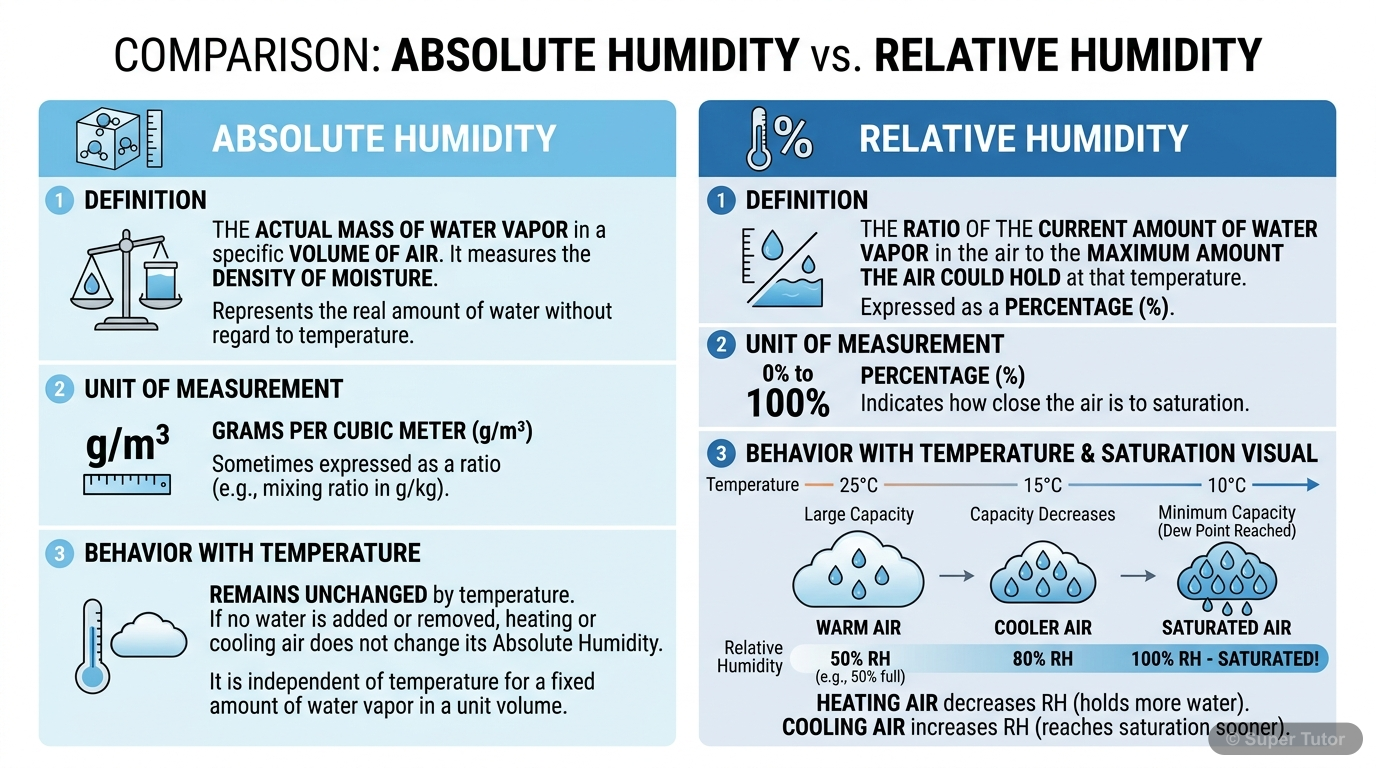
Relative humidity is the ratio between
Relative humidity is the ratio between the actual amount of water vapour present in the air and the maximum amount of water vapour the air can hold at
Absolute humidity is the actual amount
Absolute humidity is the actual amount of water vapour present in a given volume of air, regardless of temperature. It is expressed in grams of moistu
Condensation is the change of invisible
Condensation is the change of invisible water vapour into liquid water or ice. It depends on relative humidity and the rate of cooling. If the air is
Clouds are visible collections of tiny
Clouds are visible collections of tiny water droplets or ice particles in the air above the ground. They exist between sea level and 13,700 metres abo
Learning Objectives
- Understand the meaning of humidity and how it varies in the atmosphere
- Distinguish between relative humidity and absolute humidity
- Explain condensation and its forms such as clouds, dew, frost, fog, and mist
- Describe precipitation and its forms: rain, snow, and hail
- Explain convectional, orographic, and cyclonic rainfall
Frequently Asked Questions
What are the important topics in Humidity for ICSE Class 9 Geography?
How should I revise Humidity for Class 9 exams?
Sources & Official References
Content is aligned to the official syllabus. Refer to the board website for the latest curriculum.
More resources for Humidity
For serious students
Get the full Humidity chapter — start free.
Quizzes, flashcards, an AI doubt solver and a study plan for ICSE Class 9 Geography. Free to start, no card needed.