Rotation and Revolution — Chapter Summary
ICSE · Class 9 · Geography
Summary of Rotation and Revolution for ICSE Class 9 Geography. Part of the ICSE Class 9 Geography syllabus. Rotation and revolution are the two main.
Interactive on Super Tutor
Studying Rotation and Revolution? Get the full interactive chapter.
Quizzes, flashcards, AI doubt-solver and a step-by-step study plan — built for chapter summary and more.
Free trial, no card needed.
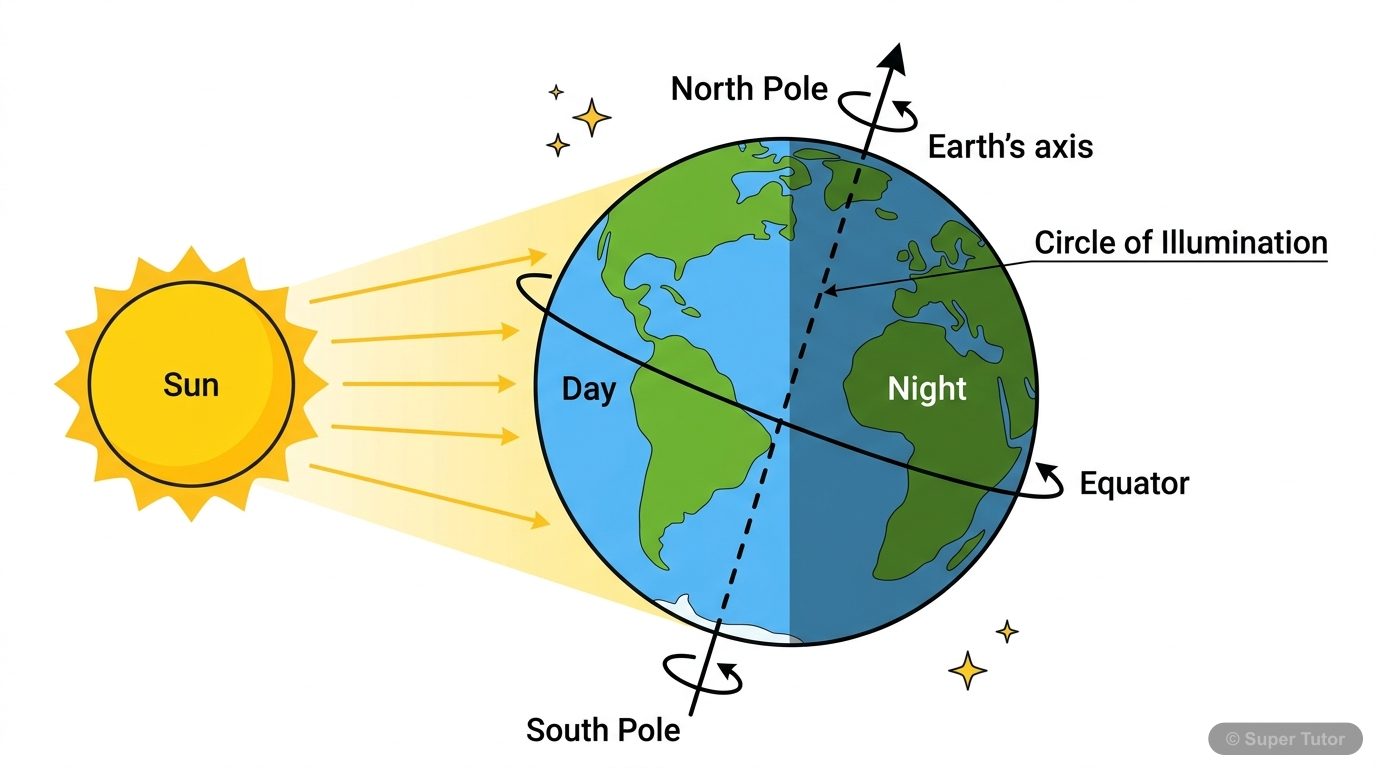
Learn better with visuals Super Tutor pairs illustrations like this with notes and quizzes for Rotation and Revolution.
Overview
Rotation and revolution are the two main movements of the Earth. Rotation is the spinning of the Earth on its axis from west to east once in 24 hours, which causes day and night. Revolution is the movement of the Earth around the Sun in approximately 365 1/4 days, which causes seasons and changes in
Key Concepts
The Earth rotates on its axis
The Earth rotates on its axis from west to east once in 24 hours. This movement causes day and night. The precise period of rotation is the sidereal d
The Earth revolves around the Sun
The Earth revolves around the Sun in approximately 365 1/4 days. This movement, together with the tilt of the axis, causes seasons and changes in day
The Earth’s axis makes an angle
The Earth’s axis makes an angle of 66 1/2 degrees with the plane of the ecliptic and is tilted 23 1/2 degrees from the perpendicular. The axis keeps a
This is the imaginary line
This is the imaginary line that separates the sunlit part of the Earth from the dark part. At equinoxes it passes through the poles and divides the Ea
This apparent force is created due
This apparent force is created due to the Earth’s rotation and deflects moving bodies such as winds and ocean currents to the right in the Northern He
Learning Objectives
- Understand the two main movements of the Earth: rotation and revolution.
- Explain how rotation causes day and night.
- Describe the period of rotation and the sidereal day.
- Recognize the effects of rotation, including the Coriolis effect, centrifugal force, and tides.
- Explain how revolution and the tilt of the Earth’s axis cause seasons.
Frequently Asked Questions
What are the important topics in Rotation and Revolution for ICSE Class 9 Geography?
How should I revise Rotation and Revolution for Class 9 exams?
Sources & Official References
Content is aligned to the official syllabus. Refer to the board website for the latest curriculum.
More resources for Rotation and Revolution
Practice Quiz
Test yourself with a quick quiz
Important Questions
Exam-style questions with answers
Revision Notes
Key points for last-minute revision
Formula Sheet
The chapter's formulas in one place
Concept Maps
See how topics connect
Study Plan
Step-by-step plan for this chapter
Flashcards
Quick-fire cards for active recall
Syllabus
What topics to cover
For serious students
Get the full Rotation and Revolution chapter — start free.
Quizzes, flashcards, an AI doubt solver and a study plan for ICSE Class 9 Geography. Free to start, no card needed.