Rocks and Rock Cycle — Chapter Summary
ICSE · Class 9 · Geography
Summary of Rocks and Rock Cycle for ICSE Class 9 Geography. Part of the ICSE Class 9 Geography syllabus. Rocks form the solid outer part of the Earth.
Interactive on Super Tutor
Studying Rocks and Rock Cycle? Get the full interactive chapter.
Quizzes, flashcards, AI doubt-solver and a step-by-step study plan — built for chapter summary and more.
Free trial, no card needed.
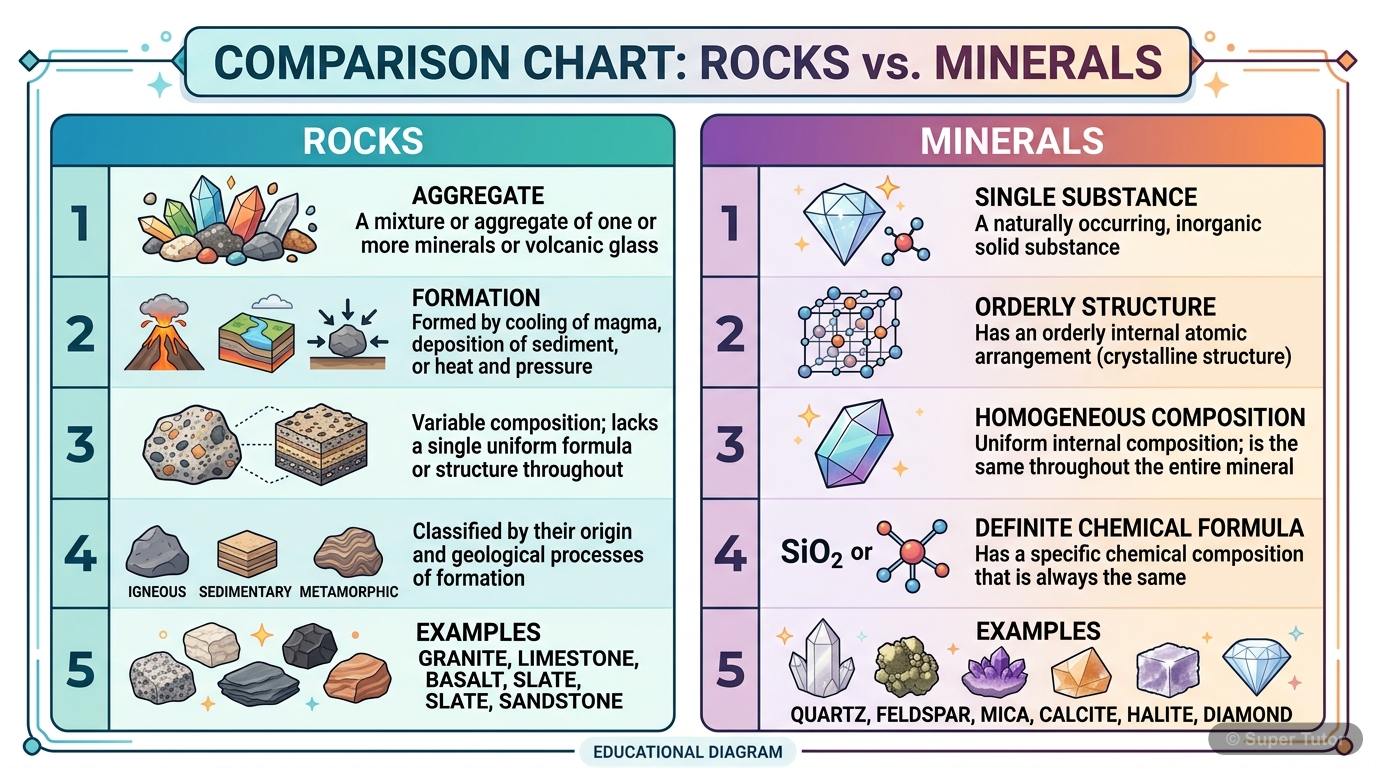
Learn better with visuals Super Tutor pairs illustrations like this with notes and quizzes for Rocks and Rock Cycle.
Overview
Rocks form the solid outer part of the Earth and make up the lithosphere, which is the outer crust on which continents and ocean basins rest. A rock is an aggregate of minerals that forms a more or less definite unit of the Earth's crust. Minerals have a definite chemical composition, are usually cr
Key Concepts
Rocks are mixtures of minerals
Rocks are mixtures of minerals, while minerals are naturally occurring solid inorganic substances with definite chemical composition and crystalline f
Igneous rocks are primary rocks formed
Igneous rocks are primary rocks formed when magma solidifies. Magma is molten rock material consisting of liquid, gas and crystals. Igneous rocks are
These rocks form when magma solidifies
These rocks form when magma solidifies below the Earth's surface, surrounded by pre-existing rock. Plutonic rocks such as granite, gabbro, and batholi
These rocks form when magma solidifies
These rocks form when magma solidifies above the Earth's surface. They include lava flows and volcanic ash. Basalt is a common extrusive rock and is f
Sedimentary rocks form from material derived
Sedimentary rocks form from material derived from pre-existing rocks and organic sources through denudation. The material is deposited in layers or st
Learning Objectives
- Understand the difference between rocks and minerals
- Identify the three main types of rocks
- Explain how igneous, sedimentary, and metamorphic rocks form
- Recognize the main features of different rock types
- Understand the rock cycle as a continuous process of change
Frequently Asked Questions
What are the important topics in Rocks and Rock Cycle for ICSE Class 9 Geography?
How should I revise Rocks and Rock Cycle for Class 9 exams?
Sources & Official References
Content is aligned to the official syllabus. Refer to the board website for the latest curriculum.
More resources for Rocks and Rock Cycle
For serious students
Get the full Rocks and Rock Cycle chapter — start free.
Quizzes, flashcards, an AI doubt solver and a study plan for ICSE Class 9 Geography. Free to start, no card needed.