Tides and Ocean Currents — Chapter Summary
ICSE · Class 9 · Geography
Summary of Tides and Ocean Currents for ICSE Class 9 Geography. Part of the ICSE Class 9 Geography syllabus. Hydrosphere is the mass of water occupying.
Interactive on Super Tutor
Studying Tides and Ocean Currents? Get the full interactive chapter.
Quizzes, flashcards, AI doubt-solver and a step-by-step study plan — built for chapter summary and more.
Free trial, no card needed.
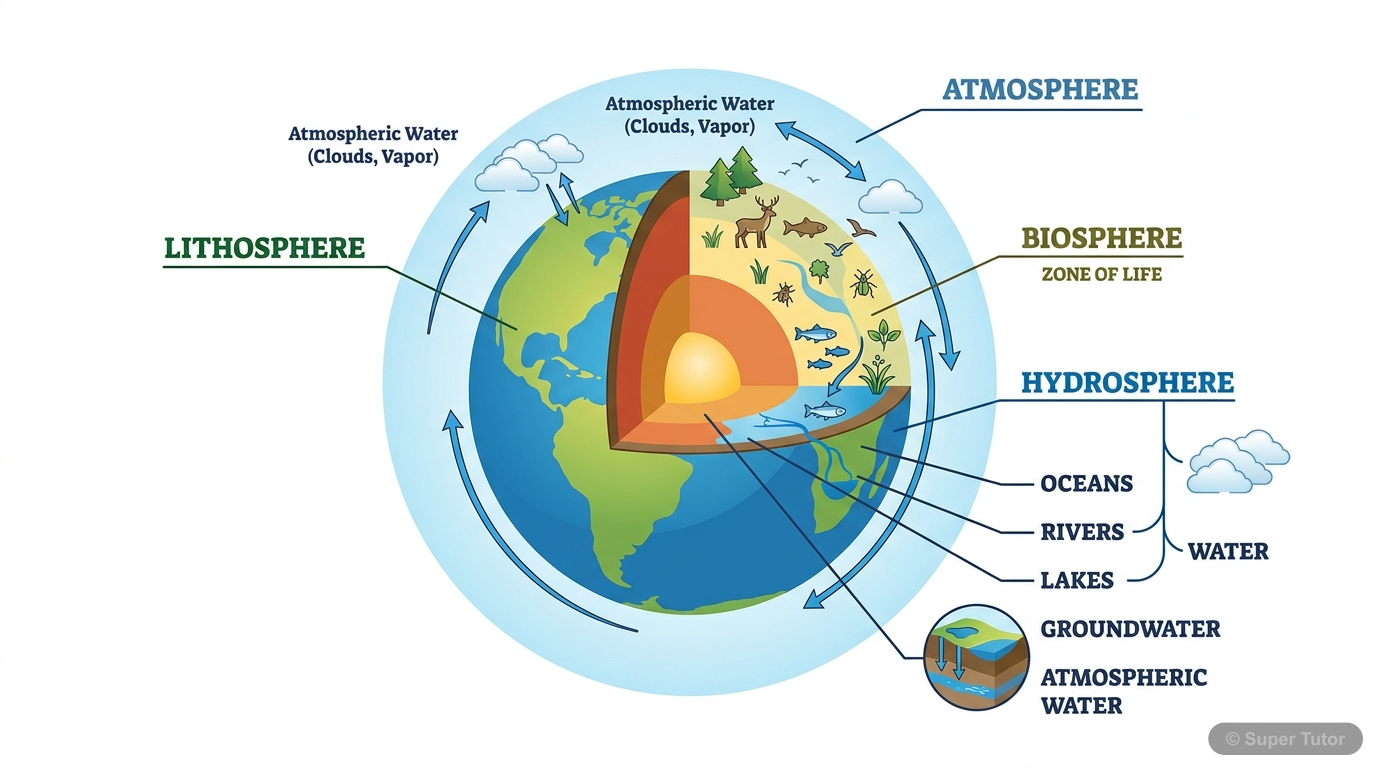
One of 6 illustrations for Tides and Ocean Currents in Super Tutor — alongside flashcards, concept maps and practice questions.
Overview
Hydrosphere is the mass of water occupying the greatest part of the Earth’s surface. Oceans cover about 71% of the Earth’s surface, so water strongly influences climate, weather, and life on land and in the sea. Ocean water moves in two main ways: horizontally as ocean currents and vertically as ris
Key Concepts
Hydrosphere refers to the mass
Hydrosphere refers to the mass of water occupying the greatest part of the Earth’s surface. It includes oceans, rivers, lakes, underground water, and
Ocean currents are the general movement
Ocean currents are the general movement of a mass of ocean water in a definite direction. They are caused by winds, temperature differences, salinity
A gyre is the flow around
A gyre is the flow around the periphery of an ocean basin. It is a circular movement of ocean currents.
The Gulf Stream is the largest
The Gulf Stream is the largest western boundary current of the North Atlantic Ocean. It is a warm current that originates in the Gulf of Mexico around
North Atlantic Drift is the continuation
North Atlantic Drift is the continuation of warm Gulf Stream water toward Western Europe. It moderates the climate of Western Europe and keeps places
Learning Objectives
- Understand the meaning of hydrosphere and the distribution of land and water on Earth.
- Explain how ocean currents are formed and identify the main factors that control them.
- Describe important warm and cold currents such as the Gulf Stream, North Atlantic Drift, Labrador Current, Kuroshio Current, and Oyashio Current.
- Understand how ocean currents affect climate, rainfall, fishing, fog, and navigation.
- Explain the causes, types, timing, and range of tides.
Frequently Asked Questions
What are the important topics in Tides and Ocean Currents for ICSE Class 9 Geography?
How should I revise Tides and Ocean Currents for Class 9 exams?
Sources & Official References
Content is aligned to the official syllabus. Refer to the board website for the latest curriculum.
More resources for Tides and Ocean Currents
For serious students
Get the full Tides and Ocean Currents chapter — start free.
Quizzes, flashcards, an AI doubt solver and a study plan for ICSE Class 9 Geography. Free to start, no card needed.