Weathering and Denudation — Chapter Summary
ICSE · Class 9 · Geography
Summary of Weathering and Denudation for ICSE Class 9 Geography. Part of the ICSE Class 9 Geography syllabus. Weathering is the disintegration.
Interactive on Super Tutor
Studying Weathering and Denudation? Get the full interactive chapter.
Quizzes, flashcards, AI doubt-solver and a step-by-step study plan — built for chapter summary and more.
Free trial, no card needed.
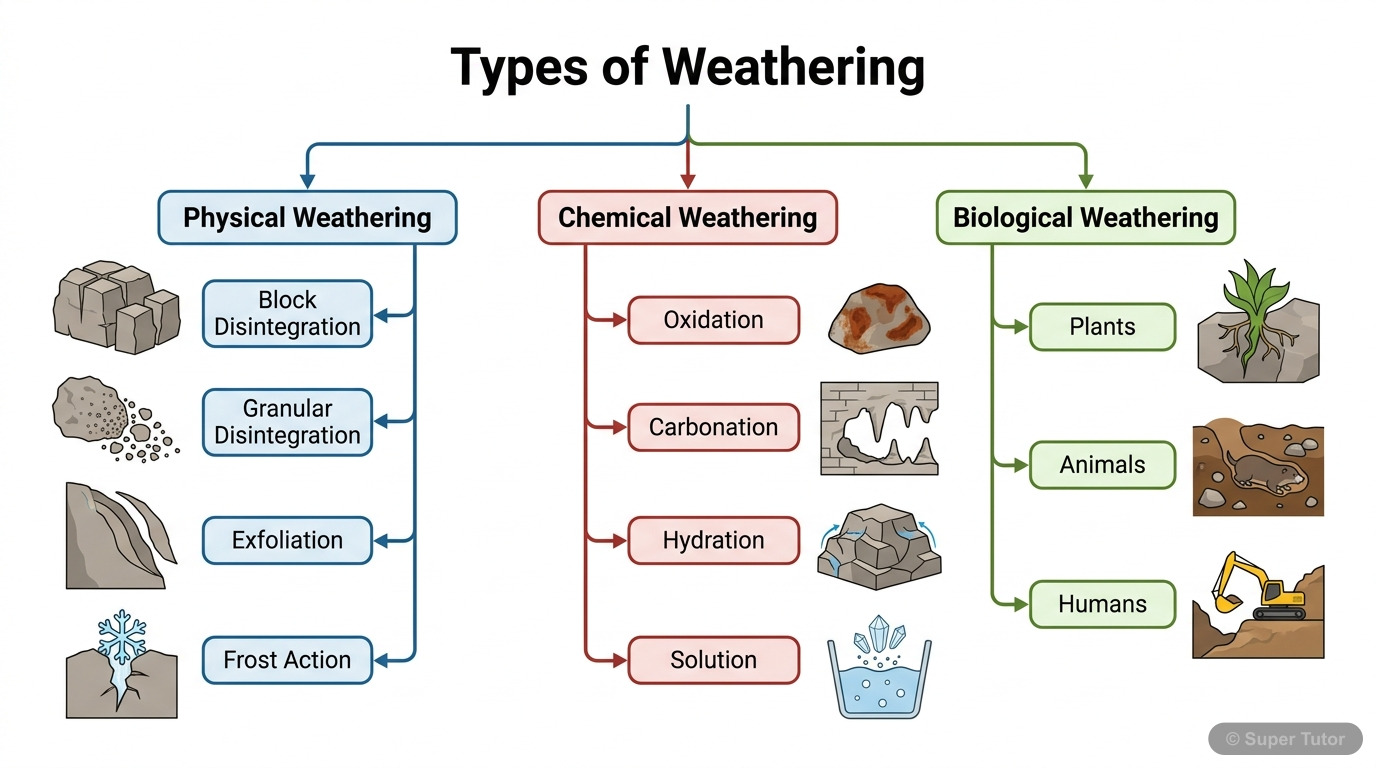
One of 6 illustrations for Weathering and Denudation in Super Tutor — alongside flashcards, concept maps and practice questions.
Overview
Weathering is the disintegration and decomposition of rocks where they exist, so it is a static process. Denudation is the long-term wearing away of the Earth's surface, so it is a dynamic process. Weathering helps in soil formation and can also create new landforms, while denudation works through w
Key Concepts
Weathering is the breaking down
Weathering is the breaking down of rocks where they exist. It does not involve movement of material, so it is a static process. It leads to soil forma
Physical weathering breaks rocks into smaller
Physical weathering breaks rocks into smaller pieces without changing their composition. It is caused by heat, frost, wind, plants, humans and animals
Chemical weathering is the decomposition
Chemical weathering is the decomposition of rocks by chemical action. It is more common in hot and humid regions and is slower than mechanical weather
Biological weathering is caused by plants
Biological weathering is caused by plants, burrowing animals and human activities. Plant roots enter cracks and widen them, and roots may also produce
Denudation means laying base
Denudation means laying base. It is the long-term sum of processes that wear away the Earth's surface and reduce relief and elevation. It is both dest
Learning Objectives
- Understand the meaning of weathering and denudation
- Identify the three types of weathering: physical, chemical and biological
- Explain how rivers and wind act as agents of denudation
- Describe landforms made by rivers in different stages
- Describe landforms made by wind erosion and deposition
Frequently Asked Questions
What are the important topics in Weathering and Denudation for ICSE Class 9 Geography?
How should I revise Weathering and Denudation for Class 9 exams?
Sources & Official References
Content is aligned to the official syllabus. Refer to the board website for the latest curriculum.
More resources for Weathering and Denudation
For serious students
Get the full Weathering and Denudation chapter — start free.
Quizzes, flashcards, an AI doubt solver and a study plan for ICSE Class 9 Geography. Free to start, no card needed.