Volcanoes — Chapter Summary
ICSE · Class 9 · Geography
Summary of Volcanoes for ICSE Class 9 Geography. Key concepts: Volcanicity is the process in, A volcano is a vent and Intrusive forms are created.
Interactive on Super Tutor
Studying Volcanoes? Get the full interactive chapter.
Quizzes, flashcards, AI doubt-solver and a step-by-step study plan — built for chapter summary and more.
Free trial, no card needed.
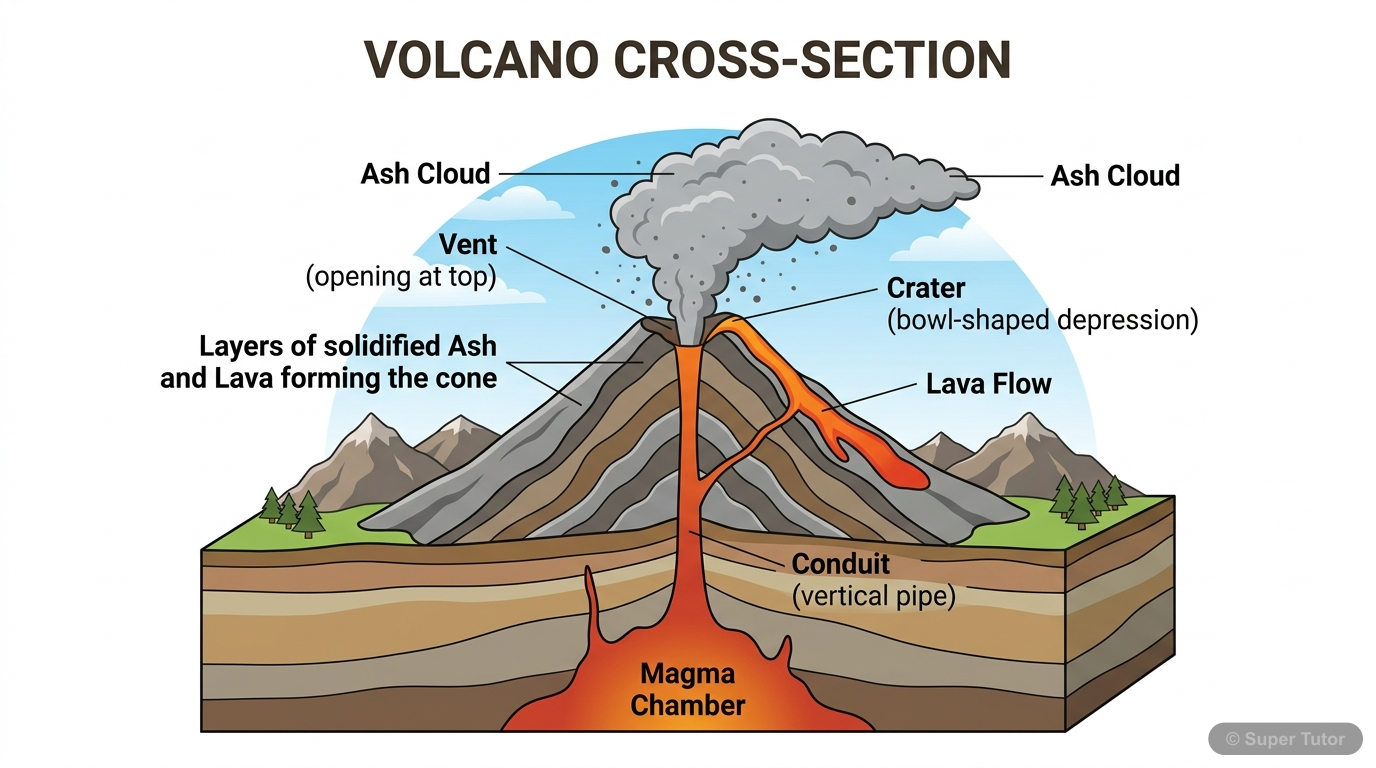
One of 6 illustrations for Volcanoes in Super Tutor — alongside flashcards, concept maps and practice questions.
Overview
Volcanicity is the intrusion of magma into the Earth's crust or the extrusion of molten material on the Earth's surface. A volcano is a vent or opening in the crust of the Earth, connected by a conduit to an underlying magma chamber from which molten lava, volcanic gases and steam are ejected. Volca
Key Concepts
Volcanicity is the process in
Volcanicity is the process in which magma intrudes into the Earth's crust or comes out on the Earth's surface as lava, gases and steam.
A volcano is a vent
A volcano is a vent or opening in the Earth's crust connected to a magma chamber. It is usually cone-shaped or dome-shaped depending on the material e
Intrusive forms are created when lava
Intrusive forms are created when lava solidifies within the Earth's crust. Examples include batholith, laccoliths, sills, dykes, lopoliths and phacoli
Extrusive forms are created when lava
Extrusive forms are created when lava comes out of the crust and solidifies on the surface. Examples include ash and cinder cones, lava dome, lava shi
A batholith is a large
A batholith is a large, coarse-grained igneous landmass that forms the base of mountains after erosion of the upper lying landmass.
Learning Objectives
- Understand the meaning of volcanicity and volcanoes
- Differentiate between intrusive and extrusive volcanic forms
- Classify volcanoes into active, dormant and extinct types
- Identify important volcanic belts of the world
- Explain the causes of volcanism
Frequently Asked Questions
What are the important topics in Volcanoes for ICSE Class 9 Geography?
How should I revise Volcanoes for Class 9 exams?
Sources & Official References
Content is aligned to the official syllabus. Refer to the board website for the latest curriculum.
More resources for Volcanoes
Practice Quiz
Test yourself with a quick quiz
Important Questions
Exam-style questions with answers
Revision Notes
Key points for last-minute revision
Formula Sheet
The chapter's formulas in one place
Concept Maps
See how topics connect
Study Plan
Step-by-step plan for this chapter
Flashcards
Quick-fire cards for active recall
Syllabus
What topics to cover
For serious students
Get the full Volcanoes chapter — start free.
Quizzes, flashcards, an AI doubt solver and a study plan for ICSE Class 9 Geography. Free to start, no card needed.