Natural Regions of the World — Chapter Summary
ICSE · Class 9 · Geography
Summary of Natural Regions of the World for ICSE Class 9 Geography. Part of the ICSE Class 9 Geography syllabus.
Interactive on Super Tutor
Studying Natural Regions of the World? Get the full interactive chapter.
Quizzes, flashcards, AI doubt-solver and a step-by-step study plan — built for chapter summary and more.
Free trial, no card needed.
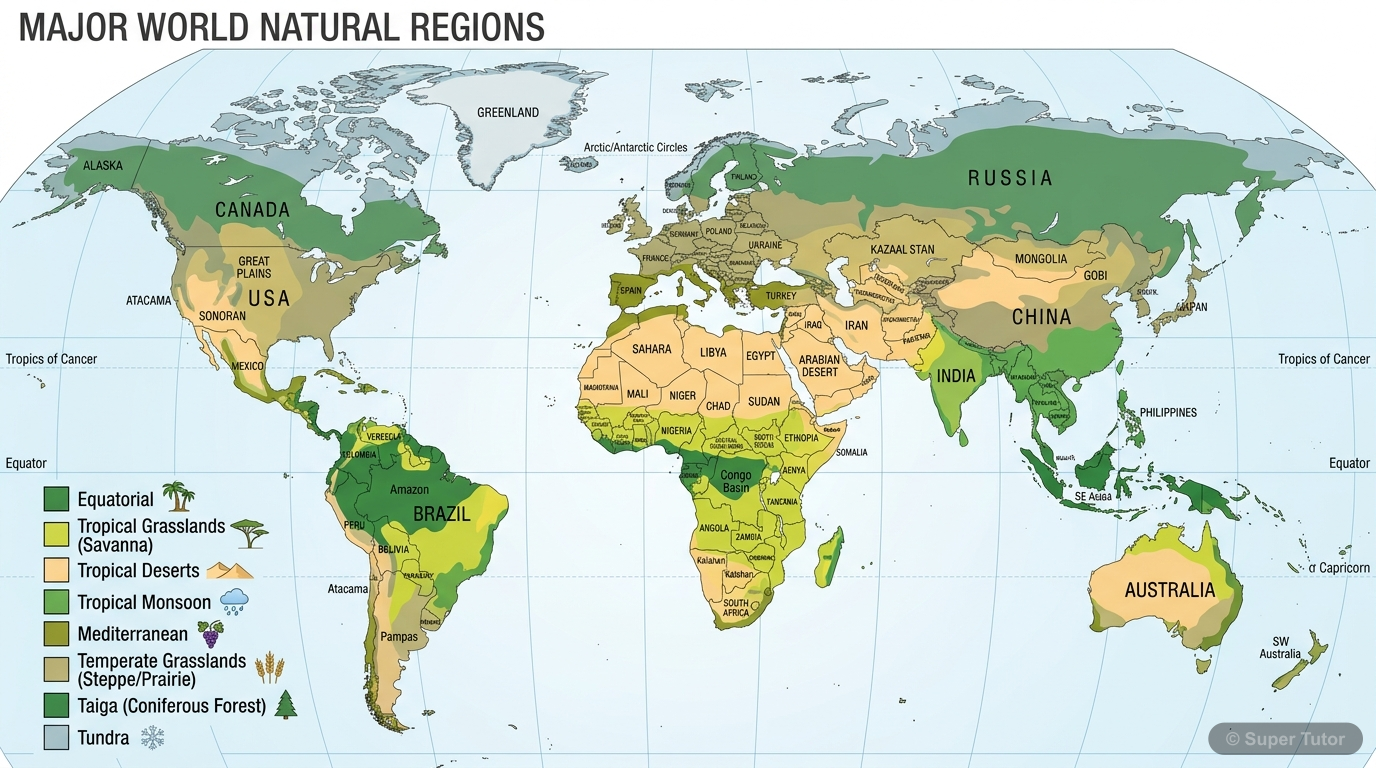
Learn better with visuals Super Tutor pairs illustrations like this with notes and quizzes for Natural Regions of the World.
Overview
Natural regions of the world are broad climatic zones with distinct temperature, rainfall, vegetation, soils, and human life. Climate is the average weather conditions of temperature and rainfall at a place over a long period, usually around 30 years. Climatic boundaries are always transitional, so
Key Concepts
Climate means the average weather conditions
Climate means the average weather conditions of temperature and rainfall at a place over several decades. A climatic region is an area with broadly si
Climatic boundaries are never fixed
Climatic boundaries are never fixed. They are broad transition zones where one climate slowly changes into another.
This climatic type lies along
This climatic type lies along the Equator from 5°N to 5°S. It is also called Tropical Wet Climate or Tropical Rainforest Climate. It has high temperat
Also called Savanna or Sudan Climate
Also called Savanna or Sudan Climate, this is a transitional climate between equatorial forests and tropical deserts. It lies mainly between 10° and 2
Hot deserts lie mostly between 15°N
Hot deserts lie mostly between 15°N and 30°N and south on western continental margins under trade winds. They have very low rainfall, extreme heat, an
Learning Objectives
- Understand the meaning of climate and climatic region
- Identify the major natural regions of the world
- Link climate with natural vegetation and human occupation
- Compare the main features of each natural region
- Recognize how climate controls daily life, farming, and settlement patterns
Frequently Asked Questions
What are the important topics in Natural Regions of the World for ICSE Class 9 Geography?
How should I revise Natural Regions of the World for Class 9 exams?
Sources & Official References
Content is aligned to the official syllabus. Refer to the board website for the latest curriculum.
More resources for Natural Regions of the World
For serious students
Get the full Natural Regions of the World chapter — start free.
Quizzes, flashcards, an AI doubt solver and a study plan for ICSE Class 9 Geography. Free to start, no card needed.