Chapter 8 of 18
Revision Notes
Earthquakes — Revision Notes
ICSE · Class 9 · Geography
Earthquakes revision notes for ICSE Class 9 Geography: 4 topics in quick points. Part of the ICSE Class 9 Geography syllabus.
53 questions34 flashcards5 concepts
Interactive on Super Tutor
Studying Earthquakes? Get the full interactive chapter.
Quizzes, flashcards, AI doubt-solver and a step-by-step study plan — built for revision notes and more.
Free trial, no card needed.
Super Tutor
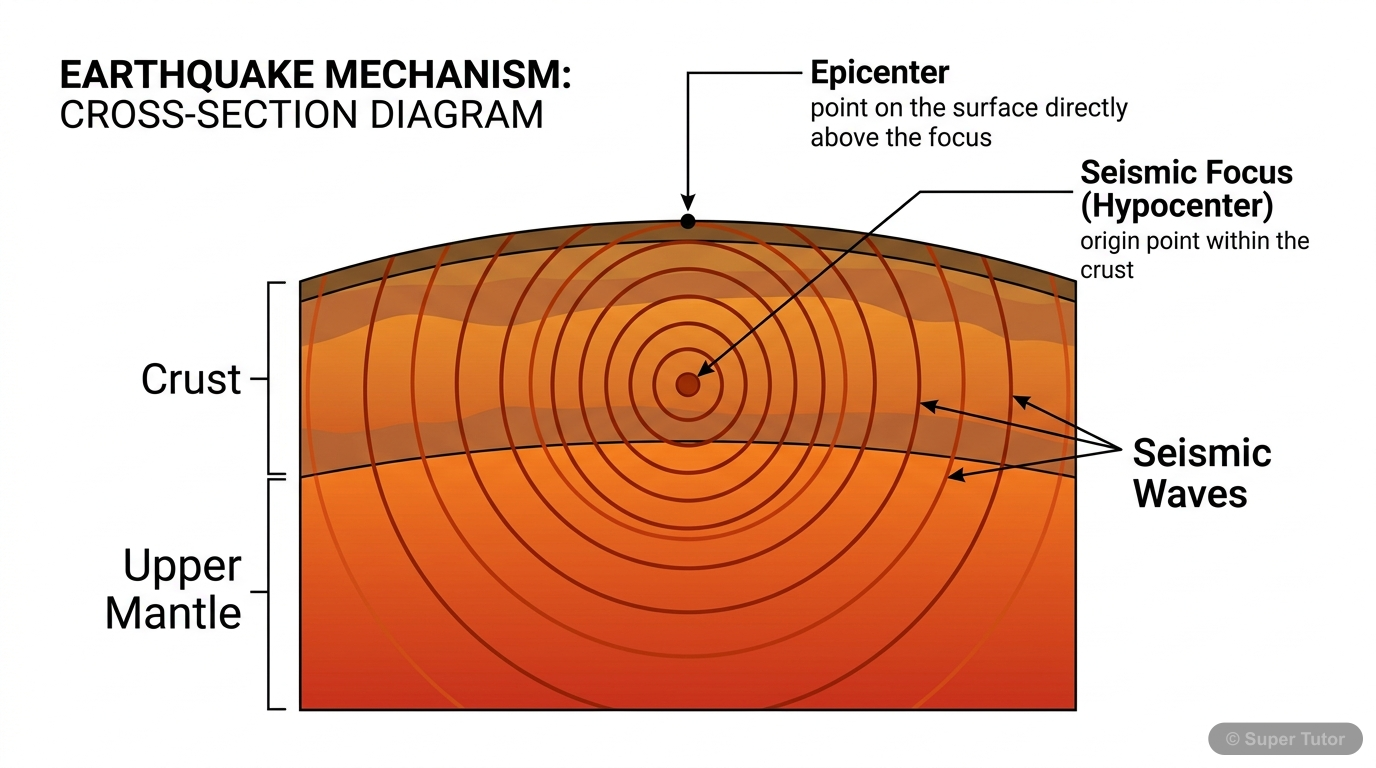
One of 6 illustrations for Earthquakes in Super Tutor — alongside flashcards, concept maps and practice questions.
Key Topics to Revise
1
1. Meaning and Basic Terms
- An earthquake is a sudden vibration or movement of part of the Earth’s crust.
- The seismic focus is the origin point inside the crust or mantle where the rocks suddenly move.
- The epicentre is the point on the Earth’s surface directly above the focus.
2
2. Causes of Earthquakes
- Earthquakes are caused by volcanic eruptions, folding and faulting, plate tectonics, and anthropogenic factors.
- Volcanic earthquakes are caused by gas explosions and may occur before or during an eruption.
- A fault is a fracture in a rock with observable displacement.
3
3. Measurement of Earthquakes
- The magnitude of earthquakes is commonly assessed by the Richter Scale.
- The Richter Scale was devised by Charles F. Richter in 1935.
- It was modified in 1965 by Richter and Beno Gutenberg.
4
4. Distribution of Earthquakes in the World
- There are three major earthquake belts in the world and a fourth category called interplate seismicity.
- The Circum-Pacific Belt is a convergent plate boundary belt and accounts for about 66% of the world’s earthquakes.
- The Mid-Atlantic Belt is a divergent plate boundary belt caused mainly by seafloor spreading.
Get complete notes with diagrams and examples
Full NotesKey Concepts
An earthquake is a shockThe focus is the origin pointThe Richter Scale is an openEarthquakes are caused by volcanic eruptionsThree major earthquake belts are
Frequently Asked Questions
What are the important topics in Earthquakes for ICSE Class 9 Geography?
Key topics in Earthquakes include Meaning and Basic Terms, Causes of Earthquakes, Measurement of Earthquakes, Distribution of Earthquakes in the World. Study these first, then practise questions on each for Class 9 exams.
How should I revise Earthquakes for Class 9 exams?
Learn the core ideas first, then work through the 53 practice questions on Earthquakes. Revise definitions regularly and use flashcards for quick recall before the exam.
Sources & Official References
Content is aligned to the official syllabus. Refer to the board website for the latest curriculum.
More resources for Earthquakes
For serious students
Get the full Earthquakes chapter — start free.
Quizzes, flashcards, an AI doubt solver and a study plan for ICSE Class 9 Geography. Free to start, no card needed.