Chapter 6 of 18
Revision Notes
Rocks and Rock Cycle — Revision Notes
ICSE · Class 9 · Geography
Rocks and Rock Cycle revision notes for ICSE Class 9 Geography: 4 topics in quick points. Part of the ICSE Class 9 Geography syllabus.
60 questions40 flashcards5 concepts
Interactive on Super Tutor
Studying Rocks and Rock Cycle? Get the full interactive chapter.
Quizzes, flashcards, AI doubt-solver and a step-by-step study plan — built for revision notes and more.
Free trial, no card needed.
Super Tutor
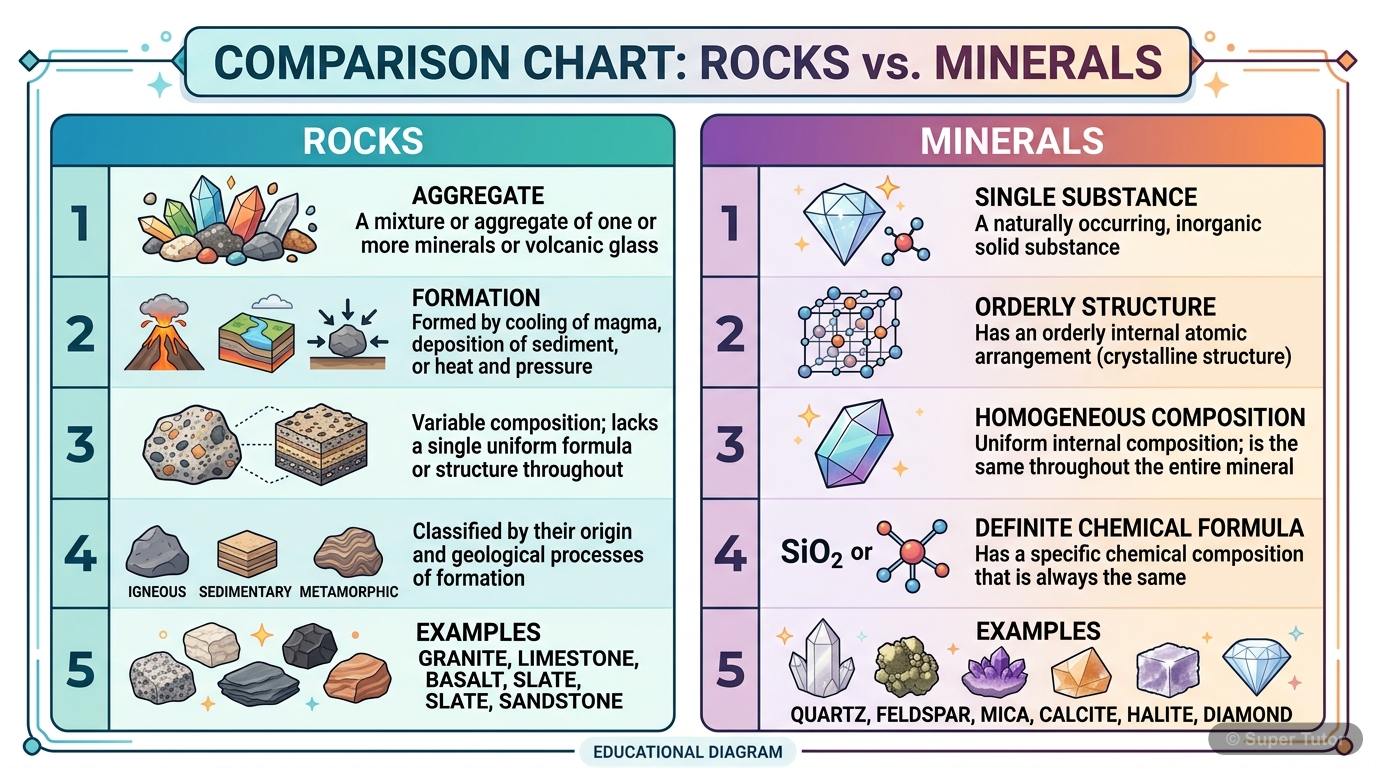
Learn better with visuals Super Tutor pairs illustrations like this with notes and quizzes for Rocks and Rock Cycle.
Key Topics to Revise
1
1. Rocks, Minerals, and Lithosphere
- Lithosphere forms the outer crust of the Earth on which continents and ocean basins rest.
- 'Litho' in Greek means rock or stone.
- A rock is an aggregate of minerals that forms a more or less definite unit of the Earth’s crust.
2
2. Igneous Rocks
- Igneous rocks are primary rocks and the parent material of all rocks in the rock cycle.
- They form when molten magma solidifies.
- Magma is molten rock material consisting of liquid, gas, and crystals.
3
3. Sedimentary Rocks
- Sedimentary rocks form from material derived from pre-existing rocks and from organic sources by the process of denudation.
- Denudation means disintegration and decomposition of rocks as well as the wearing away of the land surface.
- Weathering and erosion provide the raw materials for sedimentary rocks.
4
4. Metamorphic Rocks
- Metamorphic rocks form when pre-existing rocks change due to temperature, pressure, or the composition of pore fluids.
- Metamorphic rocks crystallize in a solid state, and the original features of the rocks are modified.
- Metamorphism may be caused by volcanic eruptions, mountain building movements, endogenetic forces, and contact with underground water.
Get complete notes with diagrams and examples
Full NotesKey Concepts
Rocks are mixtures of mineralsIgneous rocks are primary rocks formedThese rocks form when magma solidifiesThese rocks form when magma solidifiesSedimentary rocks form from material derived
Frequently Asked Questions
What are the important topics in Rocks and Rock Cycle for ICSE Class 9 Geography?
Key topics in Rocks and Rock Cycle include Rocks, Minerals, and Lithosphere, Igneous Rocks, Sedimentary Rocks, Metamorphic Rocks. Study these first, then practise questions on each for Class 9 exams.
How should I revise Rocks and Rock Cycle for Class 9 exams?
Learn the core ideas first, then work through the 60 practice questions on Rocks and Rock Cycle. Revise definitions regularly and use flashcards for quick recall before the exam.
Sources & Official References
Content is aligned to the official syllabus. Refer to the board website for the latest curriculum.
More resources for Rocks and Rock Cycle
For serious students
Get the full Rocks and Rock Cycle chapter — start free.
Quizzes, flashcards, an AI doubt solver and a study plan for ICSE Class 9 Geography. Free to start, no card needed.