Chapter 10 of 18
Revision Notes
Tides and Ocean Currents — Revision Notes
ICSE · Class 9 · Geography
Tides and Ocean Currents revision notes for ICSE Class 9 Geography: 4 topics in quick points. Part of the ICSE Class 9 Geography syllabus.
67 questions36 flashcards5 concepts
Interactive on Super Tutor
Studying Tides and Ocean Currents? Get the full interactive chapter.
Quizzes, flashcards, AI doubt-solver and a step-by-step study plan — built for revision notes and more.
Free trial, no card needed.
Super Tutor
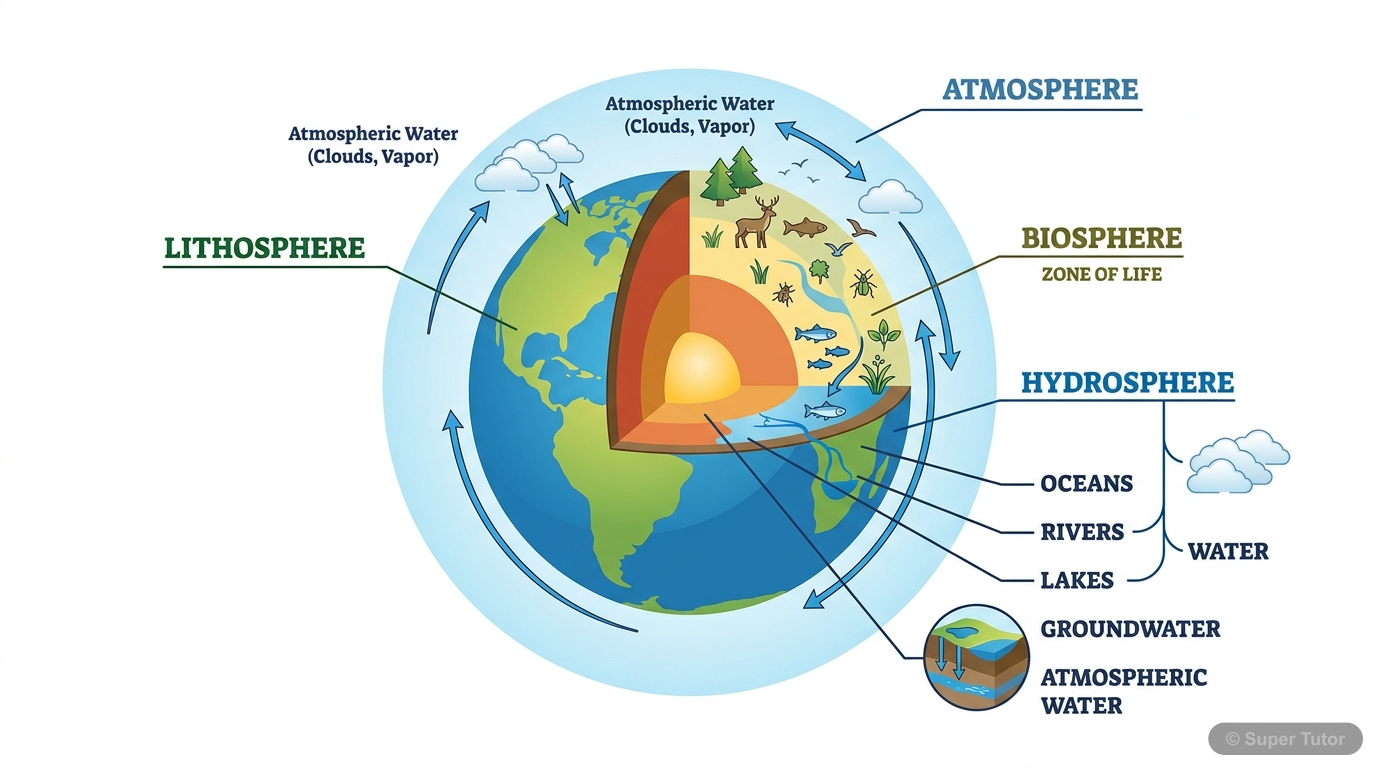
One of 6 illustrations for Tides and Ocean Currents in Super Tutor — alongside flashcards, concept maps and practice questions.
Key Topics to Revise
1
1. Hydrosphere and Distribution of Land and Water
- Hydrosphere includes oceans, rivers, lakes, underground water, and atmospheric water.
- It is one of the four realms of the Earth: Atmosphere, Lithosphere, Hydrosphere, and Biosphere.
- Oceans are interconnected and cover about 71% of Earth's surface.
2
2. Ocean Currents: Meaning, Causes, and Movement
- Ocean currents are the general movement of a mass of ocean water in a definite direction.
- They help maintain Earth's heat balance by transferring heat from lower latitudes to higher latitudes.
- Ocean currents account for about a quarter of the total heat transport in the oceans, while winds account for the remaining three quarters.
3
3. Major Ocean Currents
- Gulf Stream is the largest of the western boundary currents of the North Atlantic Ocean.
- Gulf Stream is a warm current that originates in the Gulf of Mexico around 20°N and moves north-easterly along the eastern coast of North America.
- It reaches the western coasts of Europe up to 70°N under the impact of Westerlies.
4
4. Effects of Ocean Currents
- Ocean currents influence temperature, pressure, winds, and precipitation in coastal regions.
- They help in regulating air temperatures and air routes.
- Eastern parts of oceans in lower latitudes often record relatively low temperatures, making weather cold and foggy.
Get complete notes with diagrams and examples
Full NotesKey Concepts
Hydrosphere refers to the massOcean currents are the general movementA gyre is the flow aroundThe Gulf Stream is the largestNorth Atlantic Drift is the continuation
Frequently Asked Questions
What are the important topics in Tides and Ocean Currents for ICSE Class 9 Geography?
Key topics in Tides and Ocean Currents include Hydrosphere and Distribution of Land and Water, Ocean Currents: Meaning, Causes, and Movement, Major Ocean Currents, Effects of Ocean Currents. Study these first, then practise questions on each for Class 9 exams.
How should I revise Tides and Ocean Currents for Class 9 exams?
Learn the core ideas first, then work through the 67 practice questions on Tides and Ocean Currents. Revise definitions regularly and use flashcards for quick recall before the exam.
Sources & Official References
Content is aligned to the official syllabus. Refer to the board website for the latest curriculum.
More resources for Tides and Ocean Currents
For serious students
Get the full Tides and Ocean Currents chapter — start free.
Quizzes, flashcards, an AI doubt solver and a study plan for ICSE Class 9 Geography. Free to start, no card needed.