Earthquakes — Flashcards
ICSE · Class 9 · Geography
34 flashcards for Earthquakes (ICSE Class 9 Geography) to test yourself on key terms and facts. Sample: "What is an earthquake?"
Interactive on Super Tutor
Studying Earthquakes? Get the full interactive chapter.
Quizzes, flashcards, AI doubt-solver and a step-by-step study plan — built for flashcards and more.
Free trial, no card needed.
One of 6 illustrations for Earthquakes in Super Tutor — alongside flashcards, concept maps and practice questions.
What is an earthquake?
Answer
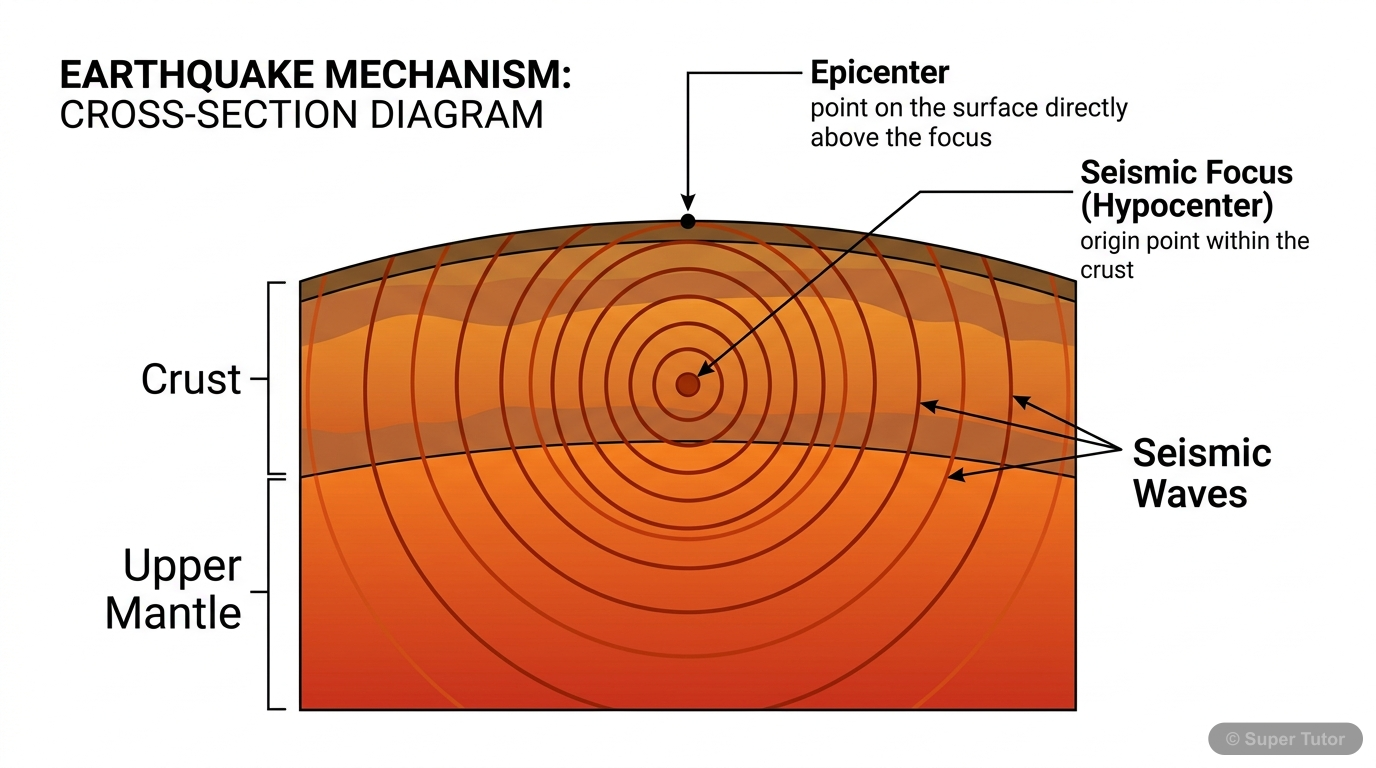
An earthquake is a shock or series of shocks caused by a sudden movement of crustal rocks at a point called the seismic focus within the crust or mantle. It produces violent trembling of the ground.
What is the seismic focus?
Answer
The seismic focus is the point within the Earth’s crust or mantle where a sudden movement of crustal rocks generates the earthquake. It is the origin point of the earthquake.
What is the epicentre?
Answer
The epicentre is the point on the Earth’s surface directly above the focus. Seismic waves reach the surface there first, and the intensity is maximum at that place.
Why are earthquakes stronger when the focus lies near the surface?
Answer
Effects of an earthquake are greater when the seismic focus lies near the surface because the waves travel a shorter distance before reaching the ground, so more energy is felt at the surface.
Which instrument records earthquake waves?
Answer
Seismograph or Seismometer records the waves generated by an earthquake. It measures the seismic waves produced during the shaking.
What is seismology?
Answer
Seismology is the science of earthquakes. It studies earthquake causes, waves, measurement, distribution, and effects.
What is the Richter Scale?
Answer
The Richter Scale is an open-ended logarithmic scale used to estimate earthquake magnitude. It was devised by Charles F. Richter in 1935 and later modified in 1965 by Richter and Beno Gutenberg.
Why is the Richter Scale important?
Answer
It estimates the magnitude of an earthquake and gives an idea of the energy released at the earthquake centre. It has no fixed maximum or minimum, so it can be used for earthquakes of many sizes.
+26 more flashcards
Practise AllFrequently Asked Questions
What are the important topics in Earthquakes for ICSE Class 9 Geography?
How many flashcards are available for Earthquakes?
How should I revise Earthquakes for Class 9 exams?
Sources & Official References
Content is aligned to the official syllabus. Refer to the board website for the latest curriculum.
More resources for Earthquakes
Practice Quiz
Test yourself with a quick quiz
Important Questions
Exam-style questions with answers
Revision Notes
Key points for last-minute revision
Chapter Summary
Understand the chapter at a glance
Concept Maps
See how topics connect
Study Plan
Step-by-step plan for this chapter
Syllabus
What topics to cover
For serious students
Get the full Earthquakes chapter — start free.
Quizzes, flashcards, an AI doubt solver and a study plan for ICSE Class 9 Geography. Free to start, no card needed.