Earthquakes — Syllabus
ICSE · Class 9 · Geography
What Earthquakes covers in ICSE Class 9 Geography: 4 topics, for the 2026-27 session. Part of the ICSE Class 9 Geography syllabus.
Interactive on Super Tutor
Studying Earthquakes? Get the full interactive chapter.
Quizzes, flashcards, AI doubt-solver and a step-by-step study plan — built for syllabus and more.
Free trial, no card needed.
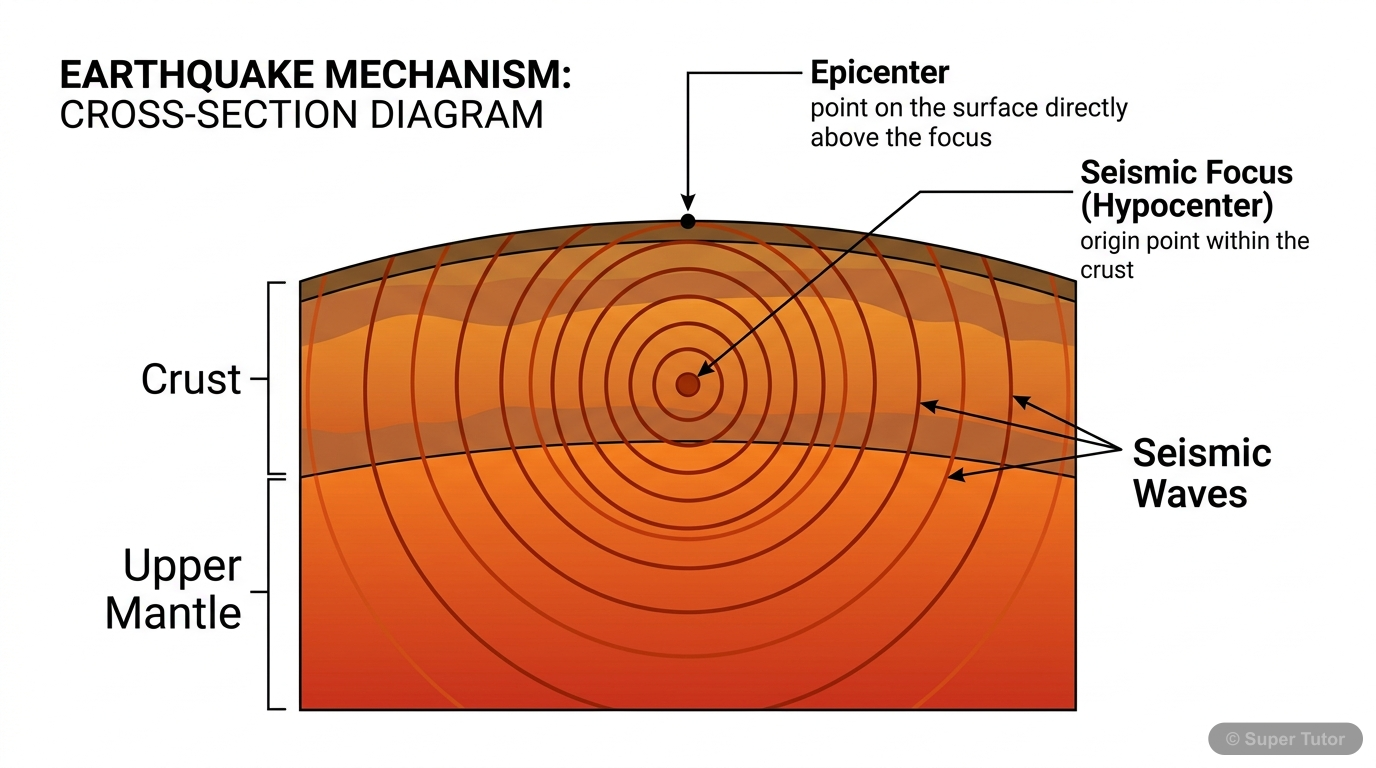
One of 6 illustrations for Earthquakes in Super Tutor — alongside flashcards, concept maps and practice questions.
Topics in Earthquakes
1. Meaning and Basic Terms
- An earthquake is a sudden vibration or movement of part of the Earth’s crust.
- The seismic focus is the origin point inside the crust or mantle where the rocks suddenly move.
- The epicentre is the point on the Earth’s surface directly above the focus.
2. Causes of Earthquakes
- Earthquakes are caused by volcanic eruptions, folding and faulting, plate tectonics, and anthropogenic factors.
- Volcanic earthquakes are caused by gas explosions and may occur before or during an eruption.
- A fault is a fracture in a rock with observable displacement.
3. Measurement of Earthquakes
- The magnitude of earthquakes is commonly assessed by the Richter Scale.
- The Richter Scale was devised by Charles F. Richter in 1935.
- It was modified in 1965 by Richter and Beno Gutenberg.
4. Distribution of Earthquakes in the World
- There are three major earthquake belts in the world and a fourth category called interplate seismicity.
- The Circum-Pacific Belt is a convergent plate boundary belt and accounts for about 66% of the world’s earthquakes.
- The Mid-Atlantic Belt is a divergent plate boundary belt caused mainly by seafloor spreading.
Key Concepts
Central concept: Earthquakes
Work through every topic in Earthquakes with notes and quizzes
Start This ChapterFrequently Asked Questions
What are the important topics in Earthquakes for ICSE Class 9 Geography?
How should I revise Earthquakes for Class 9 exams?
Sources & Official References
Content is aligned to the official syllabus. Refer to the board website for the latest curriculum.
More resources for Earthquakes
Practice Quiz
Test yourself with a quick quiz
Important Questions
Exam-style questions with answers
Revision Notes
Key points for last-minute revision
Chapter Summary
Understand the chapter at a glance
Concept Maps
See how topics connect
Study Plan
Step-by-step plan for this chapter
Flashcards
Quick-fire cards for active recall
For serious students
Get the full Earthquakes chapter — start free.
Quizzes, flashcards, an AI doubt solver and a study plan for ICSE Class 9 Geography. Free to start, no card needed.