Rocks and Rock Cycle — Flashcards
ICSE · Class 9 · Geography
40 flashcards for Rocks and Rock Cycle (ICSE Class 9 Geography) to test yourself on key terms and facts. Sample: "What is a rock?"
Interactive on Super Tutor
Studying Rocks and Rock Cycle? Get the full interactive chapter.
Quizzes, flashcards, AI doubt-solver and a step-by-step study plan — built for flashcards and more.
Free trial, no card needed.
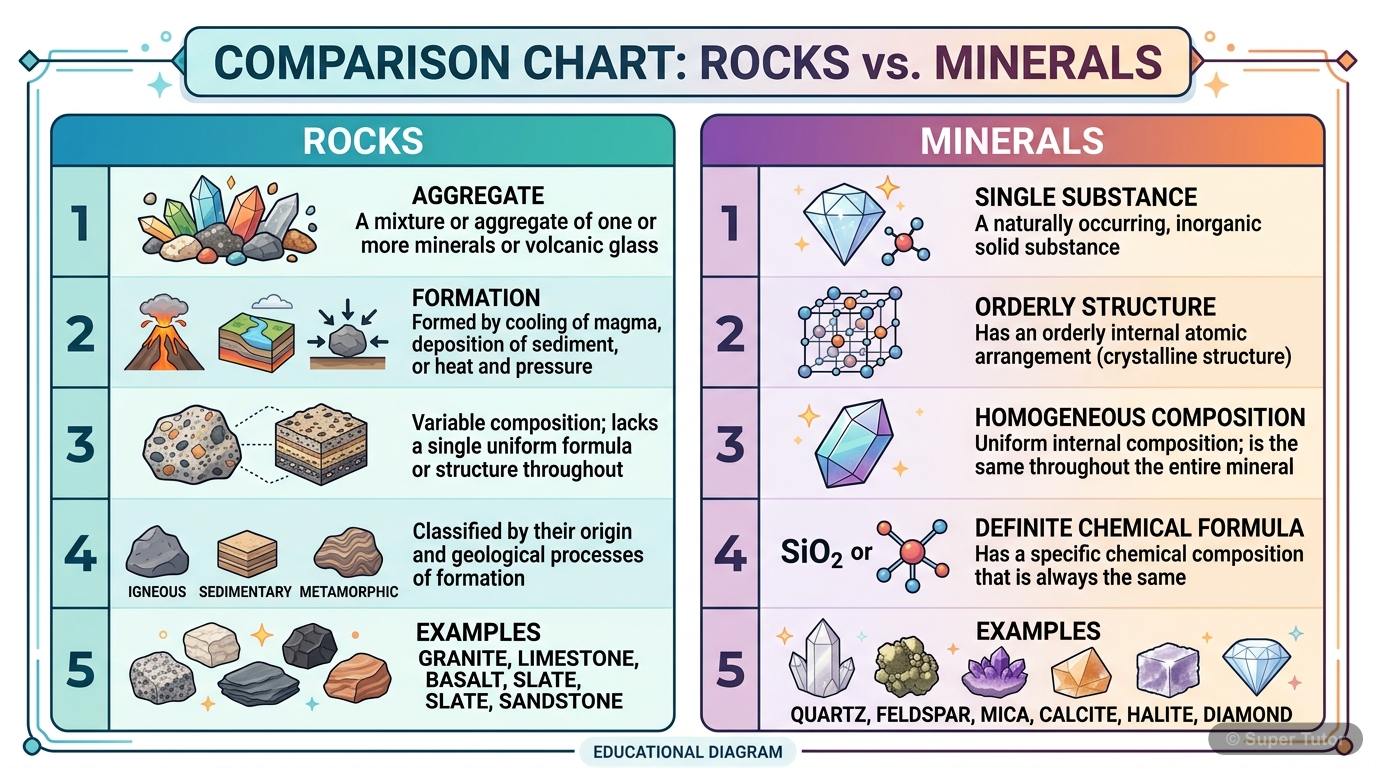
Learn better with visuals Super Tutor pairs illustrations like this with notes and quizzes for Rocks and Rock Cycle.
What is a rock?
Answer
A rock is an aggregate of minerals that forms a more or less definite unit of the Earth's crust. Rocks may contain one mineral or many minerals together.
How are rocks different from minerals?
Answer
Rocks are heterogeneous and do not have a definite chemical composition. Minerals are homogeneous, have a definite chemical composition, and generally have a crystalline form. Silicates and quartz are…
What does the word lithosphere mean in geography?
Answer
The lithosphere is the outer crust of the Earth on which the continents and ocean basins rest. The word 'litho' in Greek means rock or stone.
What are the main types of rocks?
Answer
The three main types of rocks are igneous rocks, sedimentary rocks, and metamorphic rocks. These differ in origin, structure, and formation process.
Why are igneous rocks called primary rocks?
Answer
Igneous rocks are called primary rocks because they are the parent material of all rocks in the rock cycle. They form by the solidification of magma.
What is magma?
Answer
Magma is molten rock material consisting of liquid, gas, and crystals. It is the source material for igneous rocks.
Name the two types of magma and describe them.
Answer
The two types of magma are Basalt Magma and Silicate Magma. Basalt Magma is very hot and highly fluid. Silicate Magma is about 850°C and highly viscous.
How do intrusive igneous rocks form?
Answer
Intrusive igneous rocks form when magma solidifies below the Earth's surface, surrounded by pre-existing rock. Slow cooling at depth usually produces coarse-grained rocks.
+32 more flashcards
Practise AllFrequently Asked Questions
What are the important topics in Rocks and Rock Cycle for ICSE Class 9 Geography?
How many flashcards are available for Rocks and Rock Cycle?
How should I revise Rocks and Rock Cycle for Class 9 exams?
Sources & Official References
Content is aligned to the official syllabus. Refer to the board website for the latest curriculum.
More resources for Rocks and Rock Cycle
Practice Quiz
Test yourself with a quick quiz
Important Questions
Exam-style questions with answers
Revision Notes
Key points for last-minute revision
Chapter Summary
Understand the chapter at a glance
Concept Maps
See how topics connect
Study Plan
Step-by-step plan for this chapter
Syllabus
What topics to cover
For serious students
Get the full Rocks and Rock Cycle chapter — start free.
Quizzes, flashcards, an AI doubt solver and a study plan for ICSE Class 9 Geography. Free to start, no card needed.