Tides and Ocean Currents — Flashcards
ICSE · Class 9 · Geography
36 flashcards for Tides and Ocean Currents (ICSE Class 9 Geography) to test yourself on key terms and facts. Sample: "What is the hydrosphere?"
Interactive on Super Tutor
Studying Tides and Ocean Currents? Get the full interactive chapter.
Quizzes, flashcards, AI doubt-solver and a step-by-step study plan — built for flashcards and more.
Free trial, no card needed.
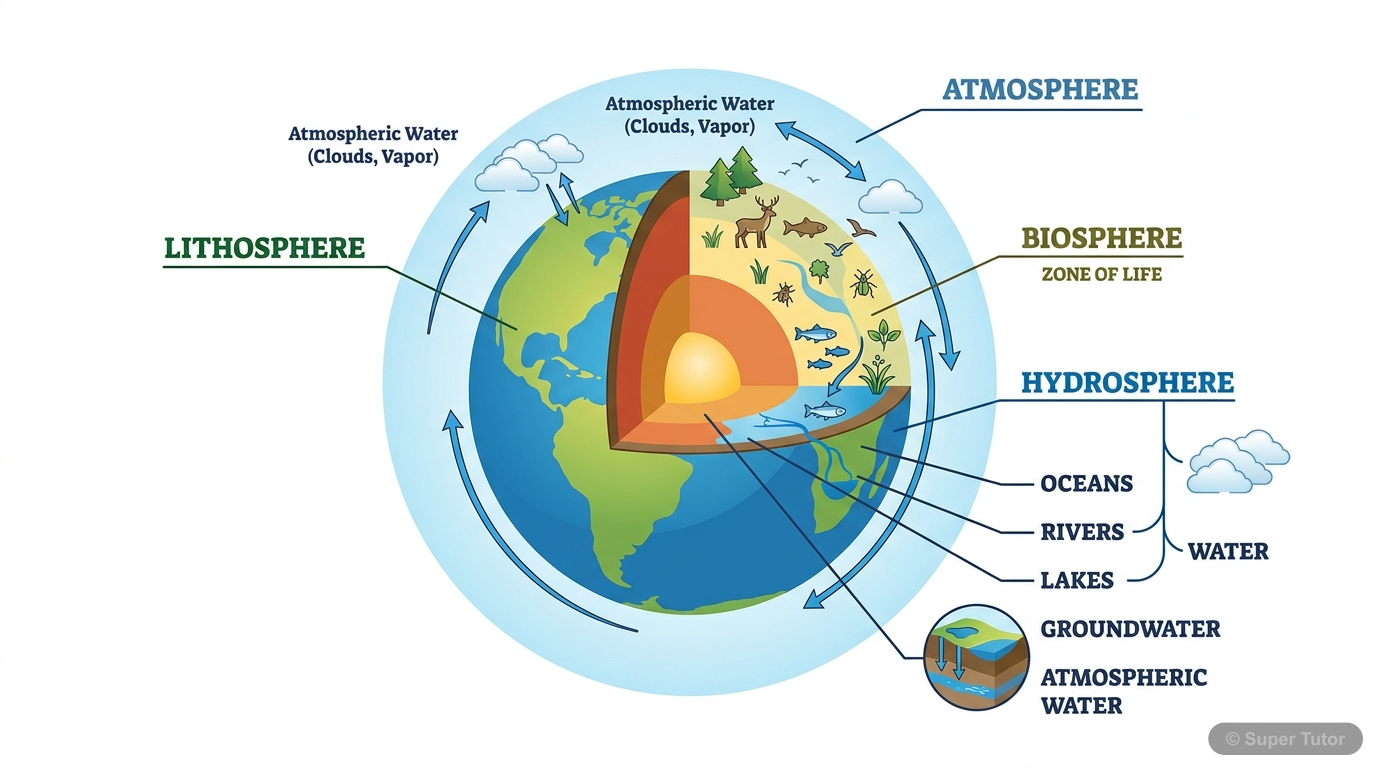
One of 6 illustrations for Tides and Ocean Currents in Super Tutor — alongside flashcards, concept maps and practice questions.
What is the hydrosphere?
Answer
Hydrosphere refers to the mass of water occupying the greatest part of the Earth's surface. It includes oceans, rivers, lakes, underground water, and atmospheric water.
How much of the Earth's surface is covered by oceans?
Answer
Oceans cover about 71% of the Earth's surface. This is why Earth is often called the watery planet.
How are land and water distributed on Earth?
Answer
Land and water are not evenly distributed. In the Northern Hemisphere, land and water are nearly equal, while in the Southern Hemisphere there is nearly fifteen times as much water as land.
What is an ocean current?
Answer
An ocean current is the general movement of a mass of ocean water in a definite direction, similar to a river flowing on land. Currents help transfer heat from lower latitudes to higher latitudes.
Why do ocean currents form?
Answer
Ocean currents form because of differences in temperature, salinity, wind action, Earth’s rotation, and the shape of coastlines. These factors set ocean water in motion in definite directions.
What is the main role of ocean currents in the Earth's heat balance?
Answer
Ocean currents help maintain the Earth's heat balance by transferring heat from lower latitudes to higher latitudes. They account for about one quarter of the total heat transport in the oceans, while…
What is Coriolis force?
Answer
Coriolis force is the deflective force caused by Earth’s rotation from west to east. It deflects winds and ocean currents to the right in the Northern Hemisphere and to the left in the Southern Hemisp…
What is a gyre?
Answer
A gyre is the flow around the periphery of an ocean basin. It is a large circular movement of ocean currents.
+28 more flashcards
Practise AllFrequently Asked Questions
What are the important topics in Tides and Ocean Currents for ICSE Class 9 Geography?
How many flashcards are available for Tides and Ocean Currents?
How should I revise Tides and Ocean Currents for Class 9 exams?
Sources & Official References
Content is aligned to the official syllabus. Refer to the board website for the latest curriculum.
More resources for Tides and Ocean Currents
Practice Quiz
Test yourself with a quick quiz
Important Questions
Exam-style questions with answers
Revision Notes
Key points for last-minute revision
Chapter Summary
Understand the chapter at a glance
Concept Maps
See how topics connect
Study Plan
Step-by-step plan for this chapter
Syllabus
What topics to cover
For serious students
Get the full Tides and Ocean Currents chapter — start free.
Quizzes, flashcards, an AI doubt solver and a study plan for ICSE Class 9 Geography. Free to start, no card needed.