Construction of Polygons — Flashcards
ICSE · Class 9 · Mathematics
26 flashcards for Construction of Polygons (ICSE Class 9 Mathematics) to test yourself on key terms and facts.
Interactive on Super Tutor
Studying Construction of Polygons? Get the full interactive chapter.
Quizzes, flashcards, AI doubt-solver and a step-by-step study plan — built for flashcards and more.
Free trial, no card needed.
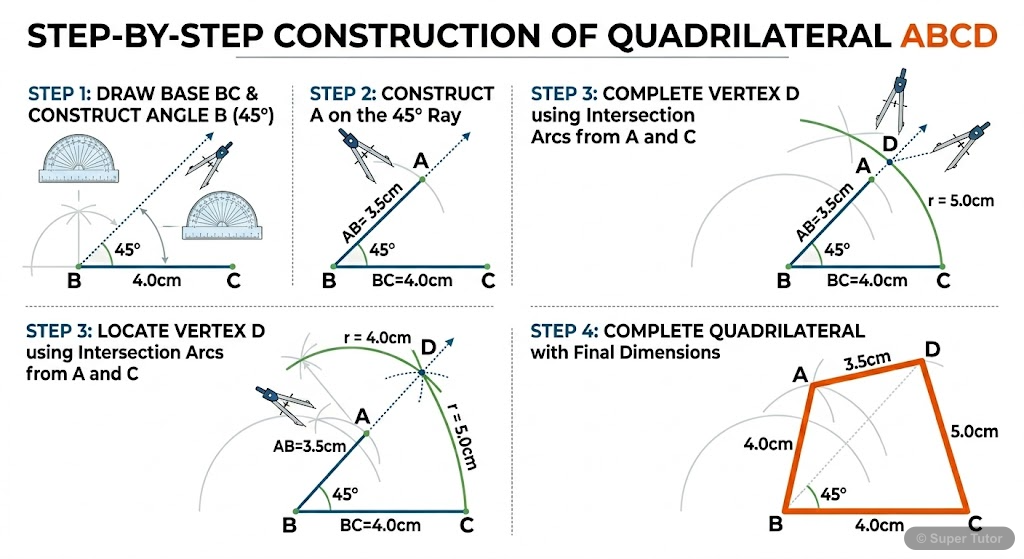
One of 17 illustrations for Construction of Polygons in Super Tutor — alongside flashcards, concept maps and practice questions.
Construct a quadrilateral with AB = 3.5 cm, BC = 4.0 cm, CD = 5.0 cm, DA = 4.0 cm and ∠B = 45°.
Answer
Step 1: Draw BC = 4.0 cm. Step 2: Through B, draw a ray BP such that ∠B = 45°. Step 3: On BP, mark BA = 3.5 cm. Step 4: With A as centre and radius 4.0 cm, and with C as centre and radius 5.0 cm, draw…
Construct a quadrilateral with AB = 4.0 cm, BC = 4.5 cm, CD = 4.7 cm, ∠B = 60° and ∠A = 120°.
Answer
Step 1: Draw BC = 4.5 cm. Step 2: At B, construct ∠MBC = 60° and cut BA = 4.0 cm on ray BM. Step 3: At A, draw a ray AP such that ∠A = 120°. Step 4: With C as centre and radius 4.7 cm, draw an arc cut…
Construct a quadrilateral when AB = 3.0 cm, BC = 4.0 cm, CD = 5.0 cm, DA = 3.5 cm and diagonal AC = 4.5 cm.
Answer
Step 1: First construct triangle ABC using AB = 3.0 cm, BC = 4.0 cm and AC = 4.5 cm. Step 2: Then construct triangle ADC using AD = 3.5 cm, CD = 5.0 cm and the same diagonal AC = 4.5 cm. Step 3: Join …
Construct a quadrilateral when AB = 3.5 cm, BC = 3.0 cm, AD = 3.8 cm, AC = 5.0 cm and BD = 4.5 cm.
Answer
Step 1: First construct triangle ABC. Step 2: Then construct triangle ABD. Step 3: Join C and D. Answer: ABCD is the required quadrilateral.
Why is a rough free-hand sketch drawn before starting an actual construction?
Answer
A rough sketch gives the shape a clear plan before using the ruler and compass. It helps identify the given sides, angles, and diagonals correctly, so the construction can be done in the right order.
Construct a parallelogram with AB = 3.0 cm, BC = 4.0 cm and ∠B = 60°.
Answer
Step 1: Use the fact that opposite sides of a parallelogram are equal. Step 2: Take AB = 3.0 cm, BC = 4.0 cm and ∠B = 60° and construct triangle ABC. Step 3: Then construct triangle ADC. Step 4: Join …
When do you use the fact that opposite sides of a parallelogram are equal in construction?
Answer
Use it when two consecutive sides and the included angle are given. Example: If AB = 3.0 cm, BC = 4.0 cm and ∠B = 60°, then AB = DC and BC = AD. So triangle ABC is drawn first, and then triangle ADC i…
Construct a parallelogram with BC = 4.5 cm, AC = 5.6 cm and BD = 5.0 cm.
Answer
Step 1: Since diagonals of a parallelogram bisect each other, construct triangle OBC. Step 2: Find half of BD: OB = 1/2 × 5.0 cm = 2.5 cm. Step 3: Find half of AC: OC = 1/2 × 5.6 cm = 2.8 cm. Step 4: …
+18 more flashcards
Practise AllFrequently Asked Questions
What are the important topics in Construction of Polygons for ICSE Class 9 Mathematics?
How many flashcards are available for Construction of Polygons?
How should I revise Construction of Polygons for Class 9 exams?
Sources & Official References
Content is aligned to the official syllabus. Refer to the board website for the latest curriculum.
More resources for Construction of Polygons
Practice Quiz
Test yourself with a quick quiz
Important Questions
Exam-style questions with answers
Revision Notes
Key points for last-minute revision
Formula Sheet
The chapter's formulas in one place
Chapter Summary
Understand the chapter at a glance
Concept Maps
See how topics connect
Study Plan
Step-by-step plan for this chapter
Syllabus
What topics to cover
For serious students
Get the full Construction of Polygons chapter — start free.
Quizzes, flashcards, an AI doubt solver and a study plan for ICSE Class 9 Mathematics. Free to start, no card needed.